The Fountains of Paradise
The Fountains of Paradise is a 1979 novel by Arthur C. Clarke. It won the Hugo Award for Best Novel and 1 more.
- Published
- January 1979
- Came out
- 1978
- Written by
- Arthur C. Clarke
- Genre
- science fiction
- Country of origin
- United Kingdom
All 10 facts, and where they come from
Facts
10 facts · 0 confirmed by two sources · 4 cited · 6 from one source
Where this comes from
Papalocal keeps its own record. It started from these sources; what each one said is kept here as it was copied, so a change on their side never changes this page by itself. Tap one to read its version.
What Wikidata says · copied November 17, 2026 · revision 2568592664
- Described as
- 1979 novel by Arthur C. Clarke
- What it is
- literary work
- Written by
- Arthur C. Clarke · 1 reference
- Publisher
- Gollancz
- Genre
- science fiction
- Published
- January 1979 · 1 reference
- Language
- English
- Country of origin
- United Kingdom
- Came out
- 1978
- Awards
- Hugo Award for Best Novel (1980) · 1 reference; Nebula Award for Best Novel (1980) · 2 references
- Wikipedias with a page
- 19
Wikidata item Q786025 (wikidata.org/wiki/Q786025), public domain (CC0). Copied 2026-11-17.
What Wikipedia says · copied November 17, 2026 · revision 1384221139
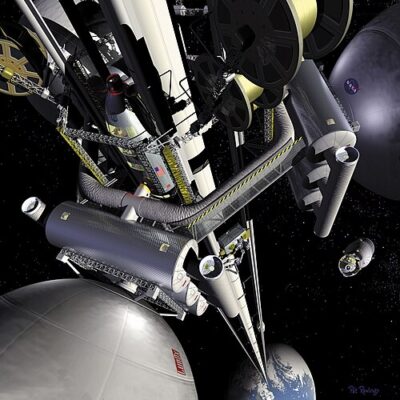
The Fountains of Paradise is a 1979 science fiction novel by British writer Arthur C. Clarke. Set in the 22nd century, it describes the construction of a space elevator. This "orbital tower" is a giant structure rising from the ground and linking with a satellite in geostationary orbit at the height of approximately 36,000 kilometres (approx. 22,300 miles). Such a structure would be used to raise payloads to orbit without the expense of using rockets. The novel won both the Hugo and Nebula Awards for Best Novel.
From the Wikipedia article “The Fountains of Paradise” (en.wikipedia.org/wiki/The_Fountains_of_Paradise), by its contributors, under CC BY-SA 4.0 (creativecommons.org/licenses/by-sa/4.0/). Copied 2026-11-17; not changed.
Confirmed Two sources agree. Cited One source, and it names where it got it. One source One source, without a reference of its own. Sources disagree The sources disagree. We show the best-supported value and keep theirs below.
Picture: NASA/Pat Rawlings, via Wikimedia Commons · Public domain