
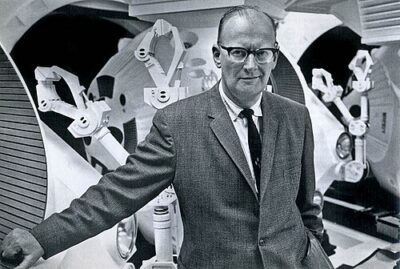
Arthur C. Clarke
Arthur C. Clarke was a British science fiction writer, inventor, and futurist. Born December 16, 1917, in Minehead. Died March 19, 2008, in Colombo. Known for Rendezvous with Rama, The Fountains of Paradise and 2001: A Space Odyssey. Educated at King's College London and Richard Huish College, Taunton. Awards include Commander of the Order of the British Empire, Nebula Award for Best Novel (2 times) and Stuart Ballantine Medal.
Facts
48 facts · 2 confirmed by two sources · 22 cited · 24 from one source
Where this comes from
Papalocal keeps its own record. It started from these sources; what each one said is kept here as it was copied, so a change on their side never changes this page by itself. Tap one to read its version.
What Wikidata says · copied November 16, 2026 · revision 2565597734
- Described as
- British science fiction writer, inventor, and futurist (1917–2008)
- Other names
- Arthur Charles Clarke, Sir Arthur Charles Clarke, Charles Willis, Arthur Clarke
- Born
- December 16, 1917 · 15 references
- Died
- March 19, 2008 · 11 references
- Born in
- Minehead · 1 reference
- Died in
- Colombo · 2 references
- Buried in
- Kanatte Cemetery
- Cause of death
- heart failure
- Name at birth
- Arthur Charles Clarke
- Citizen of
- United Kingdom · 1 reference
- Occupation
- inventor; screenwriter · 2 references; novelist · 2 references; science fiction writer; explorer; writer · 3 references; physicist · 3 references; non-fiction writer · 2 references
- Education
- King's College London; Richard Huish College, Taunton
- Member of
- The World Academy of Sciences · 1 reference
- Genre
- science fiction; popularisation of science
- Known for
- Rendezvous with Rama; The Fountains of Paradise; 2001: A Space Odyssey; 2010: Odyssey Two; 2061: Odyssey Three; 3001: The Final Odyssey
- Awards
- Commander of the Order of the British Empire (1989); Nebula Award for Best Novel (2 times) (1974, 1980) · 1 reference; Stuart Ballantine Medal (1963) · 1 reference; Kalinga Prize (1961) · 1 reference; Marconi Prize (1982) · 1 reference; Damon Knight Memorial Grand Master Award (1986) · 2 references; Hugo Award for Best Novel (2 times) (1974, 1980) · 1 reference; Knight Bachelor (1994) · 2 references; Science Fiction and Fantasy Hall of Fame (1997); Theodore von Kármán Award (1996) · 1 reference; Geffen Award for Best Translated Science Fiction Novel (2005) · 1 reference; Sri Lankabhimanya (2005); Hugo Award for Best Short Story (1956) · 1 reference; Hugo Award for Best Dramatic Presentation (1969); Retro Hugo Award for Best Short Story (2004) · 1 reference
- Field
- science fiction · 1 reference; science fiction literature · 1 reference
- Spouse
- Marilyn Mayfield (1953–1964)
- Religion
- agnosticism
- Military branch
- Royal Air Force
- Lived in
- Sri Lanka (1956–2009)
- Wikipedias with a page
- 128
Wikidata item Q47087 (wikidata.org/wiki/Q47087), public domain (CC0). Copied November 16, 2026.
What Wikipedia says · copied November 16, 2026 · revision 1384315368
Sir Arthur Charles Clarke (16 December 1917 – 19 March 2008) was an English science fiction writer, inventor, undersea explorer and TV series host.
He popularised space travel and wrote many books and many essays for popular magazines. In 1961, he received the Kalinga Prize, a UNESCO award for popularising science. Clarke's science and science fiction writings earned him the moniker "Prophet of the Space Age". His science fiction writings in particular earned him a number of Hugo and Nebula awards, which, along with a large readership, made him one of the leading figures of the genre. Clarke co-wrote the screenplay for the 1968 film 2001: A Space Odyssey, regarded as one of the most influential films of all time.
Clarke was a lifelong proponent of space travel. In 1934, while still a teenager, he joined the British Interplanetary Society (BIS). In 1945, he proposed a satellite communication system using geostationary orbits. He was the chairman of the BIS from 1946 to 1947 and again in 1951–1953.
Clarke emigrated to Ceylon in 1956 to pursue his interest in scuba diving. That year he discovered the underwater ruins of the ancient original Koneswaram Temple in Trincomalee. In the 1980s, Clarke hosted television shows such as Arthur C. Clarke's Mysterious World. He lived in Sri Lanka until his death.
Clarke was appointed Commander of the Order of the British Empire (CBE) in 1989 "for services to British cultural interests in Sri Lanka". He was knighted in 2000, after requesting the honours be postponed due to child sex abuse allegations, later dismissed. He was also awarded Sri Lanka's highest civil honour, Sri Lankabhimanya, in 2005.
- Born, in its opening lines
- December 16, 1917
- Died, in its opening lines
- March 19, 2008
From the Wikipedia article “Arthur C. Clarke” (en.wikipedia.org/wiki/Arthur_C._Clarke), by its contributors, under CC BY-SA 4.0 (creativecommons.org/licenses/by-sa/4.0/). Copied November 16, 2026; not changed.
Confirmed Two sources agree. Cited One source, and it names where it got it. One source One source, without a reference of its own. Sources disagree The sources disagree. We show the best-supported value and keep theirs below.
