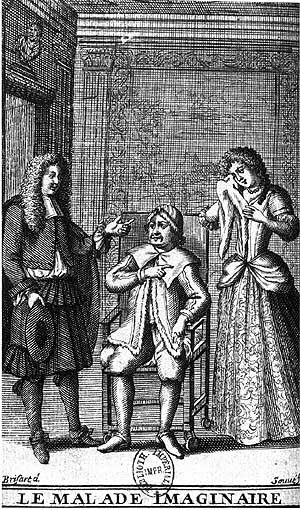
The Imaginary Invalid
The Imaginary Invalid is a comedy-ballet by Molière. It came out in 1673.
- Released
- 1673
- Came out
- February 10, 1673
- Written by
- Molière
- Genre
- comédie-ballet
All 8 facts, and where they come from
Facts
8 facts · 0 confirmed by two sources · 1 cited · 7 from one source
Where this comes from
Papalocal keeps its own record. It started from these sources; what each one said is kept here as it was copied, so a change on their side never changes this page by itself. Tap one to read its version.
What Wikidata says · copied November 17, 2026 · revision 2549136623
- Described as
- comedy-ballet by Molière
- Other names
- Le Malade imaginaire
- What it is
- dramatic work
- Written by
- Molière
- Music by
- Marc-Antoine Charpentier
- Genre
- comédie-ballet
- Released
- 1673
- Language
- French · 1 reference; Latin
- Came out
- February 10, 1673
- Wikipedias with a page
- 40
Wikidata item Q588161 (wikidata.org/wiki/Q588161), public domain (CC0). Copied 2026-11-17.
What Wikipedia says · copied November 17, 2026 · revision 1381473511
The Imaginary Invalid, The Hypochondriac, or The Would-Be Invalid (French title Le Malade imaginaire, [lə malad imaʒinɛːʁ]) is a three-act comédie-ballet by the French playwright Molière with dance sequences and musical interludes (H.495, H.495 a, H.495 b) by Marc-Antoine Charpentier. It premiered on 10 February 1673 at the Théâtre du Palais-Royal in Paris and was originally choreographed by Pierre Beauchamp.
Molière had fallen out with the powerful court composer Jean-Baptiste Lully, with whom he had pioneered the comédie-ballet form a decade earlier, and had opted for the collaboration with Charpentier. Le malade imaginaire was Molière's last work. He collapsed during his fourth performance as Argan on 17 February and died soon after.
From the Wikipedia article “The Imaginary Invalid” (en.wikipedia.org/wiki/The_Imaginary_Invalid), by its contributors, under CC BY-SA 4.0 (creativecommons.org/licenses/by-sa/4.0/). Copied 2026-11-17; not changed.
Confirmed Two sources agree. Cited One source, and it names where it got it. One source One source, without a reference of its own. Sources disagree The sources disagree. We show the best-supported value and keep theirs below.
Picture: Pierre Brissart, via Wikimedia Commons · Public domain