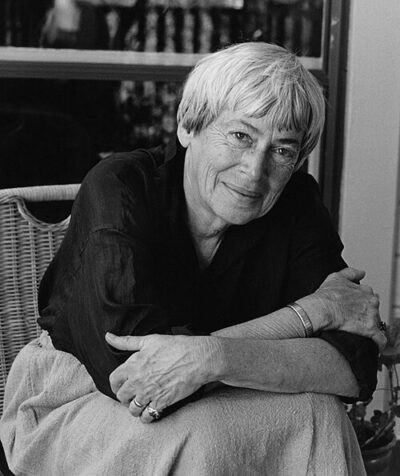
The Left Hand of Darkness
The Left Hand of Darkness is a 1969 novel by Ursula K. Le Guin. It is part of Hainish Cycle. It won the Hugo Award for Best Novel and 3 more.
- Published
- March 1969
- Came out
- 1969
- Written by
- Ursula K. Le Guin
- Genre
- science fiction
- Country of origin
- United States
All 17 facts, and where they come from
Facts
17 facts · 0 confirmed by two sources · 7 cited · 10 from one source
Where this comes from
Papalocal keeps its own record. It started from these sources; what each one said is kept here as it was copied, so a change on their side never changes this page by itself. Tap one to read its version.
What Wikidata says · copied November 16, 2026 · revision 2568620834
- Described as
- 1969 novel by Ursula K. Le Guin
- Other names
- Left Hand of Darkness
- What it is
- literary work
- Written by
- Ursula K. Le Guin · 2 references
- Genre
- science fiction · 1 reference; gay literature; feminist science fiction
- Published
- March 1969 · 1 reference
- Language
- American English; English
- Country of origin
- United States
- Part of the series
- Hainish Cycle · 1 reference
- Comes after
- City of Illusions · 1 reference
- Followed by
- The Word for World Is Forest
- Came out
- 1969 · 1 reference
- Awards
- Hugo Award for Best Novel (1970) · 1 reference; NPR Top 100 Science Fiction and Fantasy Books; Nebula Award for Best Novel (1970) · 1 reference; Otherwise Retrospective Award (1995) · 1 reference
- Wikipedias with a page
- 35
Wikidata item Q2008211 (wikidata.org/wiki/Q2008211), public domain (CC0). Copied 2026-11-16.
What Wikipedia says · copied November 16, 2026 · revision 1384335004
The Left Hand of Darkness is a science fiction novel by the American writer Ursula K. Le Guin. Published in 1969, its popularity established Le Guin's status as a major author of science fiction. The novel is set in the fictional universe of the Hainish Cycle, a series of novels and short stories by Le Guin, which she introduced in the 1964 short story "The Dowry of Angyar". It was fourth in writing sequence among the Hainish novels, preceded by City of Illusions and followed by The Word for World Is Forest.
The novel follows the story of Genly Ai, a human native of Terra, who is sent to the planet of Gethen as an envoy of the Ekumen, a loose confederation of planets. Ai's mission is to persuade the nations of Gethen to join the Ekumen, but he is stymied by a limited understanding of their culture. Individuals on Gethen are ambisexual, with no fixed sex; this situation has a strong influence on the planet's culture, and it creates a barrier of understanding for Ai.
The Left Hand of Darkness was among the first books in the genre now known as feminist science fiction, and it is described as the most famous examination of androgyny in science fiction. A major theme of the novel is the effect of sex and gender on culture and society, explored particularly through the relationship between Ai and Estraven, a Gethenian politician who trusts and helps Ai. When the book was first published, the gender theme touched off a feminist debate over the depiction of the ambisexual Gethenians. The novel also explores the interaction between the unfolding loyalties of its two main characters; the loneliness and rootlessness of Ai; and the contrast between the religions of Gethen's two major nations.
The Left Hand of Darkness has been reprinted more than 30 times, and it has received high praise from reviewers. In 1970, it was awarded the Hugo and Nebula Awards for Best Novel by fans and writers, respectively. Of the novel's impact, the literary critic Harold Bloom wrote, "Le Guin, more than Tolkien, has raised fantasy into high literature, for our time". The scholar Donna White wrote that the book was a seminal work of science fiction, comparing it to Mary Shelley's novel Frankenstein.
From the Wikipedia article “The Left Hand of Darkness” (en.wikipedia.org/wiki/The_Left_Hand_of_Darkness), by its contributors, under CC BY-SA 4.0 (creativecommons.org/licenses/by-sa/4.0/). Copied 2026-11-16; not changed.
Confirmed Two sources agree. Cited One source, and it names where it got it. One source One source, without a reference of its own. Sources disagree The sources disagree. We show the best-supported value and keep theirs below.