
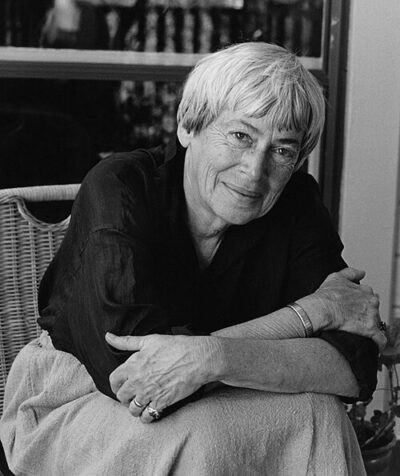
Ursula K. Le Guin
Ursula K. Le Guin was an American fantasy and science fiction author. Born October 21, 1929, in Berkeley. Died January 22, 2018, in Portland. Known for Earthsea series, The Left Hand of Darkness and The Dispossessed. Educated at Harvard University and Columbia University. Awards include Margaret Edwards Award, Prometheus Award - Hall of Fame and Grand Prix de l'Imaginaire for Best Foreign-Language Short Story.
Facts
67 facts · 2 confirmed by two sources · 32 cited · 33 from one source
Where this comes from
Papalocal keeps its own record. It started from these sources; what each one said is kept here as it was copied, so a change on their side never changes this page by itself. Tap one to read its version.
What Wikidata says · copied November 13, 2026 · revision 2566642164
- Described as
- American fantasy and science fiction author (1929–2018)
- Other names
- Ursula Kroeber, Ursula Kroeber Le Guin, Ursula Le Guin, Ursula K. LeGuin, Ursula LeGuin
- Born
- October 21, 1929 · 11 references
- Died
- January 22, 2018 · 9 references
- Born in
- Berkeley · 2 references
- Died in
- Portland · 1 reference
- Cause of death
- myocardial infarction
- Name at birth
- Ursula Kroeber · 1 reference
- Citizen of
- United States · 1 reference
- Occupation
- writer · 2 references; screenwriter; translator · 1 reference; novelist · 1 reference; poet · 1 reference; author · 1 reference; literary critic; science fiction writer
- Worked for
- University of Oregon
- Education
- Harvard University; Columbia University (–1952); Radcliffe College; Berkeley High School
- Member of
- Phi Beta Kappa Society; American Academy of Arts and Letters
- Genre
- science fiction; fantasy; feminist science fiction
- Known for
- Earthsea series; The Left Hand of Darkness; The Dispossessed; The Eye of the Heron; Malafrena; The Beginning Place; Always Coming Home; Annals of the Western Shore; Lavinia; Catwings
- Awards
- Margaret Edwards Award (2004) · 1 reference; Prometheus Award - Hall of Fame (1993) · 1 reference; Grand Prix de l'Imaginaire for Best Foreign-Language Short Story (2008) · 1 reference; Hugo Award for Best Short Story (1974) · 1 reference; Hugo Award for Best Novelette (1988) · 1 reference; Janet Heidinger Kafka Prize (1985) · 1 reference; PEN/Malamud Award (2002) · 1 reference; Otherwise Award (2 times) (1994, 1996) · 1 reference; Locus Award for Best Short Story (3 times) (1975, 1983, 2002) · 1 reference; Hugo Award for Best Novel (2 times) (1970, 1975) · 1 reference; Locus Award for Best Science Fiction Novel (2001) · 1 reference; Nebula Award for Best Novel (4 times) (1970, 1975, 1991, 2009) · 2 references; Pilgrim Award (1989) · 1 reference; World Fantasy Award for Life Achievement (1995) · 1 reference; World Fantasy Award for Best Novella (1988) · 2 references
- Field
- fiction · 1 reference; science fiction · 1 reference; fantasy literature · 1 reference; science fiction literature · 1 reference; fantasy · 1 reference; poetry · 1 reference
- Spouse
- Charles Le Guin (1953–2018) · 3 references
- Children
- Caroline · 1 reference; Theo; Elisabeth
- Father
- Alfred L. Kroeber · 1 reference
- Mother
- Theodora Kroeber · 1 reference
- Siblings
- Karl Kroeber · 1 reference
- Religion
- Taoism
- Lived in
- Berkeley; Portland (1958–2018) · 1 reference
- Website
- https://www.ursulakleguin.com
- Wikipedias with a page
- 111
Wikidata item Q181659 (wikidata.org/wiki/Q181659), public domain (CC0). Copied November 13, 2026.
What Wikipedia says · copied November 13, 2026 · revision 1384629457
Ursula Kroeber Le Guin ( KROH-bər lə GWIN; née Kroeber; October 21, 1929 – January 22, 2018) was an American author. She is best known for her works of speculative fiction, including science fiction works set in her Hainish universe and the fantasy series Earthsea. Her work was first published in 1959, and her literary career spanned nearly sixty years, producing more than twenty novels and more than a hundred short stories, in addition to poetry, literary criticism, translations, and children's books. Frequently described as an author of science fiction, Le Guin has also been called a "major voice in American Letters". Le Guin said that she would prefer to be known as an "American novelist".
Le Guin was born in Berkeley, California, to author and anthropologist Theodora Kroeber and anthropologist Alfred Louis Kroeber. Having earned a master's degree in French, Le Guin began doctoral studies but abandoned these after her marriage in 1953 to historian Charles Le Guin. She began writing full-time in the late 1950s, and she achieved major critical and commercial success with the novels A Wizard of Earthsea (1968) and The Left Hand of Darkness (1969); these have been described by Harold Bloom as her masterpieces. For the latter volume, Le Guin won both the Hugo and Nebula awards for best novel, becoming the first woman to do so. Several more works set in Earthsea or the Hainish universe followed; others included books set in the fictional country of Orsinia, several works for children, and many anthologies.
Cultural anthropology, Taoism, feminism, and the writings of Carl Jung all had a strong influence on Le Guin's work. Many of her stories used anthropologists or cultural observers as protagonists, and Taoist ideas about balance and equilibrium have been identified in several writings. Le Guin often subverted typical speculative fiction tropes, such as by writing dark-skinned protagonists in Earthsea, and also used unusual stylistic or structural devices in works such as the experimental Always Coming Home (1985). Social and political themes, including race, gender, sexuality, and coming of age were prominent in her writing. She explored alternative political structures in many stories, such as the philosophical short story "The Ones Who Walk Away from Omelas" (1973) and the anarchist utopian novel The Dispossessed (1974).
Le Guin's writing was enormously influential in the field of speculative fiction and has been the subject of intense critical attention. She received numerous accolades, including eight Hugo Awards, six Nebula Awards, and twenty-five Locus Awards; in 2003, she became the second woman honored as a Grand Master of the Science Fiction and Fantasy Writers of America. The U.S. Library of Congress named her a Living Legend in 2000, and in 2014, she won the National Book Foundation Medal for Distinguished Contribution to American Letters. Le Guin influenced many other authors, including the Booker Prize winner Salman Rushdie, David Mitchell, Neil Gaiman, and Iain Banks. After her death in 2018, critic John Clute wrote that Le Guin had "presided over American science fiction for nearly half a century", while author Michael Chabon referred to her as the "greatest American writer of her generation".
- Born, in its opening lines
- October 21, 1929
- Died, in its opening lines
- January 22, 2018
From the Wikipedia article “Ursula K. Le Guin” (en.wikipedia.org/wiki/Ursula_K._Le_Guin), by its contributors, under CC BY-SA 4.0 (creativecommons.org/licenses/by-sa/4.0/). Copied November 13, 2026; not changed.
Confirmed Two sources agree. Cited One source, and it names where it got it. One source One source, without a reference of its own. Sources disagree The sources disagree. We show the best-supported value and keep theirs below.
