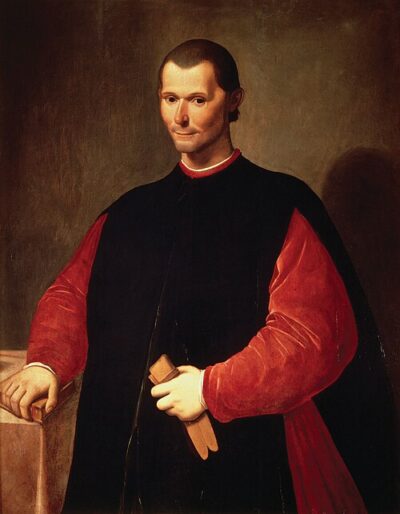
The Prince
The Prince is a political treatise by Niccolò Machiavelli. It came out in 1532.
- Published
- 1532
- Came out
- 1513
- Written by
- Niccolò Machiavelli
- Genre
- essay
- Country of origin
- Italy
All 9 facts, and where they come from
Facts
9 facts · 0 confirmed by two sources · 0 cited · 9 from one source
Where this comes from
Papalocal keeps its own record. It started from these sources; what each one said is kept here as it was copied, so a change on their side never changes this page by itself. Tap one to read its version.
What Wikidata says · copied November 17, 2026 · revision 2566042221
- Described as
- political treatise by Niccolò Machiavelli
- Other names
- De Principatibus (“Of Principalities”), Il Principe (“The Prince”)
- What it is
- literary work
- Written by
- Niccolò Machiavelli
- Genre
- essay
- Published
- 1532
- Language
- Italian
- Country of origin
- Italy; Republic of Florence
- Followed by
- Discourses on Livy
- Came out
- 1513
- Wikipedias with a page
- 101
Wikidata item Q131719 (wikidata.org/wiki/Q131719), public domain (CC0). Copied 2026-11-17.
What Wikipedia says · copied November 17, 2026 · revision 1386019233
The Prince (Italian: Il Principe [il ˈprintʃipe]; Latin: De Principatibus) is a 16th-century political treatise written by the Italian diplomat and political philosopher Niccolò Machiavelli in the form of an instruction guide for new princes. Many commentators have viewed that one of the main themes of The Prince is that immoral acts are sometimes necessary to achieve political glory.
From Machiavelli's correspondence, a version was being written in 1513, using a Latin title, De Principatibus (Of Principalities). However, the printed version was not published until 1532, five years after Machiavelli's death. This was carried out with the permission of the Medici pope Clement VII, but "long before then, in fact since the first appearance of The Prince in manuscript, controversy had swirled about his writings".
Although The Prince was written as if it were a traditional work in the mirrors for princes style, it was generally agreed as being especially innovative. This is because Machiavelli appears to distance his book from all of the classical works of political philosophy, as he viewed that they were too concerned with the ideal regime. Machiavelli illustrates his reasoning using remarkable comparisons of classical, biblical, and medieval events, including many positive references to the murderous career of Cesare Borgia, which occurred during Machiavelli's own diplomatic career.
The Prince is sometimes claimed to be one of the first works of modern philosophy, especially modern political philosophy, in which practical effect is taken to be more important than any abstract ideal. Its worldview came in direct conflict with the dominant Catholic and scholastic doctrines of the time, particularly those on politics and ethics.
This short treatise is the most remembered of Machiavelli's works, and the most responsible for the later pejorative use of the word "Machiavellian". It even contributed to the modern negative connotations of the words "politics" and "politician" in Western countries. In subject matter, it overlaps with the much longer Discourses on Livy, which was written a few years later. In its use of near-contemporary Italians as examples of people who perpetrated criminal deeds for political ends, Leo Strauss compared the lesser-known work, the Life of Castruccio Castracani, to The Prince.
From the Wikipedia article “The Prince” (en.wikipedia.org/wiki/The_Prince), by its contributors, under CC BY-SA 4.0 (creativecommons.org/licenses/by-sa/4.0/). Copied 2026-11-17; not changed.
Confirmed Two sources agree. Cited One source, and it names where it got it. One source One source, without a reference of its own. Sources disagree The sources disagree. We show the best-supported value and keep theirs below.
Picture: Wikimedia Commons: Nicolo Machiavelli, Il Principe, 1550, title page.jpg · See Commons file page