
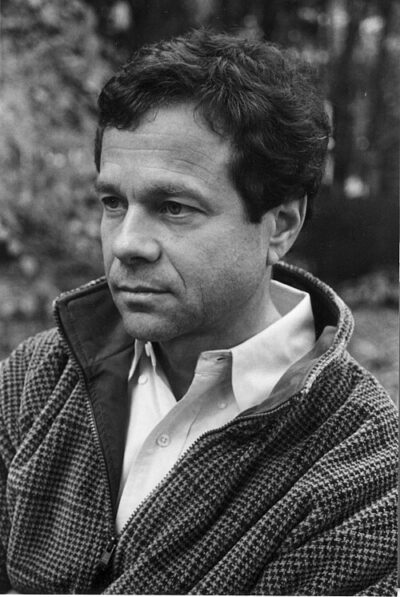
Alan Lightman
Alan Lightman is an American physicist, science writer, essayist, novelist. Born November 28, 1948, in Memphis. Educated at California Institute of Technology and Princeton University. Awards include Fellow of the American Physical Society and Rhysling Award.
Facts
20 facts · 1 confirmed by two sources · 3 cited · 16 from one source
Where this comes from
Papalocal keeps its own record. It started from these sources; what each one said is kept here as it was copied, so a change on their side never changes this page by itself. Tap one to read its version.
What Wikidata says · copied November 16, 2026 · revision 2563859821
- Described as
- American physicist, science writer, essayist, novelist
- Other names
- Alan Paige Lightman, Alan P. Lightman
- Born
- November 28, 1948 · 2 references
- Born in
- Memphis · 1 reference
- Citizen of
- United States
- Occupation
- physicist · 1 reference; astrophysicist · 1 reference; novelist; writer; science fiction writer
- Worked for
- Harvard University; Massachusetts Institute of Technology
- Education
- California Institute of Technology; Princeton University; Cornell University; White Station High School · 1 reference
- Member of
- American Academy of Arts and Sciences; Phi Beta Kappa Society
- Awards
- Fellow of the American Physical Society; Rhysling Award
- Field
- astrophysics
- Website
- http://writing.mit.edu/people/faculty/homepage/lightman · 1 reference
- Wikipedias with a page
- 20
Wikidata item Q2664403 (wikidata.org/wiki/Q2664403), public domain (CC0). Copied November 16, 2026.
What Wikipedia says · copied November 16, 2026 · revision 1385925147
Alan Paige Lightman (born November 28, 1948) is an American physicist, writer, and social entrepreneur. He has served on the faculties of Harvard University and Massachusetts Institute of Technology (MIT) and is currently a professor of the practice of the humanities at MIT. He is a contributing writer for The Atlantic magazine.
Lightman was one of the first persons at MIT to hold a joint faculty position in both the sciences and the humanities. His thinking and writing explore the intersection of the sciences and humanities, especially the multilogues among science, philosophy, and religion.
Lightman is a past member of the United Nations’ Scientific Advisory Board. The purpose of this Board is to advise UN leaders on breakthroughs in science and technology and mitigate potential risks, including ethical and social issues.
Lightman is the author of the international bestseller Einstein's Dreams, and his novel The Diagnosis was a finalist for the National Book Award. He is also the founder of Harpswell, a nonprofit organization whose mission is to advance a new generation of women leaders in Southeast Asia.
Lightman hosts the public-television series Searching: Our Quest for Meaning in the Age of Science. He has also appeared in the documentaries 306 Hollywood, directed by Elan and Jonathan Bogerin, and A Trip to Infinity, directed by Drew Takahashi and Jon Halperin.
He has received six honorary doctoral degrees.
- Born, in its opening lines
- November 28, 1948
From the Wikipedia article “Alan Lightman” (en.wikipedia.org/wiki/Alan_Lightman), by its contributors, under CC BY-SA 4.0 (creativecommons.org/licenses/by-sa/4.0/). Copied November 16, 2026; not changed.
Confirmed Two sources agree. Cited One source, and it names where it got it. One source One source, without a reference of its own. Sources disagree The sources disagree. We show the best-supported value and keep theirs below.
