
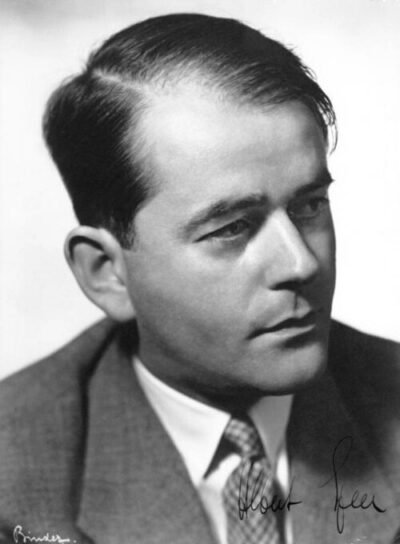
Albert Speer
Albert Speer was a German Nazi architect, Government Minister of Armaments and War Production for Nazi Germany and convicted Nazi War Criminal. Born March 19, 1905, in Mannheim. Died September 1, 1981, in London. Positions held include member of the Reichstag of Nazi Germany (1937–1945) and Ministry of Ammunition and War Production of Nazi Germany (1942–1945). Known for Deutsches Stadion, Nazi party rally grounds and Volkshalle. Educated at Technische Universität Berlin.
Facts
28 facts · 2 confirmed by two sources · 11 cited · 15 from one source
Where this comes from
Papalocal keeps its own record. It started from these sources; what each one said is kept here as it was copied, so a change on their side never changes this page by itself. Tap one to read its version.
What Wikidata says · copied November 16, 2026 · revision 2569137678
- Described as
- German Nazi architect, Government Minister of Armaments and War Production for Nazi Germany and convicted Nazi War Criminal (1905–1981)
- Other names
- Berthold Konrad Hermann Albert Speer
- Born
- March 19, 1905 · 16 references
- Died
- September 1, 1981 · 17 references
- Born in
- Mannheim · 4 references
- Died in
- London · 1 reference
- Buried in
- Bergfriedhof · 1 reference
- Citizen of
- Germany · 1 reference
- Occupation
- politician · 1 reference; architect · 2 references; Holocaust perpetrator · 1 reference
- Positions held
- member of the Reichstag of Nazi Germany (1937–1945); Ministry of Ammunition and War Production of Nazi Germany (1942–1945)
- Political party
- Nazi Party (1931–)
- Education
- Technische Universität Berlin
- Member of
- Sturmabteilung; Schutzstaffel
- Known for
- Deutsches Stadion; Nazi party rally grounds; Volkshalle; New Chancellery; Erinnerungen
- Spouse
- Margarete Weber; Margarete Speer · 1 reference
- Children
- Albert Speer · 1 reference; Hilde Schramm · 1 reference; Margret Nissen · 1 reference
- Father
- Albert Friedrich Speer · 1 reference
- Siblings
- Hermann Speer · 1 reference
- Military branch
- Schutzstaffel
- Wikipedias with a page
- 84
Wikidata item Q60045 (wikidata.org/wiki/Q60045), public domain (CC0). Copied November 16, 2026.
What Wikipedia says · copied November 16, 2026 · revision 1384831886
Berthold Konrad Hermann Albert Speer (; German: [ˈʃpeːɐ̯] ; 19 March 1905 – 1 September 1981) was a German architect who served as Minister of Armaments and War Production in Nazi Germany during most of World War II. A close friend and ally of Adolf Hitler, he was convicted at the Nuremberg trials and served 20 years in prison.
An architect by training, Speer joined the Nazi Party in 1931. His architectural skills made him increasingly prominent within the Party, and he became a member of Hitler's inner circle. Hitler commissioned him to design and construct structures, including the Reich Chancellery and the Nazi Party rally grounds in Nuremberg. In 1937, Hitler appointed Speer as General Building Inspector for Berlin. In this capacity he was responsible for the Central Department for Resettlement that evicted Jewish tenants from their homes in Berlin. In February 1942, Speer was appointed as Reich Minister of Armaments and War Production. Using misleading statistics, he promoted himself as having performed an armaments miracle that was widely credited with keeping Germany in the war. In 1944, Speer established a task force to increase production of fighter aircraft. It became instrumental in exploiting slave labor for the benefit of the German war effort.
After the war, Speer was among the 24 major war criminal defendants charged by the International Military Tribunal for Nazi atrocities. He was found guilty of war crimes and crimes against humanity, principally for the use of slave labor, narrowly avoiding a death sentence. Having served his full term, Speer was released in 1966. He used his writings from the time of imprisonment as the basis for two autobiographical books, Inside the Third Reich and Spandau: The Secret Diaries. Speer's books were a success; the public was fascinated by the inside view of the Third Reich he provided. He died of a stroke in 1981.
Through his autobiographies and interviews, Speer carefully constructed an image of himself as a man who deeply regretted having failed to discover the crimes of the Third Reich. He continued to deny explicit knowledge of, and responsibility for, the Holocaust. This image dominated his historiography in the decades following the war, giving rise to the "Speer myth": the perception of him as an apolitical technocrat responsible for revolutionizing the German war machine. The myth began to fall apart in the 1980s, when the armaments miracle was attributed to Nazi propaganda. Twenty-five years after Speer's death, Adam Tooze wrote in The Wages of Destruction that the idea that Speer was an apolitical technocrat was "absurd". Martin Kitchen, writing in Speer: Hitler's Architect, stated that much of the increase in Germany's arms production was actually due to systems instituted by Speer's predecessor (Fritz Todt) and that Speer was intimately aware of and involved in the Final Solution, evidence of which has been conclusively shown in the decades following the Nuremberg trials.
- Born, in its opening lines
- March 19, 1905
- Died, in its opening lines
- September 1, 1981
From the Wikipedia article “Albert Speer” (en.wikipedia.org/wiki/Albert_Speer), by its contributors, under CC BY-SA 4.0 (creativecommons.org/licenses/by-sa/4.0/). Copied November 16, 2026; not changed.
Confirmed Two sources agree. Cited One source, and it names where it got it. One source One source, without a reference of its own. Sources disagree The sources disagree. We show the best-supported value and keep theirs below.
