
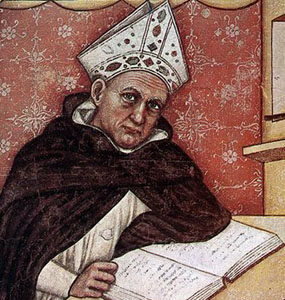
Albertus Magnus
Albertus Magnus was a German-Dominican friar and saint (c. 1200–1280). Born 1200, in Lauingen. Died November 15, 1280, in Cologne. Positions held include Roman Catholic Bishop of Regensburg (1260–1262), auxiliary bishop of Utrecht and Auxiliary Bishop of the Diocese of Strasbourg. Known for De homine, De vegetabilis et plantis libri septem and De mineralibus. Educated at University of Padua and University of Paris.
Facts
35 facts · 2 confirmed by two sources · 10 cited · 23 from one source
Where this comes from
Papalocal keeps its own record. It started from these sources; what each one said is kept here as it was copied, so a change on their side never changes this page by itself. Tap one to read its version.
What Wikidata says · copied November 16, 2026 · revision 2570032081
- Described as
- German-Dominican friar and saint (c. 1200–1280)
- Other names
- Albertus Teutonicus, Albertus Colonensis, Albertus Coloniensis, Albertus Bolstadius, Albertus de Bollstadt, Pseudo-Albertus, Albert von Bollstädt, Albertus Alemannus, Albert the Great, Albert Von Bollstaedt, Albert of Cologne, St. Albertus
- Born
- 1200 · 6 references
- Died
- November 15, 1280 · 7 references
- Born in
- Lauingen · 5 references
- Died in
- Cologne · 4 references
- Buried in
- St. Andreas Church · 1 reference
- Name at birth
- Albrecht
- Citizen of
- Holy Roman Empire
- Occupation
- chemist · 1 reference; musicologist; philosopher · 2 references; writer · 3 references; economist; astrologer; entomologist; geographer
- Positions held
- Roman Catholic Bishop of Regensburg (1260–1262) · 3 references; auxiliary bishop of Utrecht · 1 reference; Auxiliary Bishop of the Diocese of Strasbourg · 1 reference; Auxiliary bishop of the archdiocese of Cologne · 1 reference; auxiliary bishop of Konstanz · 1 reference
- Worked for
- University of Paris (1243) · 1 reference
- Education
- University of Padua (1223) · 1 reference; University of Paris (1243) · 2 references
- Known for
- De homine; De vegetabilis et plantis libri septem; De mineralibus; Secreta mulierum; De passionibus aeris; De meteoris; De quindecim problematibus; De animalibus; Quaestiones super De Animalibus; Biblia mariana
- Field
- philosophy
- Religion
- Catholic Church · 1 reference
- Wikipedias with a page
- 94
Wikidata item Q60059 (wikidata.org/wiki/Q60059), public domain (CC0). Copied November 16, 2026.
What Wikipedia says · copied November 16, 2026 · revision 1385916733
Albertus Magnus (c. 1200 – 15 November 1280), also known as Saint Albert the Great, Albert of Swabia, Albert von Bollstadt, or Albert of Cologne, was a German Dominican friar, philosopher, scientist, and bishop. He is considered one of the greatest medieval philosophers and thinkers.
Canonized in 1931, he was known during his lifetime as Doctor universalis and Doctor expertus; late in his life the sobriquet Magnus was appended to his name. Scholars such as James A. Weisheipl and Joachim R. Söder have referred to him as the greatest German philosopher and theologian of the Middle Ages. The Catholic Church distinguishes him as one of the Doctors of the Church.
- Born, in its opening lines
- c. 1200
- Died, in its opening lines
- November 15, 1280
From the Wikipedia article “Albertus Magnus” (en.wikipedia.org/wiki/Albertus_Magnus), by its contributors, under CC BY-SA 4.0 (creativecommons.org/licenses/by-sa/4.0/). Copied November 16, 2026; not changed.
Confirmed Two sources agree. Cited One source, and it names where it got it. One source One source, without a reference of its own. Sources disagree The sources disagree. We show the best-supported value and keep theirs below.
