
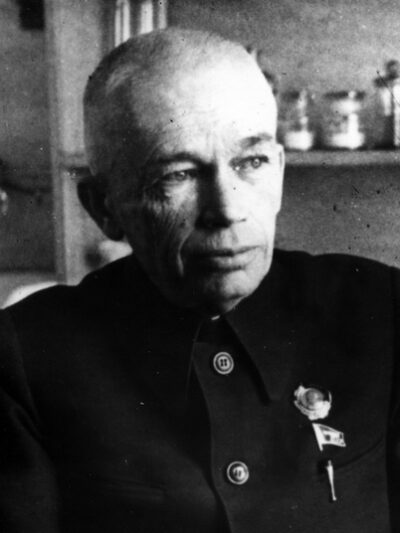
Alexander Bogomolets
Alexander Bogomolets was a Soviet-Ukrainian pathophysiologist. Born May 12, 1881, in Kyiv. Died July 19, 1946, in Kyiv. Positions held include deputy of the Supreme Soviet of the Soviet Union. Educated at Odesa University. Awards include Stalin Prize, Order of Lenin and Hero of Socialist Labour.
Facts
39 facts · 1 confirmed by two sources · 5 cited · 32 from one source · 1 where the sources disagree
What’s different
- Born: we show May 12, 1881 (Sources disagree). Wikipedia says May 24, 1881
Where this comes from
Papalocal keeps its own record. It started from these sources; what each one said is kept here as it was copied, so a change on their side never changes this page by itself. Tap one to read its version.
What Wikidata says · copied November 18, 2026 · revision 2567741278
- Described as
- Soviet-Ukrainian pathophysiologist (1881-1946)
- Other names
- Aleksandr Bogomolets, Oleksandr Bohomolets, Oleksandr O. Bohomolets, A. A. Bogomolets, O. O. Bohomolets, Aleksandr Aleksandrovich Bogomolets
- Born
- May 12, 1881
- Died
- July 19, 1946 · 2 references
- Born in
- Kyiv · 1 reference
- Died in
- Kyiv · 1 reference
- Buried in
- Akademik Bohomolets Memorial Park, Kyiv
- Citizen of
- Russian Empire; Russian Republic; Ukrainian People's Republic; Ukrainian State
- Occupation
- physician · 1 reference; university teacher; non-fiction writer; politician; pathologist · 1 reference; immunologist · 1 reference
- Positions held
- deputy of the Supreme Soviet of the Soviet Union
- Worked for
- Odesa University; National Academy of Sciences of Ukraine · 1 reference; Russian Academy of Sciences (1942–1945) · 1 reference
- Education
- Odesa University
- Member of
- National Academy of Sciences of Ukraine (1929–) · 1 reference; Russian Academy of Sciences (1932–) · 1 reference; National Academy of Sciences of Belarus (1939–) · 1 reference; USSR Academy of Medical Sciences (1944–) · 1 reference; Georgian National Academy of Sciences (1944–) · 1 reference
- Awards
- Stalin Prize; Order of Lenin; Hero of Socialist Labour; Order of the Patriotic War, 1st class; Order of the Red Banner of Labour; Honored Scientist of Ukraine; Medal "For Valiant Labour in the Great Patriotic War 1941–1945"; State Stalin Prize, 1st degree · 1 reference
- Field
- pathophysiology; oncology
- Spouse
- Olga Bogomolets
- Children
- Oleh Bohomolets
- Father
- Alexander M. Bogomolets
- Mother
- Sofiya Nikolaevna Bogomolets
- Wikipedias with a page
- 22
Wikidata item Q724434 (wikidata.org/wiki/Q724434), public domain (CC0). Copied November 18, 2026.
What Wikipedia says · copied November 18, 2026 · revision 1371963409
Oleksandr Oleksandrovych Bogomolets (Ukrainian: Олександр Олександрович Богомолець; Russian: Александр Александрович Богомолец, romanized: Aleksandr Aleksandrovich Bogomolets; 24 May 1881 – 19 July 1946) was a Soviet and Ukrainian pathophysiologist.
His father was the physician and revolutionary Oleksandr Mykhailovych Bogomolets (1850–1935).
He was president of the National Academy of Sciences of Ukraine and director of the Institute of clinical Physiology in Kyiv. In 1911-1925 he work in Saratov University, 1925–1931 in Moscow University.[1] His laboratories were located in Georgia, where he had a permanent research unit attached to the Academy of Sciences (1937). According to Zhores Medvedev, this was made possible by Stalin, who wanted members of the Experimental Institute to study the extension of life expectancy. He developed antireticular cytotoxic serum. In 1938, in Kyiv, Oleksandr Bogomolets convened the world's first scientific conference on aging and longevity.
- Born, in its opening lines
- May 24, 1881
- Died, in its opening lines
- July 19, 1946
From the Wikipedia article “Aleksandr Bogomolets” (en.wikipedia.org/wiki/Aleksandr_Bogomolets), by its contributors, under CC BY-SA 4.0 (creativecommons.org/licenses/by-sa/4.0/). Copied November 18, 2026; not changed.
Confirmed Two sources agree. Cited One source, and it names where it got it. One source One source, without a reference of its own. Sources disagree The sources disagree. We show the best-supported value and keep theirs below.
