
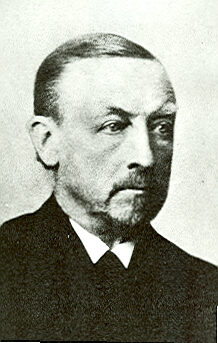
Alexander Conze
Alexander Conze was the 1831-1914, German classical archaeologist, director of the Berlin Collection of Classical Antiquities. Born December 10, 1831, in Hanover. Died July 19, 1914, in Grunewald. Educated at University of Göttingen. Awards include Travel Scholarship of the German Archaeological Institute.
Facts
31 facts · 2 confirmed by two sources · 6 cited · 23 from one source
Where this comes from
Papalocal keeps its own record. It started from these sources; what each one said is kept here as it was copied, so a change on their side never changes this page by itself. Tap one to read its version.
What Wikidata says · copied November 18, 2026 · revision 2569109755
- Described as
- 1831-1914, German classical archaeologist, director of the Berlin Collection of Classical Antiquities
- Other names
- Alexander Christian Leopold Conze, Conze, Alexander Christian Leopold, Alexander Christoph Leopold Conze, Conze, Alexander Christoph Leopold, Conze, Alex. Christ. Leop., Alex. Christ. Leop. Conze
- Born
- December 10, 1831 · 7 references
- Died
- July 19, 1914 · 7 references
- Born in
- Hanover · 2 references
- Died in
- Grunewald · 1 reference
- Buried in
- Grunewald Cemetery
- Name at birth
- Alexander Christian Leopold Conze
- Citizen of
- Kingdom of Prussia
- Occupation
- anthropologist; art historian · 3 references; archaeologist · 2 references; university teacher; classical archaeologist
- Worked for
- University of Vienna; University of Göttingen; Martin Luther University Halle-Wittenberg; Humboldt-Universität zu Berlin · 1 reference
- Education
- University of Göttingen
- Member of
- Royal Prussian Academy of Sciences; German Archaeological Institute; Göttingen Academy of Sciences and Humanities in Lower Saxony; Austrian Academy of Sciences; Hellenic Philological Society of Constantinople (1885–); Royal Swedish Academy of Letters, History and Antiquities; Bavarian Academy of Sciences and Humanities; Corps Brunsviga Göttingen · 1 reference
- Awards
- Travel Scholarship of the German Archaeological Institute (1859–1860)
- Spouse
- Elise Conze (1861–)
- Children
- Elsbeth Krukenberg · 1 reference; Hans Conze · 1 reference
- Father
- Georg Conze
- Mother
- Sophie Helwing · 1 reference
- Wikipedias with a page
- 20
Wikidata item Q72857 (wikidata.org/wiki/Q72857), public domain (CC0). Copied November 18, 2026.
What Wikipedia says · copied November 18, 2026 · revision 1253586444
Alexander Christian Leopold Conze (10 December 1831 – 19 July 1914) was a German archaeologist, who specialized in ancient Greek art.
He was a native of Hanover, and studied at the universities of Göttingen and Berlin. In 1855 he obtained his doctorate at Berlin as a student of Eduard Gerhard. In 1863 he became an associate professor at the University of Halle, and from 1869 to 1877, he served as a professor of archaeology at the University of Vienna. In the 1870s, he performed two archaeological explorations at Samothrace (1873 and 1875). In 1876, with Otto Hirschfeld, he organized the Archaeologic-Epigraphic Seminar at the university.In 1877 he succeeded Karl Bötticher as director of the Berlin Antikensammlung (Collection of Classical Antiquities), In 1887, he became Secretariat of the German Archaeological Institute.
In 1878 with engineer Carl Humann, he began excavation at Pergamon in Asia Minor, a project that lasted until 1886. With Wilhelm Dörpfeld, he started a second archaeological dig at Pergamon in 1900. At Pergamon, Conze and Humann uncovered one of the greatest archaeological treasures of Hellenistic civilization, the Pergamon Altar, which today is housed at the Pergamon Museum in Berlin.
Conze died in Berlin.
- Born, in its opening lines
- December 10, 1831
- Died, in its opening lines
- July 19, 1914
From the Wikipedia article “Alexander Conze” (en.wikipedia.org/wiki/Alexander_Conze), by its contributors, under CC BY-SA 4.0 (creativecommons.org/licenses/by-sa/4.0/). Copied November 18, 2026; not changed.
Confirmed Two sources agree. Cited One source, and it names where it got it. One source One source, without a reference of its own. Sources disagree The sources disagree. We show the best-supported value and keep theirs below.
