
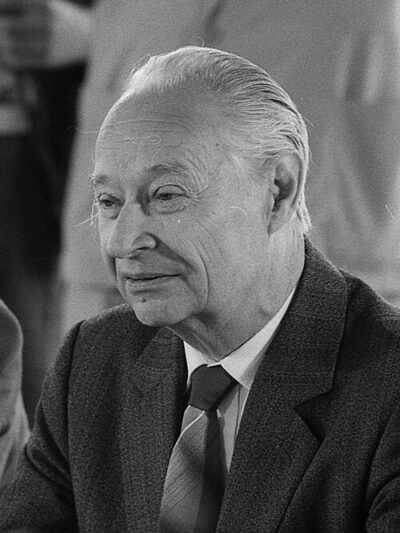
Alexander Dubček
Alexander Dubček was a first Secretary of the Czechoslovak Communist Party. Born November 27, 1921, in Uhrovec. Died November 7, 1992, in Prague. Positions held include member of the Federal Assembly of Czechoslovakia (1989–1992), First Secretary of the Communist Party of Czechoslovakia (1968–1969) and ambassador. Educated at Higher Party School at the Central Committee of the CPSU and Comenius University. Awards include Order of the White Lion, Sakharov Prize and Ľudovít Štúr Order 1st class.
Facts
33 facts · 2 confirmed by two sources · 13 cited · 18 from one source
Where this comes from
Papalocal keeps its own record. It started from these sources; what each one said is kept here as it was copied, so a change on their side never changes this page by itself. Tap one to read its version.
What Wikidata says · copied November 16, 2026 · revision 2568566307
- Described as
- first Secretary of the Czechoslovak Communist Party (1921-1992)
- Other names
- Alexander Dubcek
- Born
- November 27, 1921 · 14 references
- Died
- November 7, 1992 · 12 references
- Born in
- Uhrovec · 6 references
- Died in
- Prague · 7 references
- Buried in
- Slávičie údolie cemetery · 1 reference
- Cause of death
- car collision · 1 reference
- Citizen of
- Czechoslovakia · 1 reference
- Occupation
- politician · 2 references; diplomat; mechanical technician · 1 reference; general secretary · 1 reference
- Positions held
- member of the Federal Assembly of Czechoslovakia (1989–1992); First Secretary of the Communist Party of Czechoslovakia (1968–1969); ambassador
- Political party
- Communist Party of Slovakia (1939–1948); Communist Party of Czechoslovakia (1948–1970); Public Against Violence (1989–1992); Social Democratic Party of Slovakia (1992–)
- Education
- Higher Party School at the Central Committee of the CPSU; Comenius University · 1 reference
- Member of
- Interhelpo
- Awards
- Order of the White Lion; Sakharov Prize (1989) · 1 reference; Ľudovít Štúr Order 1st class (1995) · 1 reference; Cross of Pribina class I (2000) · 1 reference; honorary doctor of the University of Madrid Complutense (1990); Order of February 25, 1st class (1949) · 1 reference; honorary doctor of Comenius University (1991) · 1 reference; Order of Georgi Dimitrov · 1 reference
- Spouse
- Anna Dubček
- Children
- Pavol Dubček · 1 reference; Peter Dubček
- Father
- Štefan Dubček
- Wikipedias with a page
- 87
Wikidata item Q150543 (wikidata.org/wiki/Q150543), public domain (CC0). Copied November 16, 2026.
What Wikipedia says · copied November 16, 2026 · revision 1385560199
Alexander Dubček (Slovak pronunciation: [ˈaleksander ˈduptʂek]; 27 November 1921 – 7 November 1992) was a Slovak statesman who served as the First Secretary of the Presidium of the Central Committee of the Communist Party of Czechoslovakia (KSČ) (de facto leader of Czechoslovakia) from January 1968 to April 1969 and as Chairman of the Federal Assembly from 1989 to 1992 following the Velvet Revolution. He oversaw significant reforms to the communist system during a period that became known as the Prague Spring, but his reforms were reversed and he was eventually sidelined following the Warsaw Pact invasion in August 1968.
Best known by the slogan "Socialism with a human face", Dubček led a process that accelerated cultural and economic liberalization in Czechoslovakia. Reforms were opposed by conservatives inside the party who benefited from the Stalinist economy, as well as interests in the neighbouring Soviet-bloc who feared contagion, western subversion, strategic vulnerability, and loss of institutional power. For reasons of institutional interests in the Soviet Union such as those of the military and KGB, false reports, and the growing concern among the Soviet leadership that Dubček was no longer able to maintain control of the country, Czechoslovakia was invaded by half a million Soviet-led Warsaw Pact troops on the night of 20–21 August 1968. This was intended to enable a coup by conservative forces. That coup, however, could not materialize due to lack of a viable pro-Soviet replacement leadership and the unexpected extraordinary popularity of Dubček and the reformist leadership. Soviet intervention ushered in a period of maneuver between conservatives and reformers where conservatives relied on Soviet influence to shift the balance of power, reversing reforms of the Prague Spring.
Dubček was forced to resign as party head in April 1969, and was succeeded by Gustáv Husák, a former reformer and victim of Stalinism who was ambiguously favored by Moscow. This signaled the end of the Prague Spring and the beginning of normalization. Dubček was expelled from the Communist Party in 1970, amid a purge that eventually expelled almost two-thirds of the 1968 party membership. This mostly purged the younger generation of post-Stalin communists that he represented along with many of the most competent technical experts and managers.
During the Velvet Revolution in 1989, Dubček served as the Chairman of the federal Czechoslovak parliament and contended for the presidency with Václav Havel. The European Parliament awarded Dubček the Sakharov Prize the same year. In the interim between the Prague Spring and the Velvet Revolution, Dubček withdrew from high politics but served as a leading inspiration and symbolic leader for Eurocommunism, maintaining intermittent contact with European communist reformers, especially in Italy and the Soviet Union. Also in 1989, just before his death, Andrei Sakharov wrote, "I am convinced that the 'breath of freedom' which the Czechs and the Slovaks enjoyed when Dubček was their leader was a prologue to the peaceful revolutions now taking place in eastern Europe and Czechoslovakia itself." Sakharov credited Dubček and the Prague Spring as his inspiration.
At the time of his death in an automobile crash in 1992, Dubček remained an important political figure. Many saw him as the destined future president of newly-formed Slovakia.
- Born, in its opening lines
- November 27, 1921
- Died, in its opening lines
- November 7, 1992
From the Wikipedia article “Alexander Dubček” (en.wikipedia.org/wiki/Alexander_Dubček), by its contributors, under CC BY-SA 4.0 (creativecommons.org/licenses/by-sa/4.0/). Copied November 16, 2026; not changed.
Confirmed Two sources agree. Cited One source, and it names where it got it. One source One source, without a reference of its own. Sources disagree The sources disagree. We show the best-supported value and keep theirs below.
