
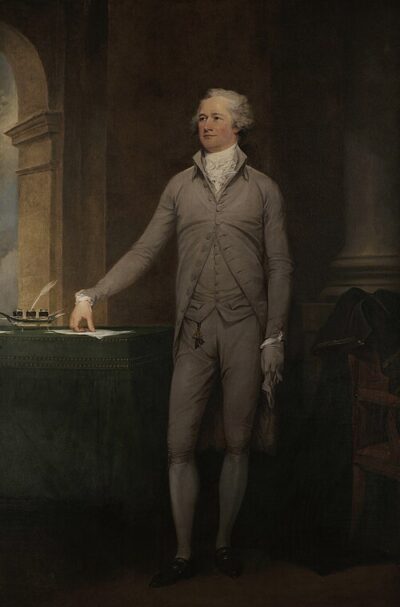
Alexander Hamilton
Alexander Hamilton was an American Founding Father and statesman (1755/1757–1804). Born January 11, 1757, in Charlestown. Died July 12, 1804, in Greenwich Village. Positions held include United States Secretary of the Treasury (1789–1795), Commanding General of the United States Army (1799–1800) and Delegate to the United States Constitutional Convention (1787). Known for Federalist Papers, First Report on the Public Credit and Report on a National Bank. Educated at Columbia College and Columbia University. Awards include Fellow of the American Academy of Arts and Sciences and New Jersey Hall of Fame.
Facts
47 facts · 1 confirmed by two sources · 10 cited · 35 from one source · 1 where the sources disagree
What’s different
- Born: we show January 11, 1757 (Sources disagree). Wikipedia says January 11, 1755
Where this comes from
Papalocal keeps its own record. It started from these sources; what each one said is kept here as it was copied, so a change on their side never changes this page by itself. Tap one to read its version.
What Wikidata says · copied November 13, 2026 · revision 2568669192
- Described as
- American Founding Father and statesman (1755/1757–1804)
- Other names
- Alexander Hamilton, US Treasury secretary, Hamilton, Publius, A. Ham
- Born
- January 11, 1757 · 9 references
- Died
- July 12, 1804 · 6 references
- Born in
- Charlestown · 1 reference
- Died in
- Greenwich Village · 1 reference
- Buried in
- Trinity Churchyard
- Cause of death
- gunshot wound
- Citizen of
- United States · 3 references
- Occupation
- economist; philosopher; military personnel; politician · 2 references; aide-de-camp; military officer; writer · 1 reference; businessperson · 1 reference
- Positions held
- United States Secretary of the Treasury (1789–1795); Commanding General of the United States Army (1799–1800); Delegate to the United States Constitutional Convention (1787) · 1 reference
- Political party
- Federalist Party
- Worked for
- United States Department of the Treasury
- Education
- Columbia College; Columbia University; Benicia High School
- Member of
- American Philosophical Society (1791–); American Academy of Arts and Sciences; New York Manumission Society
- Known for
- Federalist Papers; First Report on the Public Credit; Report on a National Bank; Report on Manufactures; Second Report on Public Credit
- Awards
- Fellow of the American Academy of Arts and Sciences (1791–) · 1 reference; New Jersey Hall of Fame (2021) · 1 reference
- Spouse
- Elizabeth Schuyler Hamilton
- Children
- Philip Hamilton; Angelica Hamilton; Alexander Hamilton Jr.; James Alexander Hamilton · 1 reference; William S. Hamilton; Eliza Hamilton Holly; Philip Hamilton; John Church Hamilton · 1 reference
- Father
- James A. Hamilton
- Mother
- Rachel Faucitt Lavien · 1 reference
- Religion
- Episcopal Church
- Military branch
- Continental Army
- Military rank
- general
- Wikipedias with a page
- 106
Wikidata item Q178903 (wikidata.org/wiki/Q178903), public domain (CC0). Copied November 13, 2026.
What Wikipedia says · copied November 13, 2026 · revision 1384860288
Alexander Hamilton (January 11, 1755, or 1757 – July 12, 1804) was an American military officer, statesman, and Founding Father who served as the first U.S. secretary of the treasury from 1789 to 1795 under the presidency of George Washington. He also founded America's first political party, the Federalist Party, in 1789.
Born out of wedlock in Charlestown on the Caribbean island of Nevis, Hamilton was orphaned as a child and taken in by a prosperous merchant. He was given a scholarship and pursued his education at King's College (now Columbia University) in New York City where, despite his young age, he was an anonymous but prolific and widely read pamphleteer and advocate for the American Revolution. He then served as an artillery officer in the American Revolutionary War, where he saw military action against the British Army in the New York and New Jersey campaign, served for four years as aide-de-camp to Continental Army commander-in-chief George Washington, and fought under Washington's command in the war's climactic battle, the Siege of Yorktown, which secured American victory in the war and with it the independence of the United States.
After the Revolutionary War, Hamilton served as a delegate from New York to the Congress of the Confederation in Philadelphia. He resigned to practice law and founded the Bank of New York. In 1786, Hamilton led the Annapolis Convention, which sought to strengthen the power of the loose confederation of independent states under the limited authorities granted the Congress by the Articles of Confederation. The following year he was a delegate to the Philadelphia Convention, which drafted the U.S. Constitution creating a more centralized federal national government. He then authored 51 of the 85 installments of The Federalist Papers, which proved persuasive in securing its ratification by the states and remains the preeminent interpretation of Constitutional intent.
As a trusted member of President Washington's first cabinet, Hamilton served as the first U.S. secretary of the treasury. He envisioned a central government led by an energetic executive, a strong national defense, and a more diversified economy with significantly expanded industry. He successfully argued that the implied powers of the U.S. Constitution provided the federal government the legal basis to create the First Bank of the United States as a fiscal agent to assume the states' war debts, a bank that was funded by a tariff on imports and a whiskey tax. Hamilton opposed American entanglement with the succession of unstable French revolutionary governments. In 1790, he persuaded the U.S. Congress to establish the U.S. Revenue Cutter Service to protect American shipping. In 1793, he advocated in support of the Jay Treaty under which the U.S. resumed friendly trade relations with the British Empire. Hamilton's views became the basis for the Federalist Party, which was opposed by the Democratic-Republican Party, led by Thomas Jefferson. Hamilton and other Federalists supported the Haitian Revolution, and Hamilton helped draft Haiti's constitution in 1801.
After resigning as the nation's secretary of the treasury in 1795, Hamilton resumed his legal and business activities and helped lead the abolition of the Atlantic slave trade. In the Quasi-War, fought at sea between 1798 and 1800, Hamilton called for mobilization against France, and President John Adams appointed him major general. The U.S. Army, however, did not see combat in the conflict. Outraged by Adams' response to the crisis, Hamilton opposed his 1800 presidential re-election. Jefferson and Aaron Burr tied for the presidency in the electoral college and, despite philosophical differences, Hamilton endorsed Jefferson over Burr, whom he found unprincipled. When Burr ran for Governor of New York in 1804, Hamilton again opposed his candidacy, arguing that he was unfit for the office. Taking offense, Burr challenged Hamilton to a pistol duel, which took place in Weehawken, New Jersey, on July 11, 1804. Hamilton was mortally wounded and immediately transported back across the Hudson River in a delirious state to the home of William Bayard Jr. in Greenwich Village, New York, for medical attention. The following day, on July 12, 1804, Hamilton succumbed to his wounds.
Scholars generally regard Hamilton as an astute and intellectually brilliant administrator, politician, and financier who was sometimes impetuous. His ideas are credited with influencing the founding principles of American finance and government. In 1997, the historian Paul Johnson wrote that Hamilton was a "genius—the only one of the Founding Fathers fully entitled to that accolade—and he had the elusive, indefinable characteristics of genius."
- Born, in its opening lines
- January 11, 1755
- Died, in its opening lines
- July 12, 1804
From the Wikipedia article “Alexander Hamilton” (en.wikipedia.org/wiki/Alexander_Hamilton), by its contributors, under CC BY-SA 4.0 (creativecommons.org/licenses/by-sa/4.0/). Copied November 13, 2026; not changed.
Confirmed Two sources agree. Cited One source, and it names where it got it. One source One source, without a reference of its own. Sources disagree The sources disagree. We show the best-supported value and keep theirs below.
