
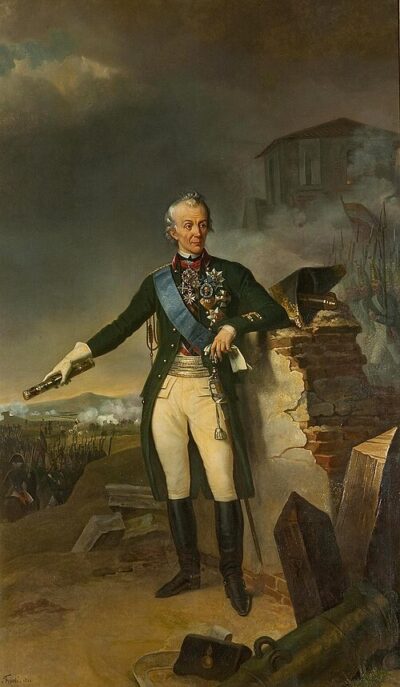
Alexander Suvorov
Alexander Suvorov was a Russian marshal. Born November 13, 1730, in Moscow. Died May 6, 1800, in Saint Petersburg. Educated at First Cadet Corps. Awards include Pour le Mérite, Order of Saint Anna and Order of Saint Alexander Nevsky.
Facts
43 facts · 0 confirmed by two sources · 13 cited · 28 from one source · 2 where the sources disagree
What’s different
- Born: we show November 13, 1730 (Sources disagree). Wikipedia says November 24, 1729
- Died: we show May 6, 1800 (Sources disagree). Wikipedia says May 18, 1800
Where this comes from
Papalocal keeps its own record. It started from these sources; what each one said is kept here as it was copied, so a change on their side never changes this page by itself. Tap one to read its version.
What Wikidata says · copied November 16, 2026 · revision 2568544149
- Described as
- Russian marshal (1730–1800)
- Other names
- Count Alexander Suvorov-Rymnikskij, Prince Italijskij, Alexander Vasilyevich Suvorov, Suwarrow, Suvoroff
- Born
- November 13, 1730 · 1 reference
- Died
- May 6, 1800 · 4 references
- Born in
- Moscow · 3 references
- Died in
- Saint Petersburg · 2 references
- Buried in
- Annunciation Church of the Alexander Nevsky Lavra
- Citizen of
- Russian Empire
- Occupation
- military personnel; military officer; military leader · 1 reference; soldier · 1 reference; military theorist · 1 reference; Generalfeldmarschall · 1 reference
- Education
- First Cadet Corps
- Awards
- Pour le Mérite; Order of Saint Anna (1770); Order of Saint Alexander Nevsky (1771); Order of St. George, 3rd class (1772); Order of St. George, 2nd class (1773); Gold Sword for Bravery (1775); Order of St. Vladimir, 1st class (1783); Order of St. Andrew (1787); Order of St. George, 1st class (1789); Order of the Black Eagle (1794); Order of the White Eagle (Polish–Lithuanian Commonwealth); Order of the Red Eagle (1794); Grand Cross of the Military Order of Maria Theresa (1799); Order of the Most Holy Annunciation (1799); Order of Saints Maurice and Lazarus (1799)
- Field
- military affairs · 1 reference; military strategy · 1 reference; military tactics · 1 reference; military education and training · 1 reference
- Spouse
- Varvara Ivanovna Prozorovskaya (1774–) · 1 reference
- Children
- Natalya Suvorova · 1 reference; Arkadi Suvorov
- Father
- Vasily Suvorov · 1 reference
- Mother
- Yevdokiya Manukova · 1 reference
- Military branch
- Imperial Russian Army; infantry · 1 reference; cavalry · 1 reference
- Military rank
- poruchik (1754–); second-major; prime major
- Wikipedias with a page
- 90
Wikidata item Q154232 (wikidata.org/wiki/Q154232), public domain (CC0). Copied November 16, 2026.
What Wikipedia says · copied November 16, 2026 · revision 1380269081
Count Alexander Vasilyevich Suvorov-Rymniksky, Prince of Italy (24 November [O.S. 13 November] 1729 or 1730 – 18 May [O.S. 6 May] 1800) was a Russian general and military theorist in the service of the Russian Empire.
Born in Moscow, he studied military history as a young boy and joined the Imperial Russian Army at the age of 17. Promoted to colonel in 1762 for his successes during the Seven Years' War, his victories during the War of the Bar Confederation included the capture of Kraków and victories at Orzechowo, Lanckorona, and Stołowicze. His reputation rose further when, in the Russo-Turkish War of 1768–1774, he captured Turtukaya twice and won a decisive victory at Kozludzha. After a period of little progress, he was promoted to general and led Russian forces in the Russo-Turkish War of 1787–1792, participating in the siege of Ochakov, as well as victories at Kinburn and Focșani.
Suvorov won a decisive victory at the Battle of Rymnik, and afterwards decisively defeated the Ottomans in the storming of Izmail. His victories at Focșani and Rymnik established him as the most brilliant general in Russia, if not in all of Europe. In 1794, he put down the Polish uprising, defeating them at the battle of Praga and elsewhere. After Catherine the Great died in 1796, her successor Paul I often quarrelled with Suvorov. After a period of ill-favour, Suvorov was recalled to a field marshal position at the outbreak of the French Revolutionary Wars. He was given command of the Austro-Russian army, and after a series of victories, such as the battle of the Trebbia, he captured Milan and Turin, and nearly erased all of Napoleon's Italian conquests of 1796–97. After an Austro-Russian army was defeated in Switzerland, Suvorov, ordered to reinforce them, was cut off by André Masséna and later surrounded in the Swiss Alps. Suvorov's successful extraction of the exhausted, ill-supplied, and heavily-outnumbered Russian army was rewarded by a promotion to generalissimo (Russian: генералиссимус, romanized: generalissimus). The most prominent battle was in the Muottental. According to one statement, Masséna himself would later confess that he would exchange all of his victories for Suvorov's passage of the Alps; as per another, Masséna said that he would never forgive him for the crossing accomplished by him in Switzerland. Suvorov died in 1800 of illness in Saint Petersburg. He was instrumental in expanding the Russian Empire, as his success ensured Russia's conquering of Kuban, Crimea, and New Russia.
He was one of the foremost generals in all of military history, and considered the greatest military commander in Russian history. Undefeated in major engagements, he has been described as the best general Republican France ever fought against, and noted as "one of those rare generals who were consistently successful despite suffering from considerable disadvantages and lack of support and resources." Suvorov was also admired by his soldiers throughout his whole military life, and was respected for his honest service and truthfulness.
- Born, in its opening lines
- November 24, 1729
- Died, in its opening lines
- May 18, 1800
From the Wikipedia article “Alexander Suvorov” (en.wikipedia.org/wiki/Alexander_Suvorov), by its contributors, under CC BY-SA 4.0 (creativecommons.org/licenses/by-sa/4.0/). Copied November 16, 2026; not changed.
Confirmed Two sources agree. Cited One source, and it names where it got it. One source One source, without a reference of its own. Sources disagree The sources disagree. We show the best-supported value and keep theirs below.
