
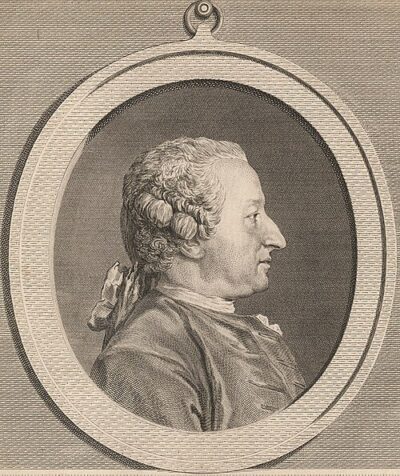
Alexis Clairaut
Alexis Clairaut was a French mathematician, astronomer, and geophysicist (*1713 – †1765). Born May 13, 1713, in Paris. Died May 17, 1765, in Paris. Known for theory of hydrostatic equilibrium, Théorie de la Lune and Recherches sur différents points importants du système du Monde. Awards include Fellow of the Royal Society.
Facts
28 facts · 2 confirmed by two sources · 15 cited · 11 from one source
Where this comes from
Papalocal keeps its own record. It started from these sources; what each one said is kept here as it was copied, so a change on their side never changes this page by itself. Tap one to read its version.
What Wikidata says · copied November 16, 2026 · revision 2569371798
- Described as
- French mathematician, astronomer, and geophysicist (*1713 – †1765)
- Other names
- Alexis Claude Clairaut
- Born
- May 13, 1713 · 2 references
- Died
- May 17, 1765 · 10 references
- Born in
- Paris · 2 references
- Died in
- Paris · 1 reference
- Buried in
- Saint-Nicholas-des-Champs, Paris (1765–1846) · 1 reference; Cimetière de l’Ouest (1846–1859) · 1 reference; Catacombs of Paris (1859–) · 1 reference
- Name at birth
- Alexis Claude Clairault · 1 reference
- Citizen of
- France
- Occupation
- astronomer; mathematician · 1 reference; physicist; geodesist · 1 reference
- Worked for
- French Academy of Sciences (1729–) · 2 references
- Member of
- Royal Society of London (1737–) · 1 reference; French Academy of Sciences (1738–) · 1 reference; Russian Academy of Sciences; Royal Prussian Academy of Sciences (1744–) · 1 reference
- Known for
- theory of hydrostatic equilibrium · 1 reference; Théorie de la Lune · 1 reference; Recherches sur différents points importants du système du Monde; symmetry of second derivatives; Clairaut's theorem
- Awards
- Fellow of the Royal Society (1737) · 1 reference
- Field
- mathematics; mechanics; astronomy; geodesy
- Wikipedias with a page
- 53
Wikidata item Q28937 (wikidata.org/wiki/Q28937), public domain (CC0). Copied November 16, 2026.
What Wikipedia says · copied November 16, 2026 · revision 1385107398
Alexis Claude Clairaut (; French: [alɛksi klod klɛʁo]; 13 May 1713 – 17 May 1765) was a French mathematician, astronomer, and physicist. He was a prominent Newtonian whose work helped to establish the validity of the principles and results that Sir Isaac Newton had outlined in the Principia of 1687. Clairaut was one of the key figures in the expedition to the Lapland that helped to confirm Newton's deduction of the figure of the Earth. In that context, Clairaut deduced what is now known as Clairaut's theorem. He also tackled the gravitational three-body problem, being the first to obtain a satisfactory result for the apsidal precession of the Moon's orbit. In mathematics he is also credited with Clairaut's theorem on mixed partial derivatives, Clairaut's equation, and Clairaut's relation in differential geometry.
- Born, in its opening lines
- May 13, 1713
- Died, in its opening lines
- May 17, 1765
From the Wikipedia article “Alexis Clairaut” (en.wikipedia.org/wiki/Alexis_Clairaut), by its contributors, under CC BY-SA 4.0 (creativecommons.org/licenses/by-sa/4.0/). Copied November 16, 2026; not changed.
Confirmed Two sources agree. Cited One source, and it names where it got it. One source One source, without a reference of its own. Sources disagree The sources disagree. We show the best-supported value and keep theirs below.
