
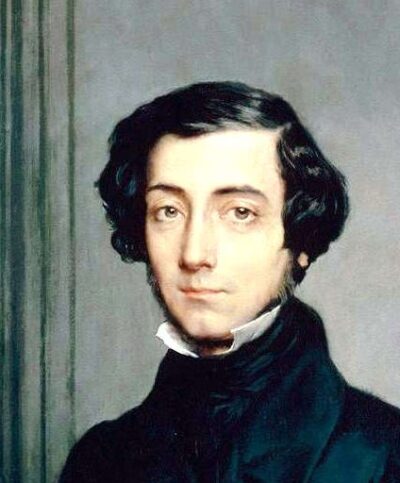
Alexis de Tocqueville
Alexis de Tocqueville was a French political thinker and historian, minister of Foreign Affairs. Born July 29, 1805, in Paris. Died April 16, 1859, in Cannes. Positions held include member of the National Assembly (1839–1848), president (1849–1852) and Minister of Foreign Affairs (1849). Known for Democracy in America and The Old Regime and the Revolution. Educated at University of Paris and Lycée Fabert. Awards include Knight of the Legion of Honour and Montyon Prize.
Facts
37 facts · 2 confirmed by two sources · 14 cited · 21 from one source
Where this comes from
Papalocal keeps its own record. It started from these sources; what each one said is kept here as it was copied, so a change on their side never changes this page by itself. Tap one to read its version.
What Wikidata says · copied November 16, 2026 · revision 2569371919
- Described as
- French political thinker and historian, minister of Foreign Affairs (1805-1859)
- Other names
- Tocqueville, Alexis-Charles-Henri Clerel de Tocqueville, Alexis Clérel de Tocqueville, Alexis-Charles-Henri Clérel de Tocqueville
- Born
- July 29, 1805 · 15 references
- Died
- April 16, 1859 · 16 references
- Born in
- Paris · 2 references
- Died in
- Cannes · 2 references
- Cause of death
- tuberculosis
- Name at birth
- Alexis-Charles-Henri Clérel de Tocqueville
- Citizen of
- France · 1 reference
- Occupation
- philosopher; politician · 1 reference; writer · 2 references; sociologist; jurist · 1 reference; historian · 1 reference; count · 1 reference; opinion journalist · 1 reference
- Positions held
- member of the National Assembly (1839–1848) · 1 reference; president (1849–1852); Minister of Foreign Affairs (1849); Member of the Académie française (1841–1859) · 1 reference; Member of the 1848 Constituent Assembly (1848–1849) · 1 reference; Deputy of the French Second Republic (1849–1851) · 1 reference
- Education
- University of Paris · 1 reference; Lycée Fabert
- Member of
- Académie Française (1841–1859) · 1 reference; Académie des Sciences Morales et Politiques (1838–); Académie des sciences, arts et belles-lettres de Caen
- Known for
- Democracy in America; The Old Regime and the Revolution
- Awards
- Knight of the Legion of Honour; Montyon Prize (1835)
- Spouse
- Mary Mottley Tocqueville · 1 reference
- Father
- Hervé Clérel de Tocqueville
- Mother
- Louise Le Peletier de Rosanbo
- Siblings
- Hippolyte Clérel de Tocqueville; Édouard de Tocqueville
- Religion
- Catholicism
- Lived in
- Château de Tocqueville
- Wikipedias with a page
- 116
Wikidata item Q140694 (wikidata.org/wiki/Q140694), public domain (CC0). Copied November 16, 2026.
What Wikipedia says · copied November 16, 2026 · revision 1379425709
Alexis Charles Henri Clérel, comte de Tocqueville (29 July 1805 – 16 April 1859), was a French diplomat, political philosopher and historian. He is best known for his works Democracy in America (appearing in two volumes, 1835 and 1840) and The Old Regime and the Revolution (1856). In these, and in reflections on his travels in England and Ireland, he analyzed the living standards and social conditions of individuals as well as their relationship to the market and state in Western societies. Democracy in America was published after Tocqueville's travels in the United States and is today considered an early work of sociology and political science.
Tocqueville was active in French politics, first under the July Monarchy (1830–1848), during which he was considered the parliament's foremost expert on the French colonial project in Algeria, and then, following the 1848 Revolution, in the Second Republic (1849–1851). He retired from political life after Louis Napoléon Bonaparte's 2 December 1851 coup and thereafter began work on The Old Regime and the Revolution. Tocqueville argued the importance of the French Revolution was to continue the process of modernizing and centralizing the French state which had begun under King Louis XIV. He believed the failure of the Revolution came from the inexperience of the deputies who were too wedded to abstract Enlightenment ideals.
Tocqueville was a classical liberal who advocated parliamentary government and was sceptical of the extremes of majoritarianism. During his time in parliament, he was first a member of the centre-left before moving to the centre-right, and the complex and restless nature of his liberalism has led to contrasting interpretations and admirers across the political spectrum. For example, Democracy in America was interpreted differently across national contexts. In France and the United States, Tocqueville's work was seen as liberal, whereas both progressives and conservatives in the British Isles interpreted his work as supporting their own positions.
- Born, in its opening lines
- July 29, 1805
- Died, in its opening lines
- April 16, 1859
From the Wikipedia article “Alexis de Tocqueville” (en.wikipedia.org/wiki/Alexis_de_Tocqueville), by its contributors, under CC BY-SA 4.0 (creativecommons.org/licenses/by-sa/4.0/). Copied November 16, 2026; not changed.
Confirmed Two sources agree. Cited One source, and it names where it got it. One source One source, without a reference of its own. Sources disagree The sources disagree. We show the best-supported value and keep theirs below.
