
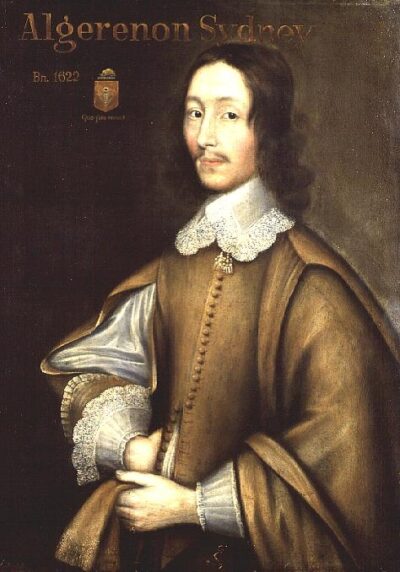
Algernon Sidney
Algernon Sidney was a British politician and political theorist. Born January 15, 1623, in Baynard's Castle. Died December 7, 1683, in Tower Hill. Positions held include Member of Parliament in the Parliament of England, Member of the 1642-48 Parliament and Member of the 1648-53 Parliament.
Facts
20 facts · 2 confirmed by two sources · 9 cited · 9 from one source
Where this comes from
Papalocal keeps its own record. It started from these sources; what each one said is kept here as it was copied, so a change on their side never changes this page by itself. Tap one to read its version.
What Wikidata says · copied November 17, 2026 · revision 2568776385
- Described as
- British politician and political theorist (1623-1683)
- Other names
- Algernon Sydney, Hon. Algernon Sidney
- Born
- January 15, 1623
- Died
- December 7, 1683 · 4 references
- Born in
- Baynard's Castle
- Died in
- Tower Hill · 1 reference
- Cause of death
- decapitation · 1 reference
- Citizen of
- Kingdom of England · 3 references
- Occupation
- diplomat · 2 references; politician · 2 references; writer · 2 references
- Positions held
- Member of Parliament in the Parliament of England · 2 references; Member of the 1642-48 Parliament; Member of the 1648-53 Parliament; Lord Warden of the Cinque Ports (1648–1651)
- Political party
- Republican Party
- Father
- Robert Sidney, 2nd Earl of Leicester · 2 references
- Mother
- Dorothy Sidney, Countess of Leicester · 2 references
- Siblings
- Dorothy Spencer, Countess of Sunderland · 1 reference; Philip Sidney, 3rd Earl of Leicester · 1 reference; Henry Sydney, 1st Earl of Romney · 1 reference; Lady Lucy Sydney · 1 reference
- Wikipedias with a page
- 28
Wikidata item Q1034181 (wikidata.org/wiki/Q1034181), public domain (CC0). Copied November 17, 2026.
What Wikipedia says · copied November 17, 2026 · revision 1378530493
Algernon Sidney or Sydney (15 January 1623 – 7 December 1683) was an English military officer, politician, and republican political theorist. A member of the middle part of the Long Parliament and commissioner of the trial of King Charles I of England, he opposed the king's execution. Sidney was later charged with plotting against Charles II, in part based on his most famous work, Discourses Concerning Government, which was used by the prosecution as a witness at his trial. He was executed for treason. After his death, Sidney was revered as a "Whig patriot—hero and martyr".
The works of Algernon Sidney, along with those of contemporary John Locke, are considered as cornerstones of western thought. James Madison and Thomas Jefferson stated that Locke's Second Treatise on Government and Sidney's Discourses Concerning Government contained the "general principles of liberty and rights of man in nature and society". While Discourses Concerning Government cost Sidney his life, the ideas which it put forth survived and ultimately culminated in the Glorious Revolution in England and the founding of the United States. Sidney directly opposed the theory of divine right of kings by suggesting ideas such as limited government, voluntary consent of the people and the right of citizens to alter or abolish a corrupt government. Discourses Concerning Government has been called "the textbook of the American revolution."
- Born, in its opening lines
- January 15, 1623
- Died, in its opening lines
- December 7, 1683
From the Wikipedia article “Algernon Sidney” (en.wikipedia.org/wiki/Algernon_Sidney), by its contributors, under CC BY-SA 4.0 (creativecommons.org/licenses/by-sa/4.0/). Copied November 17, 2026; not changed.
Confirmed Two sources agree. Cited One source, and it names where it got it. One source One source, without a reference of its own. Sources disagree The sources disagree. We show the best-supported value and keep theirs below.
