
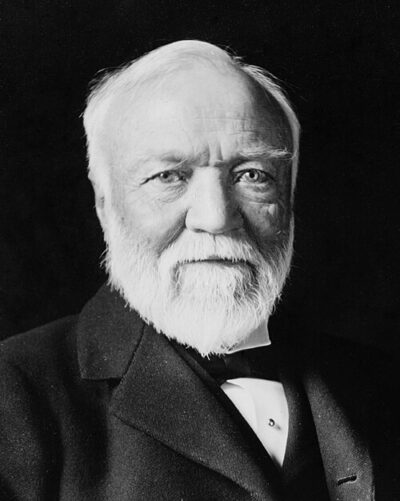
Andrew Carnegie
Andrew Carnegie was a Scottish-American industrialist and philanthropist. Born November 25, 1835, in Dunfermline. Died August 11, 1919, in Lenox. Positions held include rector (1911–1914). Known for The Gospel of Wealth. Awards include Library Hall of Fame, Bessemer Gold Medal and Honorary Doctorate from the National Autonomous University of Mexico.

Facts
31 facts · 2 confirmed by two sources · 7 cited · 22 from one source
Where this comes from
Papalocal keeps its own record. It started from these sources; what each one said is kept here as it was copied, so a change on their side never changes this page by itself. Tap one to read its version.
What Wikidata says · copied November 13, 2026 · revision 2565597660
- Described as
- Scottish-American industrialist and philanthropist (1835–1919)
- Other names
- A. Carnegie, Endriu Karnegi, Andrew Carnegie (1835-1919)
- Born
- November 25, 1835 · 11 references
- Died
- August 11, 1919 · 11 references
- Born in
- Dunfermline · 1 reference
- Died in
- Lenox
- Buried in
- Sleepy Hollow Cemetery · 1 reference
- Cause of death
- bronchopneumonia
- Citizen of
- United States; United Kingdom of Great Britain and Ireland
- Occupation
- philanthropist; business magnate; economist; industrialist; merchant; entrepreneur · 1 reference; writer · 1 reference; factory owner · 1 reference
- Positions held
- rector (1911–1914)
- Political party
- Republican Party · 1 reference
- Member of
- American Philosophical Society (1902–) · 1 reference
- Known for
- The Gospel of Wealth
- Awards
- Library Hall of Fame; Bessemer Gold Medal; Honorary Doctorate from the National Autonomous University of Mexico (1910); American Library Association Honorary Membership (1899) · 2 references
- Spouse
- Louise Whitfield Carnegie
- Children
- Margaret Carnegie Miller
- Father
- William Carnegie
- Mother
- Margaret Morrison Carnegie
- Siblings
- Thomas M. Carnegie
- Religion
- Presbyterianism
- Lived in
- Andrew Carnegie Mansion · 1 reference
- Wikipedias with a page
- 114
Wikidata item Q484265 (wikidata.org/wiki/Q484265), public domain (CC0). Copied November 13, 2026.
What Wikipedia says · copied November 13, 2026 · revision 1380626842
Andrew Carnegie (November 25, 1835 – August 11, 1919) was a Scottish-American industrialist and philanthropist. Carnegie led the expansion of the American steel industry in the late-19th century and became one of the richest Americans in history.
He became a leading philanthropist in the United States, Great Britain, and the British Empire. During the last 18 years of his life, he gave away around $350 million (equivalent to $6.9 billion in 2025 dollars), almost 90 percent of his fortune, to charities, foundations and universities. His 1889 article proclaiming "The Gospel of Wealth" called on the rich to use their wealth to improve society, expressed support for progressive taxation and an estate tax, and stimulated a wave of philanthropy.
Carnegie was born in Dunfermline, Scotland. He immigrated to what is now Pittsburgh, Pennsylvania, with his parents in 1848 at the age of 12. Carnegie started work in a cotton mill and later worked as a telegrapher. By the 1860s, he had investments in railroads, railroad sleeping cars, bridges, and oil derricks. He accumulated further wealth as a bond salesman, raising money for American enterprise in Europe. He built Pittsburgh's Carnegie Steel Company, which he sold to J. P. Morgan in 1901 for $303,450,000; it formed the basis of the U.S. Steel Corporation. After selling Carnegie Steel, he surpassed John D. Rockefeller as the richest American of the time.
Carnegie devoted the remainder of his life to large-scale philanthropy, with special emphasis on building local libraries, working for world peace, education, and scientific research. He funded Carnegie Hall in New York City, the Peace Palace in The Hague, founded the Carnegie Corporation of New York, Carnegie Endowment for International Peace, Carnegie Institution for Science, Carnegie Trust for the Universities of Scotland, Carnegie Hero Fund, Carnegie Mellon University, and the Carnegie Museums of Pittsburgh, among others.
- Born, in its opening lines
- November 25, 1835
- Died, in its opening lines
- August 11, 1919
From the Wikipedia article “Andrew Carnegie” (en.wikipedia.org/wiki/Andrew_Carnegie), by its contributors, under CC BY-SA 4.0 (creativecommons.org/licenses/by-sa/4.0/). Copied November 13, 2026; not changed.
Confirmed Two sources agree. Cited One source, and it names where it got it. One source One source, without a reference of its own. Sources disagree The sources disagree. We show the best-supported value and keep theirs below.
