
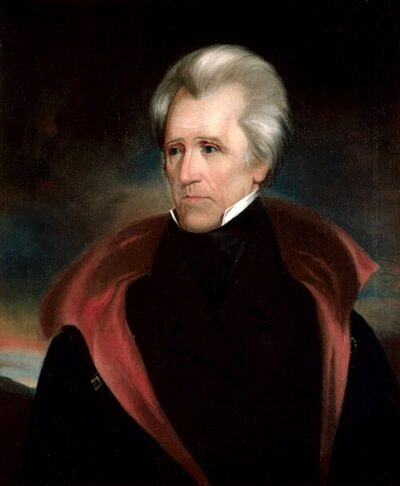
Andrew Jackson
Andrew Jackson was a president of the United States from 1829 to 1837. Born March 15, 1767, in Waxhaws. Died June 8, 1845, in The Hermitage. Positions held include President of the United States (1829–1837), United States representative (1796–1797) and Grand Master (1822–1823). Awards include Congressional Gold Medal.
Facts
31 facts · 2 confirmed by two sources · 6 cited · 23 from one source
Where this comes from
Papalocal keeps its own record. It started from these sources; what each one said is kept here as it was copied, so a change on their side never changes this page by itself. Tap one to read its version.
What Wikidata says · copied November 13, 2026 · revision 2567583312
- Described as
- president of the United States from 1829 to 1837
- Other names
- Old Hickory, A. Jackson
- Born
- March 15, 1767 · 12 references
- Died
- June 8, 1845 · 11 references
- Born in
- Waxhaws
- Died in
- The Hermitage
- Buried in
- The Hermitage
- Cause of death
- heart failure
- Citizen of
- United States · 1 reference
- Occupation
- judge; lawyer; politician · 2 references; army officer; statesperson; governor · 1 reference
- Positions held
- President of the United States (1829–1837); United States representative (1796–1797); Grand Master (1822–1823); United States senator (2 times) (1797–1825) · 1 reference; President-elect of the United States (1828–1829)
- Political party
- Democratic Party
- Member of
- American Antiquarian Society
- Awards
- Congressional Gold Medal
- Spouse
- Rachel Jackson (1791–) · 3 references
- Children
- Andrew Jackson Jr.; Lyncoya Jackson
- Father
- Andrew Jackson
- Mother
- Elizabeth Hutchinson · 1 reference
- Religion
- Presbyterianism
- Military branch
- United States Army
- Military rank
- general
- Nickname
- Old Hickory
- Height
- 1.85 m (6 ft 1 in) · 1 reference
- Wikipedias with a page
- 165
Wikidata item Q11817 (wikidata.org/wiki/Q11817), public domain (CC0). Copied November 13, 2026.
What Wikipedia says · copied November 13, 2026 · revision 1383006019
Andrew Jackson (March 15, 1767 – June 8, 1845) was the seventh president of the United States from 1829 to 1837. He rose to fame as a U.S. Army general and served in both houses of the U.S. Congress. His political philosophy, which dominated his presidency, became the basis for the rise of Jacksonian democracy. His legacy is controversial: being praised as an advocate for white working Americans and preserving the union of states, and criticized for his racist policies, particularly towards Native Americans.
Born in the colonial Carolinas before the American Revolutionary War, Jackson became a frontier lawyer, married Rachel Donelson, and briefly represented Tennessee in both the U.S. House of Representatives and U.S. Senate. After resigning, he served as a Tennessee Superior Court justice from 1798 to 1804. He founded The Hermitage and became a wealthy planter who profited from the forced labor of hundreds of enslaved African Americans. As commander of the Tennessee militia, he led troops in the Creek War of 1813–1814, winning the Battle of Horseshoe Bend and negotiating the Treaty of Fort Jackson, which forced the indigenous Creek to cede vast tracts of the present day states of Alabama and Georgia. In the concurrent war against the British, Jackson's victory at the Battle of New Orleans in 1815 made him a national hero. He later commanded United States forces during the First Seminole War; his campaign was one of the factors that prompted Spain to negotiate the cession of Florida to the United States.
Jackson briefly served as Florida's first territorial governor before returning to the Senate. He ran for president in 1824, winning a plurality of the popular and electoral vote. Because no candidate secured the electoral majority, the House of Representatives elected John Quincy Adams with the support of Henry Clay, who later joined Adams's cabinet. Jackson's supporters, who alleged that Adams and Clay had formed a "corrupt bargain", created a new political coalition that would become the Democratic Party.
Jackson ran again in 1828, defeating Adams in a landslide victory despite issues such as his slave trading and "irregular" marriage. In 1830, he signed the Indian Removal Act. This act, which has been described as ethnic cleansing, displaced tens of thousands of Native Americans from their ancestral homelands east of the Mississippi River. It resulted in thousands of deaths in what has become known as the Trail of Tears. Jackson faced a challenge to the integrity of the federal union when South Carolina threatened to nullify a high protective tariff set by the federal government. He threatened the use of military force to enforce the tariff, but the crisis was defused when it was amended. In 1832, he vetoed a bill by Congress to reauthorize the Second Bank of the United States, viewing the Bank as a branch of government run by the elite. After a lengthy struggle, the Bank was dismantled. In 1835, Jackson became the only U.S. president to pay off the national debt. After leaving office, he supported the presidencies of Martin Van Buren and James K. Polk, as well as the annexation of Texas.
Opinions about Jackson are often polarized. Supporters characterize him as a defender of democracy and the U.S. Constitution, while critics point to his reputation as a demagogue who ignored the law when it suited him. Scholarly rankings of U.S. presidents historically placed Jackson high in the ranking of presidents. In recent decades, his reputation has declined and his ranking has fallen.
- Born, in its opening lines
- March 15, 1767
- Died, in its opening lines
- June 8, 1845
From the Wikipedia article “Andrew Jackson” (en.wikipedia.org/wiki/Andrew_Jackson), by its contributors, under CC BY-SA 4.0 (creativecommons.org/licenses/by-sa/4.0/). Copied November 13, 2026; not changed.
Confirmed Two sources agree. Cited One source, and it names where it got it. One source One source, without a reference of its own. Sources disagree The sources disagree. We show the best-supported value and keep theirs below.
