
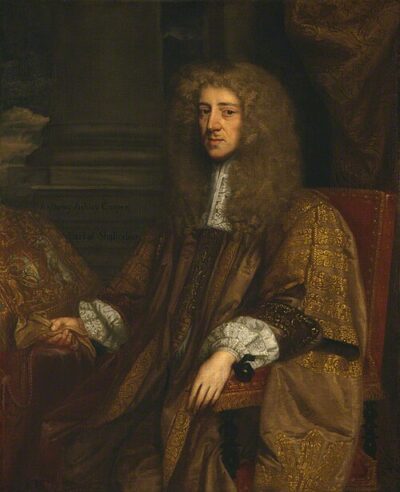
Anthony Ashley Cooper, 1st Earl of Shaftesbury
Anthony Ashley Cooper, 1st Earl of Shaftesbury was an English politician and founder of the Whig party. Born July 22, 1621, in Wimborne Minster. Died January 21, 1683, in Amsterdam. Positions held include Member of Parliament in the Parliament of England, President of the Board of Trade (1672–1676) and Chancellor of the Exchequer (1661–1672). Educated at Exeter College. Awards include Fellow of the Royal Society.
Facts
37 facts · 2 confirmed by two sources · 12 cited · 23 from one source
Where this comes from
Papalocal keeps its own record. It started from these sources; what each one said is kept here as it was copied, so a change on their side never changes this page by itself. Tap one to read its version.
What Wikidata says · copied November 17, 2026 · revision 2567379679
- Described as
- English politician and founder of the Whig party (1621-1683)
- Other names
- Anthony Ashley Cooper, Anthony Cooper, 1st Earl of Shaftesbury, Anthony Ashley Cooper, Earl of Shaftesbury, Achitophel
- Born
- July 22, 1621 · 3 references
- Died
- January 21, 1683 · 2 references
- Born in
- Wimborne Minster · 1 reference
- Died in
- Amsterdam · 1 reference
- Buried in
- Church of St Giles, Wimborne St Giles
- Name at birth
- Anthony Ashley Cooper
- Citizen of
- Kingdom of England
- Occupation
- politician · 1 reference; judge; writer · 1 reference; jurist · 1 reference
- Positions held
- Member of Parliament in the Parliament of England · 1 reference; President of the Board of Trade (1672–1676); Chancellor of the Exchequer (1661–1672); Member of the April 1640 Parliament · 1 reference; Member of the Third Protectorate Parliament; Member of the Second Protectorate Parliament; Member of the First Protectorate Parliament; Member of the 1653 Parliament; Member of the April 1660 Parliament; Lord President of the Council (1679) · 1 reference; Lord Chancellor (1672–1673) · 1 reference; Lord Lieutenant of Dorset (1672–1674); Governor of the Charterhouse (1662–)
- Political party
- Whigs
- Education
- Exeter College
- Member of
- Royal Society of London (1663–); Short Parliament
- Awards
- Fellow of the Royal Society
- Spouse
- Margaret Spencer (1655–) · 2 references; Margaret Coventry (1639–) · 2 references; Lady Frances Cecil (1650–) · 2 references
- Children
- Anthony Ashley-Cooper, 2nd Earl of Shaftesbury · 1 reference; Cecil Ashley-Cooper · 1 reference
- Father
- Sir John Cooper, 1st Baronet
- Mother
- Anne Ashley · 1 reference
- Siblings
- George Cooper
- Wikipedias with a page
- 27
Wikidata item Q336002 (wikidata.org/wiki/Q336002), public domain (CC0). Copied November 17, 2026.
What Wikipedia says · copied November 17, 2026 · revision 1380720251
Anthony Ashley-Cooper, 1st Earl of Shaftesbury (22 July 1621 – 21 January 1683), was an English statesman. He held senior political office under both the Commonwealth of England and Charles II, serving as Chancellor of the Exchequer from 1661 to 1672 and Lord Chancellor from 1672 to 1673. During the Exclusion Crisis (1679–1681), Ashley-Cooper headed the movement to bar the Catholic heir, James II, from the royal succession, which is often seen as the origin of the Whig party. He was the first patron of John Locke, who, when they met was a quiet Oxford don and practising physician; as part of Ashley-Cooper's household and retinue for 15 years, Locke became a major political philosopher.
During the Wars of the Three Kingdoms, Ashley-Cooper initially supported the Royalists, before joining the Parliamentarians in 1644. He served on the English Council of State under the English Commonwealth, although he opposed Oliver Cromwell's attempt to rule without Parliament during the Rule of the Major-Generals (1655–1657). He backed the Stuart Restoration in May 1660, and was raised to the peerage of England as Lord Ashley by Charles II.
Ashley-Cooper was a notable financier of the African slave trade, investing in both the Company of Royal Adventurers and the Royal African Company, and serving as the Company's Sub-Governor for its first two years. He was an investor for 14 years and across 120 slave crossings. He was also instrumental in enshrining slavery into the North American Fundamental Constitutions of Carolina.
After the political fall in 1667 of Edward Hyde, 1st Earl of Clarendon, Lord Ashley became one of five members of the so-called Cabal ministry and was created Earl of Shaftesbury in 1672. In 1673, it became widely known that Charles's brother and heir James had secretly converted to Catholicism. As with many English Protestants of the period, Ashley-Cooper saw Catholicism as closely linked to "arbitrary government", and thus the prospect of a Catholic monarch as a threat to the rule of Parliament.
His sponsorship of the Exclusion Bill in 1679 led to two years of political struggle, but ultimately ended in defeat. During the subsequent Tory reaction in 1681, Ashley-Cooper was arrested for high treason, a prosecution dropped several months later. Fearing re-arrest and execution, which was the fate of other opponents of the King, in 1682 he went into exile in Amsterdam, where he died in January 1683.
- Born, in its opening lines
- July 22, 1621
- Died, in its opening lines
- January 21, 1683
From the Wikipedia article “Anthony Ashley Cooper, 1st Earl of Shaftesbury” (en.wikipedia.org/wiki/Anthony_Ashley_Cooper,_1st_Earl_of_Shaftesbury), by its contributors, under CC BY-SA 4.0 (creativecommons.org/licenses/by-sa/4.0/). Copied November 17, 2026; not changed.
Confirmed Two sources agree. Cited One source, and it names where it got it. One source One source, without a reference of its own. Sources disagree The sources disagree. We show the best-supported value and keep theirs below.
