
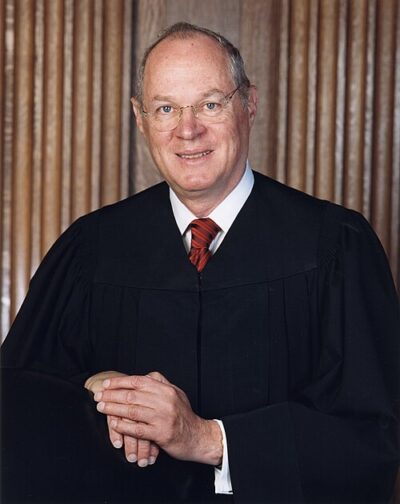
Anthony Kennedy
Anthony Kennedy is an Associate Justice of the Supreme Court of the United States from 1988 to 2018. Born July 23, 1936, in Sacramento. Positions held include Associate Justice of the Supreme Court of the United States (1988–2018) and Judge of the United States Court of Appeals for the Ninth Circuit (1975–1988). Educated at Stanford University and London School of Economics and Political Science. Awards include Great Golden Medal of Honour for Services to the Republic of Austria and Golden Plate Award.
Facts
21 facts · 1 confirmed by two sources · 3 cited · 17 from one source
Where this comes from
Papalocal keeps its own record. It started from these sources; what each one said is kept here as it was copied, so a change on their side never changes this page by itself. Tap one to read its version.
What Wikipedia says · copied November 13, 2026 · revision 1383140498
Anthony McLeod Kennedy (born July 23, 1936) is an American lawyer who served as an associate justice of the Supreme Court of the United States from 1988 until his retirement in 2018. He was nominated to the court in 1987 by President Ronald Reagan, and after being unanimously confirmed by the U.S. Senate was sworn in on February 18, 1988. After the retirement of Sandra Day O'Connor in 2006, he was considered the swing vote on many of the Roberts Court's 5–4 decisions.
Born in Sacramento, California, Kennedy took over his father's legal practice in Sacramento after graduating from Stanford University and Harvard Law School. Kennedy became a U.S. federal judge in 1975 when President Gerald Ford appointed him to the United States Court of Appeals for the Ninth Circuit. In November 1987, after two failed attempts at nominating a successor to Associate Justice Lewis F. Powell Jr., President Reagan nominated Kennedy to the Supreme Court. Kennedy won unanimous confirmation from the United States Senate in February 1988. Following the death of Antonin Scalia in February 2016, Kennedy became the senior associate justice of the court. Kennedy retired during Donald Trump's first term and was succeeded by his former law clerk, Brett Kavanaugh. Following O'Connor's death in 2023, Kennedy is the oldest living former Supreme Court justice.
Kennedy authored the majority opinion in several important cases—including Boumediene v. Bush, Citizens United v. FEC, and four major gay rights cases: Romer v. Evans, Lawrence v. Texas, United States v. Windsor, and Obergefell v. Hodges. He also co-authored the controlling opinion in Planned Parenthood v. Casey along with Justices Sandra Day O’Connor and David Souter.
- Born, in its opening lines
- July 23, 1936
From the Wikipedia article “Anthony Kennedy” (en.wikipedia.org/wiki/Anthony_Kennedy), by its contributors, under CC BY-SA 4.0 (creativecommons.org/licenses/by-sa/4.0/). Copied November 13, 2026; not changed.
What Wikidata says · copied November 14, 2026 · revision 2569081353
- Described as
- Associate Justice of the Supreme Court of the United States from 1988 to 2018
- Other names
- Anthony McLeod Kennedy, Anthony M. Kennedy, Justice Anthony Kennedy
- Born
- July 23, 1936 · 4 references
- Born in
- Sacramento · 1 reference
- Citizen of
- United States
- Occupation
- jurist · 1 reference; judge; lawyer; university teacher; politician
- Positions held
- Associate Justice of the Supreme Court of the United States (1988–2018) · 1 reference; Judge of the United States Court of Appeals for the Ninth Circuit (1975–1988)
- Political party
- Republican Party
- Worked for
- University of the Pacific
- Education
- Stanford University; London School of Economics and Political Science; Harvard Law School; C. K. McClatchy High School · 1 reference
- Awards
- Great Golden Medal of Honour for Services to the Republic of Austria; Golden Plate Award
- Children
- Justin Kennedy; Gregory Kennedy
- Religion
- Catholic Church
- Wikipedias with a page
- 42
Wikidata item Q11171 (wikidata.org/wiki/Q11171), public domain (CC0). Copied November 14, 2026.
Confirmed Two sources agree. Cited One source, and it names where it got it. One source One source, without a reference of its own. Sources disagree The sources disagree. We show the best-supported value and keep theirs below.
