
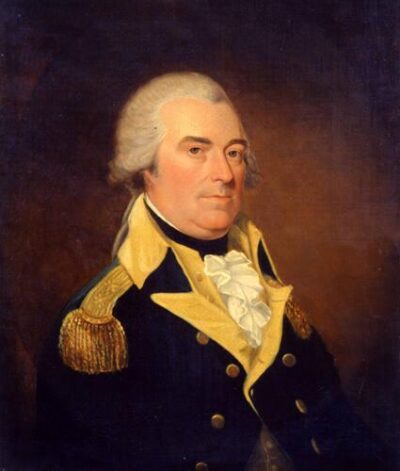
Anthony Wayne
Anthony Wayne was a Continental Army general. Born January 1, 1745, in Chester County. Died December 15, 1796, in Erie. Positions held include United States representative (1791–1792) and member of the Pennsylvania House of Representatives. Educated at University of Pennsylvania. Awards include Congressional Gold Medal.
Facts
26 facts · 2 confirmed by two sources · 2 cited · 22 from one source
Where this comes from
Papalocal keeps its own record. It started from these sources; what each one said is kept here as it was copied, so a change on their side never changes this page by itself. Tap one to read its version.
What Wikidata says · copied November 15, 2026 · revision 2538292481
- Described as
- Continental Army general (1745-1796)
- Born
- January 1, 1745 · 2 references
- Died
- December 15, 1796 · 2 references
- Born in
- Chester County
- Died in
- Erie
- Buried in
- St. David's Episcopal Church · 1 reference
- Citizen of
- Kingdom of Great Britain; United States
- Occupation
- politician · 1 reference; military officer; soldier · 1 reference
- Positions held
- United States representative (1791–1792); member of the Pennsylvania House of Representatives
- Political party
- Anti-Administration Party
- Education
- University of Pennsylvania
- Member of
- American Philosophical Society (1780–)
- Awards
- Congressional Gold Medal
- Spouse
- Mary Wayne
- Children
- Isaac Wayne
- Father
- Isaac Wayne
- Military branch
- Continental Army; United States Army; army · 1 reference
- Military rank
- colonel; brigadier general · 1 reference; major general · 1 reference
- Lived in
- Richmond Oak Grove Plantation
- Wikipedias with a page
- 24
Wikidata item Q574116 (wikidata.org/wiki/Q574116), public domain (CC0). Copied November 15, 2026.
What Wikipedia says · copied November 15, 2026 · revision 1383922614
Anthony Wayne (January 1, 1745 – December 15, 1796) was an American soldier, officer, statesman, and a Founding Father of the United States. He adopted a military career at the outset of the American Revolutionary War, where his military exploits and fiery personality quickly earned him a promotion to brigadier general and the nickname "Mad Anthony". He later served as the Senior Officer of the Army on the Ohio Country frontier and led the Legion of the United States.
Wayne was born in Chester County, Pennsylvania, and worked as a tanner and surveyor after attending the College of Philadelphia. He was elected to the Pennsylvania General Assembly and helped raise a Pennsylvania militia unit in 1775. During the Revolutionary War, he served in the Invasion of Quebec, the Philadelphia campaign, and the Yorktown campaign. Although his reputation suffered after his defeat in the 1777 Battle of Paoli, he won wide praise for his leadership in the 1779 Battle of Stony Point and was awarded the Congressional Gold Medal. Soon after being promoted to major general in 1783, he retired from the Continental Army. Anthony Wayne was a member of the Society of the Cincinnati of the state of Georgia. In 1780, he was elected to the American Philosophical Society.
After the war, Wayne held a brief career in congress and private business. Following St. Clair's defeat, Wayne was recalled by President Washington from civilian life to command of U.S. forces in the Northwest Indian War, where he defeated the Northwestern Confederacy, an alliance of several American Indian tribes. Leading up to the war, Wayne oversaw a major change and reorganization of the entire United States Army. Following the 1794 Battle of Fallen Timbers, he later negotiated the Treaty of Greenville which ended the war and the tribes’ alliance with the British Empire. In the 21st century, Wayne's legacy has become controversial due to his ownership of slaves and his participation in the ethnic cleansing of Native Americans during the Northwest Indian War.
- Born, in its opening lines
- January 1, 1745
- Died, in its opening lines
- December 15, 1796
From the Wikipedia article “Anthony Wayne” (en.wikipedia.org/wiki/Anthony_Wayne), by its contributors, under CC BY-SA 4.0 (creativecommons.org/licenses/by-sa/4.0/). Copied November 15, 2026; not changed.
Confirmed Two sources agree. Cited One source, and it names where it got it. One source One source, without a reference of its own. Sources disagree The sources disagree. We show the best-supported value and keep theirs below.
