
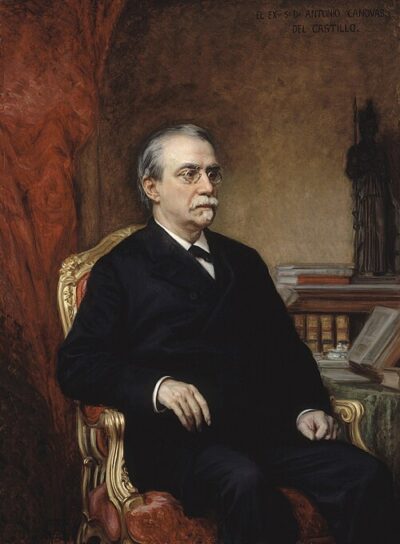
Antonio Cánovas del Castillo
Antonio Cánovas del Castillo was a Spanish politician and Bourbon Restoration architect. Born February 8, 1828, in Málaga. Died August 8, 1897, in Arrasate/Mondragón. Positions held include President of the Council of Ministers (4 times) (1875–1897), overseas minister (2 times) (1865–1878) and ministro de Gobernación (2 times) (1864–1880). Awards include Knight of the Order of St. Gregory the Great and Knight of the Order of the Golden Fleece.
Facts
42 facts · 2 confirmed by two sources · 16 cited · 24 from one source
Where this comes from
Papalocal keeps its own record. It started from these sources; what each one said is kept here as it was copied, so a change on their side never changes this page by itself. Tap one to read its version.
What Wikidata says · copied November 16, 2026 · revision 2567354079
- Described as
- Spanish politician and Bourbon Restoration architect (1828–1897)
- Other names
- Antonio Canovas del Castillo
- Born
- February 8, 1828 · 8 references
- Died
- August 8, 1897 · 7 references
- Born in
- Málaga · 1 reference
- Died in
- Arrasate/Mondragón · 2 references
- Buried in
- Pantheon of Illustrious Men
- Citizen of
- Spain
- Occupation
- politician · 1 reference; historian · 1 reference; diplomat; writer · 1 reference
- Positions held
- President of the Council of Ministers (4 times) (1875–1897) · 1 reference; overseas minister (2 times) (1865–1878) · 2 references; ministro de Gobernación (2 times) (1864–1880) · 1 reference; President of the Congress of Deputies (1885–1886) · 1 reference; member of the Cortes during the reign of Isabel II (2 times) (1854–1868) · 1 reference; Member of the Congress during Sexenio Democrático (1869–1872) · 1 reference; member of the Congress of Deputies (1876–1897) · 1 reference; Minister of the Spanish Navy (2 times) (1875–1891) · 2 references; Minister of State of Spain (1880) · 2 references; Minister of the Treasury of Spain (2 times) (1866–1876) · 2 references; ministro de la Guerra (1875–1876) · 1 reference; Minister of Grace and Justice (1875) · 2 references; president (1879–1881) · 1 reference; Académico de la Real Academia de Bellas Artes de San Fernando (1887–1897) · 1 reference; Director de la Real Academia de la Historia (1882–1897) · 1 reference
- Political party
- Liberal-Conservative Party; Liberal Union
- Member of
- Royal Academy of Moral and Political Sciences · 1 reference; Royal Spanish Academy; Royal Academy of History; Royal Academy of Jurisprudence and Legislation
- Awards
- Knight of the Order of St. Gregory the Great; Knight of the Order of the Golden Fleece (1875) · 1 reference
- Spouse
- María de la Concepción Espinosa de los Monteros (1860–1863); Joaquina de Osma y Zavala (1887–1897)
- Father
- Antonio Cánovas García
- Mother
- Juana del Castillo
- Siblings
- José Cánovas del Castillo; Máximo Cánovas del Castillo; Emilio Cánovas del Castillo
- Religion
- Catholicism
- Lived in
- Madrid
- Wikipedias with a page
- 41
Wikidata item Q336901 (wikidata.org/wiki/Q336901), public domain (CC0). Copied November 16, 2026.
What Wikipedia says · copied November 16, 2026 · revision 1383645583
Antonio Cánovas del Castillo (8 February 1828 – 8 August 1897) was a Spanish politician and historian known principally for serving six terms as prime minister and his overarching role as "architect" of the regime that ensued with the 1874 restoration of the Bourbon monarchy. He was assassinated by Italian anarchist Michele Angiolillo.
As leader of the Liberal-Conservative Party—also known more simply as the Conservative Party—the name of Cánovas became symbolic of the alternate succession in the Restoration regime along with Práxedes Mateo Sagasta's.
- Born, in its opening lines
- February 8, 1828
- Died, in its opening lines
- August 8, 1897
From the Wikipedia article “Antonio Cánovas del Castillo” (en.wikipedia.org/wiki/Antonio_Cánovas_del_Castillo), by its contributors, under CC BY-SA 4.0 (creativecommons.org/licenses/by-sa/4.0/). Copied November 16, 2026; not changed.
Confirmed Two sources agree. Cited One source, and it names where it got it. One source One source, without a reference of its own. Sources disagree The sources disagree. We show the best-supported value and keep theirs below.
