
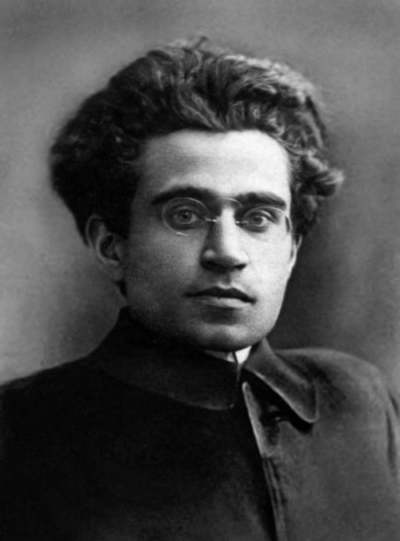
Antonio Gramsci
Antonio Gramsci was an Italian Marxist philosopher, writer, and politician. Born January 22, 1891, in Ales. Died April 27, 1937, in Rome. Positions held include member of the Chamber of Deputies of the Kingdom of Italy (1924–1929). Known for Prison Notebooks. Educated at University of Turin and Lc G.M.Dettori-Cagliari. Awards include Viareggio Prize.
Facts
29 facts · 2 confirmed by two sources · 21 cited · 6 from one source
Where this comes from
Papalocal keeps its own record. It started from these sources; what each one said is kept here as it was copied, so a change on their side never changes this page by itself. Tap one to read its version.
What Wikidata says · copied November 16, 2026 · revision 2557782638
- Described as
- Italian Marxist philosopher, writer, and politician (1891–1937)
- Other names
- Antonio Francesco Gramsci
- Born
- January 22, 1891 · 7 references
- Died
- April 27, 1937 · 15 references
- Born in
- Ales · 2 references
- Died in
- Rome · 4 references
- Buried in
- Protestant Cemetery, Rome · 3 references
- Cause of death
- cerebral hemorrhage · 1 reference
- Citizen of
- Kingdom of Italy
- Occupation
- philosopher · 4 references; politician · 4 references; journalist · 3 references; writer · 2 references; economist · 1 reference; literary critic; historian · 2 references; sociologist · 2 references
- Positions held
- member of the Chamber of Deputies of the Kingdom of Italy (1924–1929) · 1 reference
- Political party
- Italian Communist Party
- Education
- University of Turin · 1 reference; Lc G.M.Dettori-Cagliari · 1 reference
- Known for
- Prison Notebooks · 1 reference
- Awards
- Viareggio Prize (1947)
- Field
- philosophy · 1 reference; politics · 1 reference; opinion journalism · 1 reference; literature · 1 reference; economics · 1 reference; literary criticism · 1 reference
- Spouse
- Julia Schucht · 1 reference
- Religion
- atheism
- Wikipedias with a page
- 127
Wikidata item Q83003 (wikidata.org/wiki/Q83003), public domain (CC0). Copied November 16, 2026.
What Wikipedia says · copied November 16, 2026 · revision 1384732627
Antonio Francesco Gramsci (UK: GRAM-shee, US: GRAHM-shee; Italian: [anˈtɔːnjo franˈtʃesko ˈɡramʃi] ; 22 January 1891 – 27 April 1937) was an Italian Marxist philosopher, journalist and politician. He was a founding member and one-time leader of the Italian Communist Party. A vocal critic of Benito Mussolini and fascism, he was imprisoned in 1926, and remained in prison until shortly before his death in 1937.
During his imprisonment, Gramsci wrote more than 30 notebooks and 3,000 pages of history and analysis. His Prison Notebooks are considered a highly original contribution to 20th-century political theory. Gramsci drew insights from varying sources—not only other Marxists but also thinkers such as Niccolò Machiavelli, Vilfredo Pareto, Charles Darwin, Sigmund Freud, Friedrich Nietzsche, Georg Hegel, Pierre Joseph Proudhon, Georges Sorel, and Benedetto Croce. The notebooks cover a wide range of topics, including the history of Italy and Italian nationalism, the French Revolution, fascism, Taylorism and Fordism, civil society, the state, historical materialism, folklore, religion, and high and popular culture.
Gramsci is best known for his theory of cultural hegemony, which describes how the state and ruling capitalist class—the bourgeoisie—use cultural institutions to maintain wealth and power in capitalist societies. In Gramsci's view, the bourgeoisie develops a hegemonic culture using ideology rather than violence, economic force, or coercion. He also attempted to break from the economic determinism of orthodox Marxist thought, and so is sometimes described as a neo-Marxist. He held a humanistic understanding of Marxism, seeing it as a philosophy of praxis and an absolute historicism that transcends traditional materialism and traditional idealism.
- Born, in its opening lines
- January 22, 1891
- Died, in its opening lines
- April 27, 1937
From the Wikipedia article “Antonio Gramsci” (en.wikipedia.org/wiki/Antonio_Gramsci), by its contributors, under CC BY-SA 4.0 (creativecommons.org/licenses/by-sa/4.0/). Copied November 16, 2026; not changed.
Confirmed Two sources agree. Cited One source, and it names where it got it. One source One source, without a reference of its own. Sources disagree The sources disagree. We show the best-supported value and keep theirs below.
