
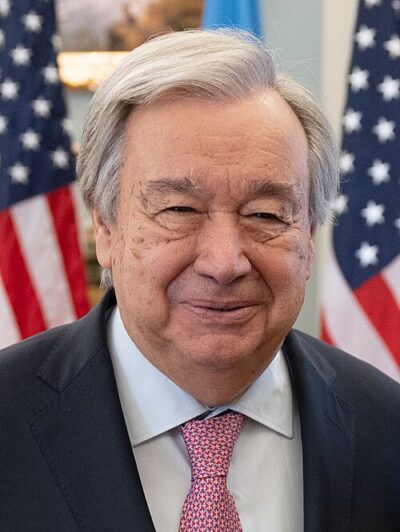
António Guterres
António Guterres is a Secretary-General of the United Nations since 2017. Born April 30, 1949, in Lisbon. Positions held include United Nations High Commissioner for Refugees (2005–2015), Prime Minister of Portugal (1995–2002) and President of the Socialist International (1999–2005). Educated at Instituto Superior Técnico. Awards include Collar of the Order of Isabella the Catholic, Freedom Award and Order of the Star of Romania.
Facts
47 facts · 1 confirmed by two sources · 18 cited · 28 from one source
Where this comes from
Papalocal keeps its own record. It started from these sources; what each one said is kept here as it was copied, so a change on their side never changes this page by itself. Tap one to read its version.
What Wikidata says · copied November 16, 2026 · revision 2557787497
- Described as
- Secretary-General of the United Nations since 2017
- Other names
- António Manuel de Oliveira Guterres, Antonio Manuel de Oliveira Guterres, Mr. António Guterres, Antonio Guterres
- Born
- April 30, 1949 · 10 references
- Born in
- Lisbon · 7 references
- Name at birth
- António Manuel de Oliveira Guterres · 2 references
- Citizen of
- Portugal · 3 references; Timor-Leste · 1 reference
- Occupation
- politician · 7 references; engineer; assistant professor; diplomat · 1 reference
- Positions held
- United Nations High Commissioner for Refugees (2005–2015); Prime Minister of Portugal (1995–2002); President of the Socialist International (1999–2005); General Secretary of the Socialist Party (Portugal) (1992–2002); President-in-Office of the European Council (2000); United Nations Secretary-General (2017–); member of the Assembly of the Republic (1976–1980) · 1 reference; substitute member of the Parliamentary Assembly of the Council of Europe (1981–1983) · 2 references
- Political party
- Socialist Party (1974–) · 2 references
- Worked for
- Technical University of Lisbon; United Nations (2017–)
- Education
- Instituto Superior Técnico (–1971) · 1 reference
- Member of
- Club of Madrid · 2 references; European Council on Foreign Relations · 1 reference; Friends of Europe · 1 reference
- Awards
- Collar of the Order of Isabella the Catholic (2002) · 2 references; Freedom Award (2007); Order of the Star of Romania; Order of the Republic; Grand Cross of the Order of the Southern Cross; Knight of the Order of Merit; Grand Cross of the National Order of Merit; Grand Cross of the Order of Honour; Order of the Aztec Eagle; Grand Cross of the Order of Merit of the Republic of Poland; Order of Prince Yaroslav the Wise, 1st class; Order of the Rising Sun, 1st class; Knight Grand Cross of the Order of Merit of the Italian Republic; Charlemagne Prize (2019) · 1 reference; Grand Cross of the Military Order of Christ (2002) · 1 reference
- Field
- politics · 1 reference; diplomacy · 1 reference
- Spouse
- Luísa Amélia Guimarães e Melo (1972–1998); Catarina Vaz Pinto (2001–)
- Father
- Virgílio Dias Guterres
- Mother
- Ilda Cândida de Oliveira
- Religion
- Catholic Church · 1 reference
- Website
- https://www.antonioguterres.gov.pt
- Wikipedias with a page
- 130
Wikidata item Q311440 (wikidata.org/wiki/Q311440), public domain (CC0). Copied November 16, 2026.
What Wikipedia says · copied November 16, 2026 · revision 1385476461
António Manuel de Oliveira Guterres (born 30 April 1949) is a Portuguese politician and diplomat who, since 2017, has served as the ninth secretary-general of the United Nations. A member of the Portuguese Socialist Party, Guterres served as the prime minister of Portugal from 1995 to 2002.
Born in Lisbon, Guterres studied physics and electrical engineering at Lisbon's Instituto Superior Técnico, briefly taught systems theory and telecommunications, and became involved in politics while active in a Catholic youth group. Guterres served as secretary-general of the Socialist Party from 1992 to 2002. He was elected prime minister in 1995. He led the party to legislative victories in 1995 and 1999. Guterres announced his resignation as Socialist Party leader in 2002 following the party's losses in the 2001 local elections, with Eduardo Ferro Rodrigues succeeding him while he remained prime minister until losing the subsequent general election to José Manuel Barroso's Social Democratic Party. Despite this defeat, polling of the Portuguese public in both 2012 and 2014 ranked Guterres the best prime minister of the previous 30 years.
Guterres served as President of the Socialist International from 1999 to 2005. He was the United Nations High Commissioner for Refugees from 2005 to 2015. He reformed the agency and addressed multiple global refugee crises. Guterres was elected secretary-general in October 2016, succeeding Ban Ki-moon at the beginning of the following year and becoming the first European to hold this office since Kurt Waldheim in 1981. As secretary-general, he has focused on peace, human rights, climate change, refugee protection, and diplomatic engagement with controversial global actors.
Guterres has held numerous advisory, board, and leadership roles in international organizations, foundations, and councils spanning journalism, finance, humanitarian aid, innovation, gender equality, and global policy. Guterres, a multilingual practicing Catholic, was married twice and has two children. He has received numerous national and international honors, honorary doctorates, and prestigious awards recognizing contributions to diplomacy, democracy and global leadership.
- Born, in its opening lines
- April 30, 1949
From the Wikipedia article “António Guterres” (en.wikipedia.org/wiki/António_Guterres), by its contributors, under CC BY-SA 4.0 (creativecommons.org/licenses/by-sa/4.0/). Copied November 16, 2026; not changed.
Confirmed Two sources agree. Cited One source, and it names where it got it. One source One source, without a reference of its own. Sources disagree The sources disagree. We show the best-supported value and keep theirs below.
