
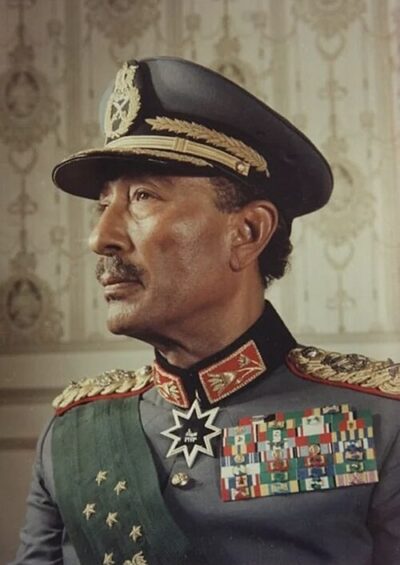
Anwar Sadat
Anwar Sadat was a President of Egypt from 1970 to 1981. Born December 25, 1918, in Mit Abu al-Kum. Died October 6, 1981, in Cairo. Positions held include President of Egypt (1970–1981), Prime Minister of Egypt (2 times) (1973–1981) and Vice President of Egypt (1969–1970). Educated at Egyptian Military College. Awards include Nobel Peace Prize, Collar of the Order of Isabella the Catholic and Presidential Medal of Freedom.
Facts
58 facts · 2 confirmed by two sources · 9 cited · 47 from one source
Where this comes from
Papalocal keeps its own record. It started from these sources; what each one said is kept here as it was copied, so a change on their side never changes this page by itself. Tap one to read its version.
What Wikidata says · copied November 16, 2026 · revision 2565534968
- Described as
- President of Egypt from 1970 to 1981
- Other names
- Muhammad Anwar es-Sadat, Muhammad Anwar el-Sadat, Mohamed Anwar El Sadat, Anwar El Sadat, Anwar al-Sadat, Anwar el-Sadat, Anwar as-Sadat, Sadat, Anwar el Sadat
- Born
- December 25, 1918 · 8 references
- Died
- October 6, 1981 · 9 references
- Born in
- Mit Abu al-Kum
- Died in
- Cairo · 1 reference
- Buried in
- Unknown Soldier Memorial · 1 reference
- Cause of death
- firearm
- Citizen of
- Sultanate of Egypt (–1922); Kingdom of Egypt (1922–1953); Republic of Egypt (1953–1958); United Arab Republic (1958–1971)
- Occupation
- politician · 1 reference; military officer · 1 reference; statesperson; diplomat; military leader; vice president; president; opinion journalist · 1 reference
- Positions held
- President of Egypt (1970–1981); Prime Minister of Egypt (2 times) (1973–1981); Vice President of Egypt (1969–1970); Speaker of the National Assembly of the United Arab Republic (2 times) (1960–1968) · 1 reference; prime minister
- Political party
- National Democratic Party (1977–1981); Arab Socialist Union (1962–1977)
- Education
- Egyptian Military College
- Member of
- Free Officers Movement; Egyptian Revolutionary Command Council
- Awards
- Nobel Peace Prize (1978) · 2 references; Collar of the Order of Isabella the Catholic (1977) · 2 references; Presidential Medal of Freedom (1984) · 1 reference; Order of Ojaswi Rajanya; Knight Grand Cross with Collar of the Order of Merit of the Italian Republic; Congressional Gold Medal; Order of King Abdulaziz al Saud; Order of the Star of Nepal; Order of Mubarak the Great; Order of the Nile; Order of the Republic; Financial Times Person of the Year (1977)
- Field
- politics; diplomacy; military
- Spouse
- Eqbal Madi (1940–1949); Jehan Sadat (1949–1981) · 1 reference
- Children
- Ruqayya Sadat; Rawia Sadat; Camilia Sadat; Lubna Sadat; Nukha Sadat; Jamal Sadat; Jehan Anwar Sadat
- Father
- Mohammed Sadati
- Mother
- Sitt-Al-Barrein
- Religion
- Sunni Islam
- Military branch
- Egyptian Army · 1 reference
- Military rank
- marshal
- Website
- http://www.anwarsadat.org
- Wikipedias with a page
- 127
Wikidata item Q42013 (wikidata.org/wiki/Q42013), public domain (CC0). Copied November 16, 2026.
What Wikipedia says · copied November 16, 2026 · revision 1384268481
Muhammad Anwar es-Sadat (25 December 1918 – 6 October 1981) was an Egyptian politician and military officer who was the third president of Egypt from 1970 until his assassination in 1981. A former member of the Free Officers movement, Sadat was vice president under Gamal Abdel Nasser on two occasions and assumed the office on Nasser's death in 1970.
In his 11 years as president, he changed Egypt's trajectory, departing from many political and economic tenets of Nasserism, reinstituting a multi-party system, and launching the Infitah economic policy. As President, he led Egypt in the October war of 1973 to regain Egypt's Sinai Peninsula, which Israel had occupied since the Six-Day War of 1967, making him a hero in Egypt and, for a time, the wider Arab world. Afterwards, he engaged in negotiations with Israel, culminating in the Camp David Accords and the Egypt–Israel peace treaty.
Although reaction to the treaty – which resulted in the return of Sinai to Egypt – was generally favorable among Egyptians, it was rejected by the country's Muslim Brotherhood and the left, which felt Sadat had abandoned efforts to ensure a State of Palestine. With the exception of Sudan, the Arab world and the Palestine Liberation Organization (PLO) strongly opposed Sadat's efforts to make a separate peace with Israel without prior consultations with the Arab states. His refusal to reconcile with them over the Palestinian issue resulted in Egypt being suspended from the Arab League from 1979 to 1989. The peace treaty was also one of the primary factors that led to his assassination; on 6 October 1981, militants led by Khalid Al-Islambuli opened fire on Sadat with automatic rifles during the 6 October parade in Cairo, killing him.
- Born, in its opening lines
- December 25, 1918
- Died, in its opening lines
- October 6, 1981
From the Wikipedia article “Anwar Sadat” (en.wikipedia.org/wiki/Anwar_Sadat), by its contributors, under CC BY-SA 4.0 (creativecommons.org/licenses/by-sa/4.0/). Copied November 16, 2026; not changed.
Confirmed Two sources agree. Cited One source, and it names where it got it. One source One source, without a reference of its own. Sources disagree The sources disagree. We show the best-supported value and keep theirs below.
