
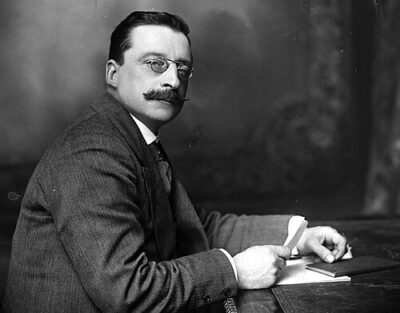
Arthur Griffith
Arthur Griffith was an Irish politician and writer, founder of Sinn Féin. Born March 31, 1872, in Dublin. Died August 12, 1922, in Dublin. Positions held include President of Dáil Éireann (1922), Minister for Foreign Affairs (Ireland) (1921–1922) and member of the 31st Parliament of the United Kingdom (1918–1922).
Facts
23 facts · 1 confirmed by two sources · 8 cited · 13 from one source · 1 where the sources disagree
What’s different
- Born: we show March 31, 1872 (Sources disagree). Wikipedia says March 31, 1871
Where this comes from
Papalocal keeps its own record. It started from these sources; what each one said is kept here as it was copied, so a change on their side never changes this page by itself. Tap one to read its version.
What Wikidata says · copied November 16, 2026 · revision 2562781977
- Described as
- Irish politician and writer, founder of Sinn Féin (1871–1922)
- Other names
- Art Ó Gríobhtha, Art O Griobhtha, Arthur Joseph Griffith
- Born
- March 31, 1872 · 5 references
- Died
- August 12, 1922 · 6 references
- Born in
- Dublin · 3 references
- Died in
- Dublin · 3 references
- Buried in
- Glasnevin Cemetery
- Cause of death
- stroke
- Citizen of
- United Kingdom of Great Britain and Ireland; Irish Free State
- Occupation
- diplomat; politician · 2 references; writer; author · 1 reference
- Positions held
- President of Dáil Éireann (1922); Minister for Foreign Affairs (Ireland) (1921–1922); member of the 31st Parliament of the United Kingdom (1918–1922) · 1 reference; Minister for Justice, Home Affairs and Migration (1919–1921); member of the 30th Parliament of the United Kingdom (1918) · 1 reference; Teachta Dála (1919–1923) · 1 reference; president · 1 reference
- Political party
- Sinn Féin; Irish Republican Brotherhood
- Worked for
- The United Irishmen
- Religion
- Catholic Church
- Wikipedias with a page
- 40
Wikidata item Q342765 (wikidata.org/wiki/Q342765), public domain (CC0). Copied November 16, 2026.
What Wikipedia says · copied November 16, 2026 · revision 1365109348
Arthur Joseph Griffith (Irish: Art Seosamh Ó Gríobhtha or Art Ó Gríofa; 31 March 1871 – 12 August 1922) was an Irish writer, newspaper editor and politician who founded the political party Sinn Féin. He led the Irish delegation at the negotiations that produced the 1921 Anglo-Irish Treaty, and served as the president of Dáil Éireann from January 1922 until his death that August.
After a short spell in South Africa, Griffith founded and edited the Irish nationalist newspaper The United Irishman in 1899. In 1904, he wrote The Resurrection of Hungary, which advocated the withdrawal of Irish members from the Parliament of the United Kingdom and the setting up of the institutions of government at home in Ireland, a policy that became known as Sinn Féin (ourselves). On 28 November 1905, he presented "The Sinn Féin Policy" at the first annual convention of his organisation, the National Council; the occasion is marked as the founding date of the Sinn Féin party. Griffith took over as president of Sinn Féin in 1911, but at that time the organisation was still small.
Griffith was arrested following the Easter Rising of 1916, despite not having taken any part in it. On his release, he worked to build up Sinn Féin, which won a string of by-election victories. At the party's Ardfheis (annual convention) in October 1917, Sinn Féin became an unambiguously republican party, and Griffith resigned the presidency in favour of the 1916 leader Éamon de Valera, becoming vice-president instead. Griffith was elected as an MP for East Cavan in a by-election in June 1918, and re-elected in the 1918 general election, when Sinn Féin won a huge electoral victory over the Irish Parliamentary Party and, refusing to take their seats at Westminster, set up their own constituent assembly, Dáil Éireann.
In the Dáil, Griffith served as Minister for Home Affairs from 1919 to 1921, and Minister for Foreign Affairs from 1921 to 1922. In September 1921, he was appointed chairman of the Irish delegation to negotiate a treaty with the British government. After months of negotiations, he and the other four delegates signed the Anglo-Irish Treaty, which created the Irish Free State, but not as a republic. This led to a split in the Dáil. After the Treaty was narrowly approved by the Dáil, de Valera resigned as president and Griffith was elected in his place. The split led to the Irish Civil War. Griffith died suddenly in August 1922, two months after the outbreak of that war.
- Born, in its opening lines
- March 31, 1871
- Died, in its opening lines
- August 12, 1922
From the Wikipedia article “Arthur Griffith” (en.wikipedia.org/wiki/Arthur_Griffith), by its contributors, under CC BY-SA 4.0 (creativecommons.org/licenses/by-sa/4.0/). Copied November 16, 2026; not changed.
Confirmed Two sources agree. Cited One source, and it names where it got it. One source One source, without a reference of its own. Sources disagree The sources disagree. We show the best-supported value and keep theirs below.
