
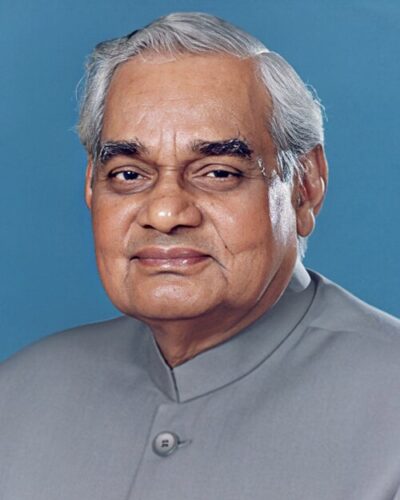
Atal Bihari Vajpayee
Atal Bihari Vajpayee was a Prime Minister of India in 1996 and from 1998 to 2004. Born December 25, 1924, in Gwalior. Died August 16, 2018, in All India Institute of Medical Sciences, New Delhi. Positions held include Prime Minister of India (2 times) (1996–2004), member of Rajya Sabha and Minister of External Affairs (2 times) (1977–1998). Educated at Dr. Bhimrao Ambedkar University and St. Mary's School, Belgaum. Awards include Bharat Ratna, Ig Nobel Prize and Padma Vibhushan in Public Affairs.
Facts
32 facts · 2 confirmed by two sources · 5 cited · 25 from one source
What’s different
- Born: we show December 25, 1924 (Confirmed). Wikidata also lists December 24, 1924
Where this comes from
Papalocal keeps its own record. It started from these sources; what each one said is kept here as it was copied, so a change on their side never changes this page by itself. Tap one to read its version.
What Wikidata says · copied November 16, 2026 · revision 2568003401
- Described as
- Prime Minister of India in 1996 and from 1998 to 2004
- Born
- December 24, 1924 · 2 references; December 25, 1924 · 3 references
- Died
- August 16, 2018 · 6 references
- Born in
- Gwalior · 1 reference
- Died in
- All India Institute of Medical Sciences, New Delhi
- Cause of death
- diabetes
- Citizen of
- British Raj (–1947); Dominion of India (1947–1950); India (1950–)
- Occupation
- politician · 1 reference; poet; journalist · 1 reference; writer · 1 reference
- Positions held
- Prime Minister of India (2 times) (1996–2004); member of Rajya Sabha; Minister of External Affairs (2 times) (1977–1998); Member of the 11th Lok Sabha; Member of the 12th Lok Sabha; Member of the 13th Lok Sabha; Member of the 7th Lok Sabha
- Political party
- Bharatiya Janata Party (1980–2018); Bharatiya Jana Sangh
- Education
- Dr. Bhimrao Ambedkar University; St. Mary's School, Belgaum; DAV College, Kanpur
- Awards
- Bharat Ratna (2015); Ig Nobel Prize (1998); Padma Vibhushan in Public Affairs; Outstanding Parliamentarian Award (1994); Banga Bibhushan (1994); Order of Ouissam Alaouite · 1 reference; Grand Cross of the Order of Wissam Alaouite (1999) · 1 reference
- Religion
- Hinduism
- Wikipedias with a page
- 91
Wikidata item Q233289 (wikidata.org/wiki/Q233289), public domain (CC0). Copied November 16, 2026.
What Wikipedia says · copied November 16, 2026 · revision 1380540148
Atal Bihari Vajpayee (25 December 1924 – 16 August 2018) was an Indian statesman and a poet who served as prime minister of India, from 1998 to 2004, and previously for two weeks in 1996. He was the first non-Congress prime minister to serve a full term in the office. Vajpayee was one of the co-founders and a senior leader of the Bharatiya Janata Party (BJP). He was a volunteer and full-time functionary (pracharak) of the Rashtriya Swayamsevak Sangh (RSS), a right-wing Hindutva paramilitary volunteer organisation. Vajpayee combined cultural nationalism with political moderation, shaping a distinctive strand of post-Independence Indian conservatism rooted in civilisational identity. Vajpayee represented a current in Hindu nationalism that sought to harmonise cultural identity with democratic pluralism.
The longest-serving member of the Indian Parliament and its lower house, the Lok Sabha, Vajpayee was a parliamentarian for over five decades, having been elected ten times to the Lok Sabha, and twice to the Rajya Sabha, the upper house of Parliament. He served as the Member of Parliament from Lucknow, Gwalior, New Delhi and Balrampur constituencies, before retiring from active politics in 2009 due to health concerns. He was among the founding members of the Bharatiya Jana Sangh (BJS), of which he was president from 1968 to 1972. The BJS merged with several other parties to form the Janata Party, which won the 1977 general election. In March 1977, Vajpayee became the minister of external affairs in the cabinet of Prime Minister Morarji Desai. He resigned in 1979, and the Janata alliance collapsed soon after. Former members of the Bharatiya Jana Sangh formed the BJP in 1980, with Vajpayee as its first president.
During his tenure as prime minister, India carried out the Pokhran-II nuclear tests in 1998, postured as nation's self-assertion. Vajpayee sought to improve diplomatic relations with Pakistan, travelling to Lahore by bus to meet with Prime Minister, Nawaz Sharif. After the 1999 Kargil War with Pakistan, he sought to restore relations through engagement with President Pervez Musharraf, inviting him to India for a summit at Agra. Vajpayee's government introduced many domestic economic and infrastructural reforms, including encouraging the private sector and foreign investments, reducing governmental waste, encouraging research and development, and the privatisation of some government owned corporations.
Vajpayee's tenure was marked by several major challenges, including the 1999 Kargil intrusion by Pakistan-backed forces, and the 2001 Indian Parliament attack carried out by Pakistan-based jihadist groups. The Parliament attack led to Operation Parakram, one of the largest post-Independence military mobilisations. The 2002 Gujarat riots followed the burning of coach S-6 of the Sabarmati Express at Godhra, in which many Ram Sevaks returning from Ayodhya were killed after a mob attacked and set the train on fire. Although the riots drew national and international criticism, scholars note that Vajpayee's defeat in the 2004 general election was more directly linked to economic factors, rural distress, and the miscalculated India Shining campaign rather than any single event.
Vajpayee was conferred with the Padma Vibhushan, India's second highest civilian award in 1992 by the Narasimha Rao led government. In 2014, the Narendra Modi administration declared Vajpayee's birthday, 25 December to be celebrated as Good Governance Day. In 2015, he was honoured India's highest civilian honour - Bharat Ratna, by the Modi government. He died in 2018 due to age-related illness. Vajpayee has left a lasting legacy as one of the great leaders of modern India. His name is commemorated across the nation including the Atal Tunnel, Atal Setu bridge, and several notable educational institutions.
- Born, in its opening lines
- December 25, 1924
- Died, in its opening lines
- August 16, 2018
From the Wikipedia article “Atal Bihari Vajpayee” (en.wikipedia.org/wiki/Atal_Bihari_Vajpayee), by its contributors, under CC BY-SA 4.0 (creativecommons.org/licenses/by-sa/4.0/). Copied November 16, 2026; not changed.
Confirmed Two sources agree. Cited One source, and it names where it got it. One source One source, without a reference of its own. Sources disagree The sources disagree. We show the best-supported value and keep theirs below.
