
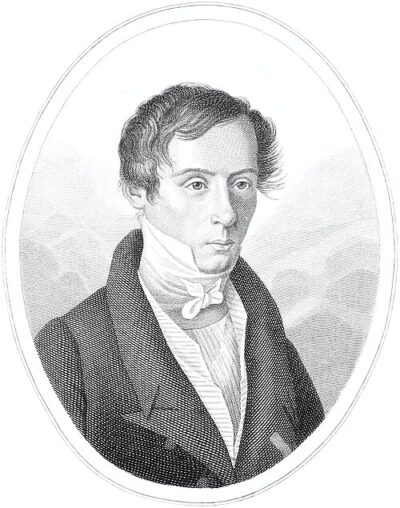
Augustin-Jean Fresnel
Augustin-Jean Fresnel was a French engineer and physicist. Born May 10, 1788, in Broglie. Died July 14, 1827, in Ville-d'Avray. Known for Fresnel lens, Fresnel diffraction and Fresnel zone. Educated at École polytechnique and Lycée François de Malherbe. Awards include Rumford Medal, Grand prix des sciences mathématiques and Foreign Member of the Royal Society.
Facts
33 facts · 2 confirmed by two sources · 15 cited · 15 from one source · 1 where the sources disagree
What’s different
- Buried in: we show Père Lachaise Cemetery (Sources disagree). Wikidata also lists Grave of Fresnel
Where this comes from
Papalocal keeps its own record. It started from these sources; what each one said is kept here as it was copied, so a change on their side never changes this page by itself. Tap one to read its version.
What Wikidata says · copied November 16, 2026 · revision 2568782450
- Described as
- French engineer and physicist (1788-1827)
- Other names
- Frenel Ogyusten Jan, Fresnel, Augustin Fresnel
- Born
- May 10, 1788 · 11 references
- Died
- July 14, 1827 · 11 references
- Born in
- Broglie · 3 references
- Died in
- Ville-d'Avray · 3 references
- Buried in
- Père Lachaise Cemetery · 1 reference; Grave of Fresnel
- Cause of death
- tuberculosis · 1 reference
- Citizen of
- France
- Occupation
- physicist · 1 reference; civil engineer; engineer · 1 reference
- Worked for
- Corps of bridges, waters and forests (1809–1824) · 1 reference; Athénée Royal (Paris) (1819–1820)
- Education
- École polytechnique (1804–1806) · 2 references; Lycée François de Malherbe (1800–1804) · 1 reference; École Nationale des Ponts et Chaussées (1806–1809) · 2 references
- Member of
- Royal Society of London (1825–) · 1 reference; Société Philomathique de Paris; French Academy of Sciences (1823–) · 1 reference
- Known for
- Fresnel lens; Fresnel diffraction; Fresnel zone; Fresnel equations; Fresnel integral; Fresnel number; Mémoire sur la diffraction de la lumière
- Awards
- Rumford Medal (1824) · 1 reference; Grand prix des sciences mathématiques (1819) · 1 reference; Foreign Member of the Royal Society (1825) · 1 reference; 72 names on the Eiffel Tower · 1 reference
- Field
- optics
- Mother
- Augustine Mérimée
- Siblings
- Fulgence Fresnel
- Lived in
- France · 1 reference
- Wikipedias with a page
- 74
Wikidata item Q187241 (wikidata.org/wiki/Q187241), public domain (CC0). Copied November 16, 2026.
What Wikipedia says · copied November 16, 2026 · revision 1385607123
Augustin-Jean Fresnel (10 May 1788 – 14 July 1827) was a French civil engineer and physicist whose research in optics led to the almost unanimous acceptance of the wave theory of light, fully supplanting Newton's corpuscular theory, from the late 1830s until the end of the 19th century. He is perhaps better known for inventing the catadioptric (reflective/refractive) Fresnel lens and for pioneering the use of "stepped" lenses to extend the visibility of lighthouses, saving countless lives at sea. The simpler dioptric (purely refractive) stepped lens, first proposed by Count Buffon and independently reinvented by Fresnel, is used in screen magnifiers and in condenser lenses for overhead projectors.
Fresnel gave the first satisfactory explanation of diffraction by straight edges, including the first satisfactory wave-based explanation of rectilinear propagation. By further supposing that light waves are purely transverse, Fresnel explained the nature of polarization. He then worked on double refraction.
Fresnel had a lifelong battle with tuberculosis, to which he succumbed at the age of 39. He lived just long enough to receive recognition from his peers, including (on his deathbed) the Rumford Medal of the Royal Society, and his name is ubiquitous in the modern terminology of optics and waves. After the wave theory of light was subsumed by Maxwell's electromagnetic theory in the 1860s, some attention was diverted from the magnitude of Fresnel's contribution. In the period between Fresnel's unification of physical optics and Maxwell's wider unification, a contemporary authority, Humphrey Lloyd, described Fresnel's transverse-wave theory as "the noblest fabric which has ever adorned the domain of physical science, Newton's system of the universe alone excepted".
- Born, in its opening lines
- May 10, 1788
- Died, in its opening lines
- July 14, 1827
From the Wikipedia article “Augustin-Jean Fresnel” (en.wikipedia.org/wiki/Augustin-Jean_Fresnel), by its contributors, under CC BY-SA 4.0 (creativecommons.org/licenses/by-sa/4.0/). Copied November 16, 2026; not changed.
Confirmed Two sources agree. Cited One source, and it names where it got it. One source One source, without a reference of its own. Sources disagree The sources disagree. We show the best-supported value and keep theirs below.
