
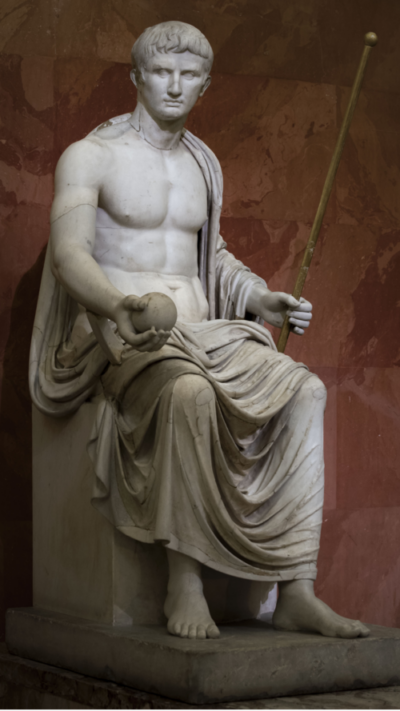
Augustus
Augustus was a first emperor of the Roman Empire and founder of the Julio-Claudian dynasty. Born September 23, 63 BC, in Rome. Died August 19, 14, in Nola. Positions held include Roman emperor (-27–14), pontifex maximus (-13–) and Roman censor.
Facts
32 facts · 0 confirmed by two sources · 16 cited · 16 from one source
Where this comes from
Papalocal keeps its own record. It started from these sources; what each one said is kept here as it was copied, so a change on their side never changes this page by itself. Tap one to read its version.
What Wikidata says · copied November 16, 2026 · revision 2568559129
- Described as
- first emperor of the Roman Empire and founder of the Julio-Claudian dynasty
- Other names
- Gaius Julius Caesar, Gaius Caesar, Caesar Octavianus, Gaius Octavius Thurinus, Gaius Octavius Caepias, Caius Octavius Thurinus, Gaius Julius Caesar Octavianus, Octavius Caesar, Gaius Julius Caesar Octavianus Augustus, Octavianus, Caius Julius Cæsar Octavianus, Augustus Caesar
- Born
- September 23, 63 BC · 3 references
- Died
- August 19, 14 · 3 references
- Born in
- Rome · 3 references
- Died in
- Nola · 3 references
- Buried in
- Mausoleum of Augustus
- Name at birth
- C. Octavius C.f. · 1 reference
- Citizen of
- Ancient Rome
- Occupation
- politician; military personnel; ruler
- Positions held
- Roman emperor (-27–14) · 1 reference; pontifex maximus (-13–); Roman censor; tribune; ancient Roman senator · 1 reference; Roman consul (-33) · 1 reference; triumvir rei publicae constituendae (-43–-33); moneyer (-43–-36) · 1 reference
- Spouse
- Claudia (-42–-40) · 2 references; Scribonia (-40–-38) · 4 references; Livia (-37–14) · 2 references
- Children
- Julia the Elder · 4 references; Gaius Caesar; Lucius Caesar; Tiberius; Agrippa Postumus
- Father
- Gaius Octavius · 1 reference
- Mother
- Atia · 2 references
- Siblings
- Octavia the Younger · 2 references; Octavia the Elder
- Religion
- ancient Roman religion · 1 reference
- Military rank
- imperator
- Wikipedias with a page
- 248
Wikidata item Q1405 (wikidata.org/wiki/Q1405), public domain (CC0). Copied November 16, 2026.
What Wikipedia says · copied November 16, 2026 · revision 1384986432
Augustus (born Gaius Octavius; 23 September 63 BC – 19 August AD 14), also known as Octavian (Latin: Octavianus), was the founder of the Roman Empire and the first Roman emperor from 27 BC until his death in AD 14. The reign of Augustus initiated an imperial cult and an era of imperial peace (the Pax Romana or Pax Augusta) when the Roman world was largely free of armed conflict. The principate, a style of government in which the emperor showed nominal deference to the Senate, was established during his reign and lasted until the Crisis of the Third Century.
Octavian was born into an equestrian branch of the gens Octavia. His great-uncle, the Roman dictator Julius Caesar, named him as his primary heir in his will; after Caesar's assassination in 44 BC, Octavian inherited his estate and assumed his name. He fought for the loyalty of Caesar's legions. He was made a senator during a state emergency and seized power by marching on Rome in 43 BC, becoming its youngest elected consul. He, Mark Antony, and Marcus Lepidus formed a triumvirate regime with legally sanctioned powers to outlaw and oppose Caesar's assassins and their allies. Following their victory at the Battle of Philippi in 42 BC, the triumvirate divided the Roman Republic among themselves and ruled as de facto oligarchs. Competing ambitions eventually tore their alliance apart; Octavian had Lepidus exiled in 36 BC for opposing him in Sicily, while Marcus Agrippa, Octavian's naval commander, defeated Antony in Greece at the Battle of Actium in 31 BC. Antony and his wife Cleopatra, the Ptolemaic queen of Egypt, killed themselves during Octavian's invasion of Egypt, which then became Octavian's personal property.
After the demise of the triumvirate, Augustus reached an accord with the remaining Roman elite: he would restore the façade of a free republic, centered around the Senate, the executive magistrates and the legislative assemblies. But his control of the military and of half of Rome's provinces meant he maintained autocratic power legitimized by his appointment as commander-in-chief of most Roman armies. To avoid the appearance of monarchy or dictatorship, he eventually refused to stand for reelection to the consulship, but the Senate granted him the powers of the tribunate and censorship and the titles princeps ('first citizen'), augustus ('the revered'), and pater patriae (lit. 'father of the country'), and named the month of August after him. After Lepidus died, Augustus also became pontifex maximus ('supreme pontiff').
Augustus dramatically enlarged the Empire, annexing Egypt, Dalmatia, Pannonia, Noricum, and Raetia, expanding possessions in Africa, and completing the conquest of Hispania. His expansionism, however, suffered a major setback in Germania. Beyond the frontiers, he secured the empire with a buffer region of client states and negotiated peace treaties with the Parthian Empire and Kingdom of Kush. He reformed the Roman system of taxation and currency, developed networks of roads with an official courier system, established a standing professional army, established the Praetorian Guard as well as official police and fire-fighting services for the city of Rome, and renovated much of the city during his reign. Augustus was a writer and patron of poets such as Virgil, and has been featured in various works of art from ancient to modern times. He died in AD 14 at age 75 from natural causes, and the Senate posthumously deified him. Persistent rumors have claimed his wife Livia poisoned him. He was succeeded as emperor by his stepson and adoptive son Tiberius.
From the Wikipedia article “Augustus” (en.wikipedia.org/wiki/Augustus), by its contributors, under CC BY-SA 4.0 (creativecommons.org/licenses/by-sa/4.0/). Copied November 16, 2026; not changed.
Confirmed Two sources agree. Cited One source, and it names where it got it. One source One source, without a reference of its own. Sources disagree The sources disagree. We show the best-supported value and keep theirs below.
