
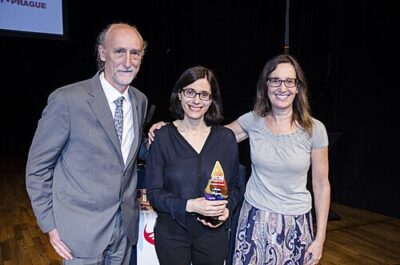
Aviv Regev is an Israeli American bioinformatician. Born July 11, 1971. Educated at Tel Aviv University. Awards include Overton Prize, ISCB Fellow and ISCB Innovator Award.
Facts
23 facts · 1 confirmed by two sources · 8 cited · 14 from one source
Where this comes from
Papalocal keeps its own record. It started from these sources; what each one said is kept here as it was copied, so a change on their side never changes this page by itself. Tap one to read its version.
What Wikidata says · copied November 19, 2026 · revision 2568521671
- Described as
- Israeli American bioinformatician
- Other names
- A. Regev, A Regev, Regev, Regev A, Regev A.
- Born
- July 11, 1971 · 1 reference
- Citizen of
- Israel; United States
- Occupation
- bioinformatician; mathematician; biologist · 1 reference
- Worked for
- Massachusetts Institute of Technology · 1 reference
- Education
- Tel Aviv University
- Member of
- National Academy of Sciences (2019–) · 1 reference; American Academy of Arts and Sciences
- Awards
- Overton Prize (2008) · 1 reference; ISCB Fellow (2016); ISCB Innovator Award (2017); National Institutes of Health Director's Pioneer Award (2008); Lurie Prize in Biomedical Sciences (2020) · 1 reference; Fellow of the American Academy of Arts and Sciences (2022) · 1 reference; Keio Medical Science Prize (2020); honorary doctor of ETH Zürich (2021) · 1 reference; Ernst Schering Prize (2021) · 1 reference; EMBO Membership
- Field
- bioinformatics · 1 reference; single-cell genomics · 1 reference
- Website
- https://www.gene.com/scientists/our-scientists/aviv-regev
- Wikipedias with a page
- 11
Wikidata item Q4829027 (wikidata.org/wiki/Q4829027), public domain (CC0). Copied November 19, 2026.
What Wikipedia says · copied November 19, 2026 · revision 1381366127
Aviv Regev (אביב רגב; born 11 July 1971) is an Israeli-American computational and systems biologist whose research has focused on gene-regulatory networks, single-cell genomics, and the application of machine learning to biology and drug discovery. She is Head and Executive Vice President of Genentech Research and Early Development (gRED) and a member of the enlarged Corporate Executive Committee of Roche.
Regev pioneered experimental and computational approaches in single-cell genomics, helping establish methods for identifying cell types and states, reconstructing cellular organization in tissues, and studying gene-regulatory circuits at single-cell resolution. In 2016, she and Sarah Teichmann co-founded the Human Cell Atlas, an international effort to create comprehensive reference maps of the cells in the human body. More recently, she has developed what she calls the "Lab in the Loop", an approach that iteratively combines large-scale biological experiments with machine-learning models to guide subsequent experiments and drug discovery.
Before joining Genentech in 2020, Regev was a professor of biology at the Massachusetts Institute of Technology, a core member and chair of the faculty at the Broad Institute, founding director of its Klarman Cell Observatory, and an investigator at the Howard Hughes Medical Institute.
- Born, in its opening lines
- July 11, 1971
From the Wikipedia article “Aviv Regev” (en.wikipedia.org/wiki/Aviv_Regev), by its contributors, under CC BY-SA 4.0 (creativecommons.org/licenses/by-sa/4.0/). Copied November 19, 2026; not changed.
Confirmed Two sources agree. Cited One source, and it names where it got it. One source One source, without a reference of its own. Sources disagree The sources disagree. We show the best-supported value and keep theirs below.
