
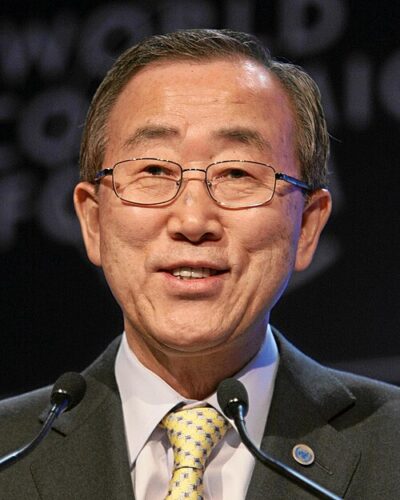
Ban Ki-moon
Ban Ki-moon is the 8th Secretary-General of the United Nations. Born June 13, 1944, in Eumseong County. Positions held include United Nations Secretary-General (2007–2017), Foreign minister of South Korea (2004–2006) and chairperson of the Ethics Commission of the International Olympic Committee (2017–). Educated at Seoul National University and John F. Kennedy School of Government. Awards include honorary doctor of the Katholieke Universiteit Leuven, Emblem of Unity and Order of Friendship.
Facts
38 facts · 1 confirmed by two sources · 7 cited · 30 from one source
Where this comes from
Papalocal keeps its own record. It started from these sources; what each one said is kept here as it was copied, so a change on their side never changes this page by itself. Tap one to read its version.
What Wikidata says · copied November 16, 2026 · revision 2568208397
- Described as
- 8th Secretary-General of the United Nations
- Other names
- Ban Kimoon, Ban Ki Moon, Ki-moon Ban, H.E. Ban Ki-moon, HE Ban Ki Moon
- Born
- June 13, 1944 · 6 references
- Born in
- Eumseong County
- Citizen of
- South Korea
- Occupation
- politician · 1 reference; diplomat · 1 reference; writer
- Positions held
- United Nations Secretary-General (2007–2017); Foreign minister of South Korea (2004–2006); chairperson of the Ethics Commission of the International Olympic Committee (2017–); ambassador of South Korea to Austria
- Political party
- independent politician · 1 reference
- Worked for
- United Nations (2007–2017) · 1 reference
- Education
- Seoul National University; John F. Kennedy School of Government; Chungju High School; Harvard University
- Member of
- ABLF alumni network · 1 reference; The Elders (2017–) · 1 reference
- Awards
- honorary doctor of the Katholieke Universiteit Leuven (2015) · 1 reference; Emblem of Unity; Order of Friendship (2016) · 1 reference; Collar of the Spanish Order of the Civil Merit (2016) · 2 references; Grand Cross 1st class of the Order of Merit of the Federal Republic of Germany (2016) · 1 reference; Grand Star of the Decoration for Services to the Republic of Austria (2001); Dostyk Order of grade I (2010); James A. Van Fleet Award (2004); Humanitarian of the Year (2014) · 1 reference; honorary doctorate from Columbia University (2016); honorary doctorate of the National University of San Marcos; Order of Rio Branco; Order of Sikatuna; Order of Ismoili Somoni; National Order of Burkina Faso
- Field
- international relations
- Religion
- Confucianism; Buddhism
- Lived in
- North Chungcheong; New York City
- Wikipedias with a page
- 153
Wikidata item Q1253 (wikidata.org/wiki/Q1253), public domain (CC0). Copied November 16, 2026.
What Wikipedia says · copied November 16, 2026 · revision 1383772364
Ban Ki-moon (Korean: 반기문; born 13 June 1944) is a South Korean politician and diplomat who served as the eighth Secretary-General of the United Nations between 2007 and 2016. Prior to his appointment as secretary-general, Ban was the South Korean minister of foreign affairs and trade between 2004 and 2006. Ban was initially considered to be a long shot for the office of Secretary-General of the United Nations; he began to campaign for the office in February 2006. As the foreign minister of South Korea, he was able to travel to all the countries on the United Nations Security Council, a manoeuvre that subsequently turned him into the campaign's front-runner.
On 13 October 2006, Ban was elected as the eighth secretary-general by the United Nations General Assembly. On 1 January 2007, he succeeded Kofi Annan. Diplomatically, Ban has taken particularly strong views on global warming, pressing the issue repeatedly with U.S. president George W. Bush, and on the Darfur conflict, where he helped persuade Sudanese president Omar al-Bashir to allow peacekeeping troops to enter Sudan.
António Guterres was appointed by the General Assembly on 13 October 2016 to be the successor of Ban Ki-moon as he exited on 31 December 2016. On 14 September 2017, Ban was elected chair of the International Olympic Committee's Ethics Commission. Also in 2017, Ban co-founded the nonprofit Ban Ki-moon Centre for Global Citizens. He also currently serves as the Distinguished Chair Professor at Yonsei University's Institute for Global Engagement and Empowerment.On 20 February 2018, Ban was unanimously elected as the president of the Assembly and chair of the council of the Global Green Growth Institute (GGGI). Ban also served as co-chair of the Global Center on Adaptation from 2018 to 2026, which has taken forward the work of the Global Commission on Adaptation through its programmes. In March 2026, the organisation announced the conclusion of his tenure as founding chair and that he would assume the role of GCA Chair Emeritus. He became the first major international diplomat to back the Green New Deal, a nascent effort by the progressive wing of the Democratic Party in the United States to zero out planet-warming emissions and end poverty over the next decade.
- Born, in its opening lines
- June 13, 1944
From the Wikipedia article “Ban Ki-moon” (en.wikipedia.org/wiki/Ban_Ki-moon), by its contributors, under CC BY-SA 4.0 (creativecommons.org/licenses/by-sa/4.0/). Copied November 16, 2026; not changed.
Confirmed Two sources agree. Cited One source, and it names where it got it. One source One source, without a reference of its own. Sources disagree The sources disagree. We show the best-supported value and keep theirs below.
