
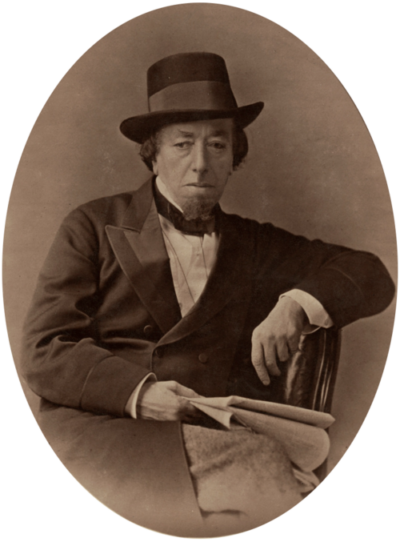
Benjamin Disraeli
Benjamin Disraeli was a British statesman. Born December 21, 1804, in London. Died April 19, 1881, in Curzon Street. Positions held include Prime Minister of the United Kingdom (2 times) (1868–1880), Leader of the Opposition (3 times) (1849–1881) and Chancellor of the Exchequer (3 times) (1852–1868). Known for Letters: 1852-1856 and Sybil. Educated at St Piran's School. Awards include Fellow of the Royal Society and Knight of the Garter.
Facts
43 facts · 2 confirmed by two sources · 23 cited · 18 from one source
Where this comes from
Papalocal keeps its own record. It started from these sources; what each one said is kept here as it was copied, so a change on their side never changes this page by itself. Tap one to read its version.
What Wikidata says · copied November 16, 2026 · revision 2563097442
- Described as
- British statesman (1804–1881)
- Other names
- 1st Earl of Beaconsfield Benjamin Disraeli, Benjamin, Earl of Beaconsfield, Viscount Hughenden of Hughenden Disraeli, Dizzy, Benjamin, Earl of Beaconsfield Disraeli, Lord Beaconsfield, Benjamin Disraeli, Earl of Beaconsfield
- Born
- December 21, 1804 · 13 references
- Died
- April 19, 1881 · 13 references
- Born in
- London · 1 reference
- Died in
- Curzon Street · 1 reference
- Buried in
- St Michael and All Angels Churchyard
- Name at birth
- Benjamin D'Israeli · 1 reference
- Citizen of
- United Kingdom of Great Britain and Ireland
- Occupation
- politician · 1 reference; novelist · 1 reference; writer · 1 reference; biographer · 1 reference; finance minister · 1 reference
- Positions held
- Prime Minister of the United Kingdom (2 times) (1868–1880); Leader of the Opposition (3 times) (1849–1881); Chancellor of the Exchequer (3 times) (1852–1868); member of the House of Lords (1876–1881); member of the 21st Parliament of the United Kingdom (1874–1876) · 1 reference; member of the 20th Parliament of the United Kingdom (1868–1874) · 1 reference; member of the 19th Parliament of the United Kingdom (1865–1868) · 1 reference; member of the 18th Parliament of the United Kingdom (1859–1865) · 1 reference; member of the 17th Parliament of the United Kingdom (1857–1859) · 1 reference; member of the 16th Parliament of the United Kingdom (1852–1857) · 1 reference; member of the 15th Parliament of the United Kingdom (1847–1852) · 1 reference; member of the 14th Parliament of the United Kingdom (1841–1847) · 1 reference; member of the 13th Parliament of the United Kingdom (1837–1841) · 1 reference; Leader of the House of Lords (1876–1880) · 1 reference; Leader of the House of Commons (4 times) (1852–1876) · 1 reference
- Political party
- Conservative Party
- Worked for
- University of Glasgow
- Education
- St Piran's School
- Member of
- Royal Society of London (1876–); Société de l'histoire de France
- Known for
- Letters: 1852-1856; Sybil · 1 reference
- Awards
- Fellow of the Royal Society; Knight of the Garter (1878) · 1 reference
- Field
- literary activity · 1 reference; political activity · 1 reference
- Spouse
- Mary Anne Disraeli (1839–) · 3 references
- Father
- Isaac D'Israeli · 2 references
- Mother
- Mary Basevi · 2 references
- Religion
- Anglicanism (1817–); Judaism (–1817)
- Wikipedias with a page
- 138
Wikidata item Q82006 (wikidata.org/wiki/Q82006), public domain (CC0). Copied November 16, 2026.
What Wikipedia says · copied November 16, 2026 · revision 1384801335
Benjamin Disraeli, 1st Earl of Beaconsfield (born Benjamin D'Israeli; 21 December 1804 – 19 April 1881), was a British statesman, Conservative politician and writer who twice served as Prime Minister of the United Kingdom. He played a central role in the creation of the modern Conservative Party, defining its policies and its broad outreach. Disraeli is remembered for his influential voice in world affairs, his political battles with the Liberal Party leader William Ewart Gladstone, and his one-nation conservatism or "Tory democracy". He made the Conservatives the party most identified with the British Empire and military action to expand it, both of which were popular among British voters. He is the only British prime minister to have been born into a Jewish family.
Disraeli was born in Bloomsbury, at that time a part of Middlesex. His father left Judaism after a dispute at his synagogue; Benjamin became an Anglican at the age of 11. After several unsuccessful attempts, Disraeli entered the House of Commons in 1837. In 1846, Prime Minister Robert Peel split the party over his proposal to repeal the Corn Laws, which involved ending the tariff on imported grain. Disraeli clashed with Peel in the House of Commons, becoming a major figure in the party. When Lord Derby, the party leader, thrice formed governments in the 1850s and 1860s, Disraeli served as Chancellor of the Exchequer and Leader of the House of Commons.
Upon Derby's retirement in 1868, Disraeli became prime minister briefly before losing that year's general election. He returned to the opposition before leading the party to a majority in the 1874 general election. He maintained a close friendship with Queen Victoria who, in 1876, elevated him to the peerage as Earl of Beaconsfield. Disraeli's second term was dominated by the Eastern question—the slow decay of the Ottoman Empire and the desire of other European powers, such as Russia, to gain at its expense. Disraeli arranged for the British to purchase a major interest in the Suez Canal Company in Egypt. In 1878, faced with Russian victories against the Ottomans, he worked at the Congress of Berlin to obtain peace in the Balkans at terms favourable to Britain and unfavourable to Russia, its longstanding enemy. This diplomatic victory established Disraeli as one of Europe's leading statesmen.
World events thereafter moved against the Conservatives. Controversial wars in Afghanistan and South Africa undermined his public support. He angered farmers by refusing to reinstitute the Corn Laws in response to poor harvests and cheap imported grain. With Gladstone conducting a massive speaking campaign, the Liberals defeated Disraeli's Conservatives at the 1880 general election. In his final months, Disraeli led the Conservatives in opposition. Disraeli wrote novels throughout his career, beginning in 1826, and published his last completed novel, Endymion, shortly before he died at the age of 76.
- Born, in its opening lines
- December 21, 1804
- Died, in its opening lines
- April 19, 1881
From the Wikipedia article “Benjamin Disraeli” (en.wikipedia.org/wiki/Benjamin_Disraeli), by its contributors, under CC BY-SA 4.0 (creativecommons.org/licenses/by-sa/4.0/). Copied November 16, 2026; not changed.
Confirmed Two sources agree. Cited One source, and it names where it got it. One source One source, without a reference of its own. Sources disagree The sources disagree. We show the best-supported value and keep theirs below.
