
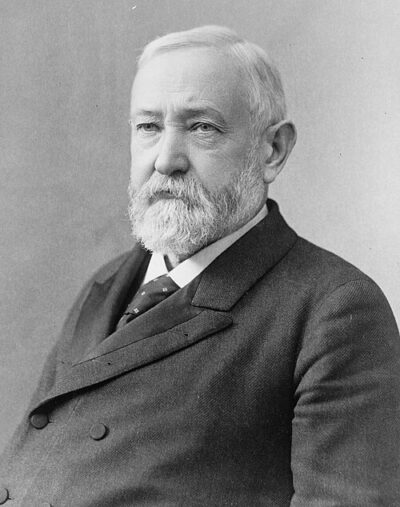
Benjamin Harrison
Benjamin Harrison was a President of the United States from 1889–1893. Born August 20, 1833, in North Bend. Died March 13, 1901, in Indianapolis. Positions held include President of the United States (1889–1893), United States senator (1881–1887) and President-elect of the United States (1888–1889). Educated at Freeman Grant Cary Pleasant Hill Academy and Miami University.
Facts
35 facts · 2 confirmed by two sources · 12 cited · 21 from one source
Where this comes from
Papalocal keeps its own record. It started from these sources; what each one said is kept here as it was copied, so a change on their side never changes this page by itself. Tap one to read its version.
What Wikidata says · copied November 13, 2026 · revision 2567580308
- Described as
- President of the United States from 1889–1893 (1833–1901)
- Other names
- President Harrison, B. Harrison
- Born
- August 20, 1833 · 10 references
- Died
- March 13, 1901 · 9 references
- Born in
- North Bend · 2 references
- Died in
- Indianapolis · 2 references
- Buried in
- Crown Hill Cemetery
- Cause of death
- pneumonia · 2 references
- Citizen of
- United States
- Occupation
- politician · 1 reference; military officer; lawyer; statesperson; writer · 2 references; jurist · 1 reference
- Positions held
- President of the United States (1889–1893) · 1 reference; United States senator (1881–1887) · 1 reference; President-elect of the United States (1888–1889)
- Political party
- Republican Party
- Worked for
- Stanford University
- Education
- Freeman Grant Cary Pleasant Hill Academy; Miami University
- Member of
- Delta Chi
- Spouse
- Mary Dimmick Harrison (1896–1901) · 1 reference; Caroline Harrison (1853–1892) · 1 reference
- Children
- Russell Benjamin Harrison · 1 reference; Mary Harrison McKee; Elizabeth Harrison Walker · 1 reference; unnamed daughter Harrison · 1 reference
- Father
- John Scott Harrison
- Mother
- Elizabeth Ramsey Irwin · 1 reference
- Religion
- Presbyterianism
- Military branch
- Union Army
- Military rank
- general; Brigadegeneral · 1 reference
- Lived in
- Benjamin Harrison Presidential Site · 1 reference
- Height
- 1.68 m (5 ft 6 in) · 1 reference
- Wikipedias with a page
- 137
Wikidata item Q35678 (wikidata.org/wiki/Q35678), public domain (CC0). Copied November 13, 2026.
What Wikipedia says · copied November 13, 2026 · revision 1382777305
Benjamin Harrison (August 20, 1833 – March 13, 1901) was the 23rd president of the United States, serving from 1889 to 1893. He was a member of the Harrison family of Virginia—a grandson of the ninth president, William Henry Harrison, and a great-grandson of Benjamin Harrison V, a Founding Father. A Union army veteran and a Republican, he defeated Democratic Party incumbent Grover Cleveland to win the presidency in the 1888 United States presidential election by winning the Electoral College while losing the popular vote. He was defeated by Cleveland in the 1892 United States presidential election, becoming the first president to be succeeded in office by his predecessor.
Harrison was born on a farm by the Ohio River and graduated from Miami University in Oxford, Ohio. After moving to Indianapolis, he established himself as a prominent local attorney, Presbyterian church leader, and politician. During the American Civil War, he served in the Union Army as a colonel, and was confirmed by the U.S. Senate as a brevet brigadier general of volunteers in 1865. Harrison unsuccessfully ran for governor of Indiana in 1876. In 1881, the Republican-controlled Indiana General Assembly elected Harrison to a six-year term in the Senate, where he served from 1881 to 1887.
Hallmarks of Harrison's administration were unprecedented economic legislation, including the McKinley Tariff, which imposed historic protective trade rates, and the Sherman Antitrust Act. Harrison also facilitated the creation of the national forest reserves through an amendment to the Land Revision Act of 1891. During his administration six western states were admitted to the Union. In addition, Harrison substantially strengthened and modernized the U.S. Navy and conducted an active foreign policy. His proposals to secure federal education funding as well as voting rights enforcement for African Americans were unsuccessful.
Due in large part to surplus revenues from the tariffs, federal spending reached $1 billion for the first time during his term. The spending issue in part led to the Republicans' defeat in the 1890 midterm elections. Cleveland defeated Harrison for reelection in 1892, due to the growing unpopularity of high tariffs and high federal spending. Harrison returned to private life and his law practice in Indianapolis. In 1899, he represented Venezuela in its British Guiana boundary dispute with the United Kingdom. Harrison traveled to the court in Paris as part of the case and after a brief stay returned to Indianapolis. He died at his home in Indianapolis in 1901 of complications from influenza.
- Born, in its opening lines
- August 20, 1833
- Died, in its opening lines
- March 13, 1901
From the Wikipedia article “Benjamin Harrison” (en.wikipedia.org/wiki/Benjamin_Harrison), by its contributors, under CC BY-SA 4.0 (creativecommons.org/licenses/by-sa/4.0/). Copied November 13, 2026; not changed.
Confirmed Two sources agree. Cited One source, and it names where it got it. One source One source, without a reference of its own. Sources disagree The sources disagree. We show the best-supported value and keep theirs below.
