
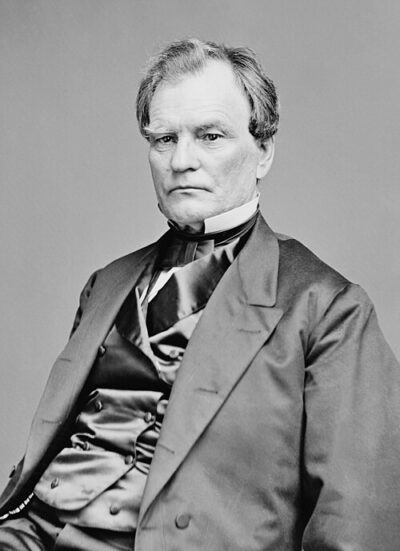
Benjamin Wade
Benjamin Wade was an American lawyer and politician. Born October 27, 1800, in Springfield. Died March 2, 1878, in Jefferson. Positions held include President pro tempore of the United States Senate (1867–1869), member of the State Senate of Ohio and United States senator (1851–1869).
Facts
19 facts · 2 confirmed by two sources · 5 cited · 12 from one source
Where this comes from
Papalocal keeps its own record. It started from these sources; what each one said is kept here as it was copied, so a change on their side never changes this page by itself. Tap one to read its version.
What Wikidata says · copied November 18, 2026 · revision 2543584057
- Described as
- American lawyer and politician (1800–1878)
- Other names
- Benjamin Franklin Wade, Benjamin F. Wade, B. F. Wade, Bluff Wade
- Born
- October 27, 1800 · 4 references
- Died
- March 2, 1878 · 4 references
- Born in
- Springfield
- Died in
- Jefferson
- Buried in
- Oakdale Cemetery · 1 reference
- Citizen of
- United States
- Occupation
- politician · 1 reference; lawyer; judge
- Positions held
- President pro tempore of the United States Senate (1867–1869); member of the State Senate of Ohio; United States senator (1851–1869) · 1 reference
- Political party
- Whig Party; Republican Party
- Children
- James F. Wade
- Father
- James Wade · 1 reference
- Mother
- Mary Wade (Upham) · 1 reference
- Siblings
- Edward Wade
- Nickname
- Bluff
- Wikipedias with a page
- 17
Wikidata item Q817729 (wikidata.org/wiki/Q817729), public domain (CC0). Copied November 18, 2026.
What Wikipedia says · copied November 18, 2026 · revision 1365222136
Benjamin Franklin "Bluff" Wade (October 27, 1800 – March 2, 1878) was an American lawyer and politician who served as a United States Senator for Ohio from 1851 to 1869. He is known for his leading role among the Radical Republicans. Had the 1868 impeachment of U.S. President Andrew Johnson led to a conviction in the Senate, as president pro tempore of the U.S. Senate, Wade would have become acting president for the remaining nine months of Johnson's term.
Born in Massachusetts, Wade worked as a laborer on the Erie Canal before establishing a law practice in Jefferson, Ohio. As a member of the Whig Party, Wade served in the Ohio Senate between 1837 and 1842. After a stint as a local judge, Wade was sworn into the United States Senate in 1851. An opponent of the Fugitive Slave Act of 1850 and the Kansas–Nebraska Act, Wade joined the nascent Republican Party as the Whigs collapsed. He established a reputation as one of the most radical American politicians of the era, favoring women's suffrage, trade union rights, and equality for African-Americans.
During the American Civil War, Wade was highly critical of President Abraham Lincoln's leadership. In opposition to Lincoln's post-war plans, which he deemed too lenient and conciliatory, Wade sponsored the Wade–Davis Bill, which proposed strict terms for the re-admittance of Confederate states. He also helped pass the Homestead Act of 1862 and the Morrill Act of 1862. In 1868, the House of Representatives impeached President Johnson for his defiance of the Tenure of Office Act; Wade's unpopularity with his senatorial Moderate Republican colleagues was a factor in Johnson's acquittal by the Senate, having been president pro tempore at the time and next in line for the presidency should Johnson be removed from the presidency. He lost his Senate re-election bid in 1868, though remained active in law and politics until his death in 1878. Although frequently criticized for his radicalism during his time, particularly as he opposed Lincoln's ten-percent plan, Wade's reputation has been lauded for his lifelong unwavering and persistent commitment to civil rights and racial equality.
- Born, in its opening lines
- October 27, 1800
- Died, in its opening lines
- March 2, 1878
From the Wikipedia article “Benjamin Wade” (en.wikipedia.org/wiki/Benjamin_Wade), by its contributors, under CC BY-SA 4.0 (creativecommons.org/licenses/by-sa/4.0/). Copied November 18, 2026; not changed.
Confirmed Two sources agree. Cited One source, and it names where it got it. One source One source, without a reference of its own. Sources disagree The sources disagree. We show the best-supported value and keep theirs below.
