
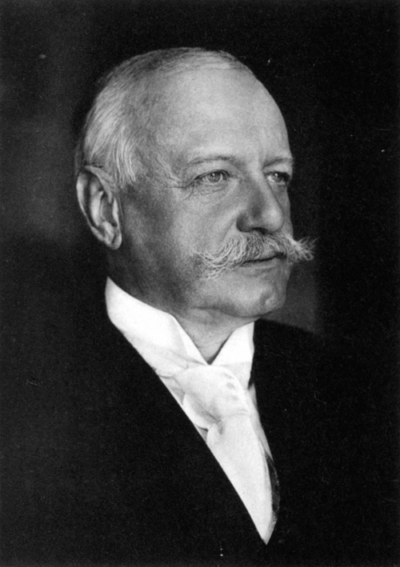
Bernhard von Bülow
Bernhard von Bülow was a German and Prussian politician. Born May 3, 1849, in Klein Flottbek. Died October 28, 1929, in Rome. Positions held include member of the Prussian House of Lords, Imperial chancellor (1900–1909) and Minister President of Prussia. Educated at University of Lausanne and University of Greifswald. Awards include Knight of the Order of the Golden Fleece, Order of the Black Eagle and Order of St. Andrew.
Facts
46 facts · 2 confirmed by two sources · 12 cited · 32 from one source
Where this comes from
Papalocal keeps its own record. It started from these sources; what each one said is kept here as it was copied, so a change on their side never changes this page by itself. Tap one to read its version.
What Wikidata says · copied November 16, 2026 · revision 2569137732
- Described as
- German and Prussian politician (1849–1929)
- Other names
- Príncipe Bernhard von Bülow, Bernard von Bülow, Bernhard Heinrich Martin Karl von Bülow, Bernhard Heinrich Karl Martin von Bülow
- Born
- May 3, 1849 · 7 references
- Died
- October 28, 1929 · 7 references
- Born in
- Klein Flottbek
- Died in
- Rome · 2 references
- Buried in
- Nienstedten Cemetery
- Cause of death
- disease
- Name at birth
- Bernhard Heinrich Martin Karl von Bülow
- Citizen of
- Germany
- Occupation
- politician · 1 reference; diplomat · 1 reference; statesperson; author; ambassador · 1 reference; jurist · 1 reference; minister · 1 reference
- Positions held
- member of the Prussian House of Lords; Imperial chancellor (1900–1909); Minister President of Prussia; Chancellor of Germany (1900–1909); ambassador; Federal Minister for Foreign Affairs (1897–1900) · 1 reference
- Education
- University of Lausanne; University of Greifswald
- Member of
- Royal Prussian Academy of Sciences
- Awards
- Knight of the Order of the Golden Fleece; Order of the Black Eagle; Order of St. Andrew; Order of the Crown; Order of the Wendish Crown; Order of Saint Hubert; Order of the Rue Crown; Order of the Elephant; Knight of the Seraphim (1908) · 1 reference; Order of the Most Holy Annunciation; honorary doctor of the University of Königsberg · 1 reference; honorary doctor of the University of Münster · 1 reference; Order of Saint Stephen of Hungary · 1 reference; Knight Grand Cross in the Order of the Netherlands Lion (1899) · 1 reference; Grand Cross of the Order of the Griffon
- Spouse
- Maria Beccadelli di Bologna · 2 references
- Father
- Bernhard Ernst von Bülow · 1 reference
- Mother
- Luise Victorine Rücker · 1 reference
- Siblings
- Alfred von Bülow; Adolf von Bülow; Karl-Ulrich von Bülow · 1 reference
- Religion
- Protestantism
- Wikipedias with a page
- 59
Wikidata item Q60113 (wikidata.org/wiki/Q60113), public domain (CC0). Copied November 16, 2026.
What Wikipedia says · copied November 16, 2026 · revision 1383734327
Bernhard Heinrich Karl Martin, Prince of Bülow (German: Bernhard Heinrich Karl Martin Fürst von Bülow [fɔn ˈbyːloː]; 3 May 1849 – 28 October 1929) was a German politician who served as the imperial chancellor of the German Empire and minister-president of Prussia from 1900 to 1909. A fervent supporter of Weltpolitik, Bülow devoted his chancellorship to transforming Germany into a global power. Despite presiding over sustained economic growth and major scientific breakthroughs within his country, his government's bellicose foreign policy did much to antagonize the French Third Republic, the United Kingdom of Great Britain and Ireland and the Russian Empire, thereby significantly contributing to the outbreak of World War I.
Born into a prominent family of Danish-German aristocrats, Bülow entered the German foreign service after his father, Bernhard Ernst von Bülow, was appointed foreign secretary in Otto von Bismarck's government. He held several diplomatic posts, including German ambassador to Rome, before being appointed foreign secretary in 1897 by Wilhelm II. Three years later, he was appointed chancellor following the resignation of the Prince of Hohenlohe.
As chancellor, Bülow promoted cautious and conservative domestic policies while pursuing an ambitious and expansionist policy in foreign affairs. His open challenge to France's growing control over Morocco sparked the First Moroccan Crisis, which aggravated the French and the British and helped strengthen the Entente Cordiale. In 1908, Wilhelm's indiscreet remarks were published during the Daily Telegraph Affair, causing significant damage to German foreign relations and the Kaiser's prestige. Bülow was blamed for failing to prevent the blunder and, having lost the support of both the Kaiser and the Reichstag, he resigned in 1909 and was succeeded by Theobald von Bethmann Hollweg.
Bülow moved to Rome after his resignation. He came out of retirement in late 1914 to serve as interim ambassador to Italy, but was unable to bring King Victor Emmanuel III to the side of the Central Powers. Bülow died in Rome in 1929 at the age of 80.
- Born, in its opening lines
- May 3, 1849
- Died, in its opening lines
- October 28, 1929
From the Wikipedia article “Bernhard von Bülow” (en.wikipedia.org/wiki/Bernhard_von_Bülow), by its contributors, under CC BY-SA 4.0 (creativecommons.org/licenses/by-sa/4.0/). Copied November 16, 2026; not changed.
Confirmed Two sources agree. Cited One source, and it names where it got it. One source One source, without a reference of its own. Sources disagree The sources disagree. We show the best-supported value and keep theirs below.
