
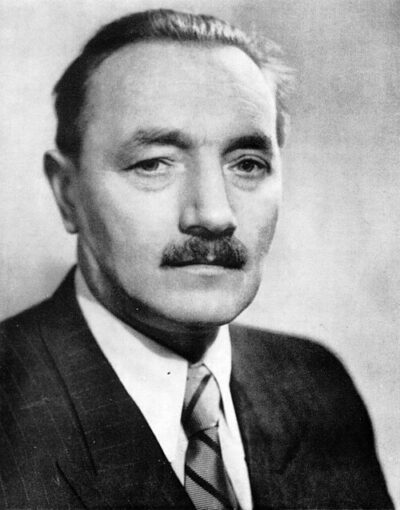
Bolesław Bierut
Bolesław Bierut was a Polish politician and leader of Poland. Born April 18, 1892, in Lublin. Died March 12, 1956, in Moscow. Positions held include President of the Republic of Poland (1944–1952), Prime Minister of Poland (1952–1954) and member of the Sejm of the Polish People's Republic (1952–1956). Educated at International Lenin School. Awards include Order of the Builders of People's Poland, Order of the Cross of Grunwald, 1st class and Partisan Cross (Poland).
Facts
31 facts · 2 confirmed by two sources · 4 cited · 25 from one source
Where this comes from
Papalocal keeps its own record. It started from these sources; what each one said is kept here as it was copied, so a change on their side never changes this page by itself. Tap one to read its version.
What Wikidata says · copied November 16, 2026 · revision 2568981241
- Described as
- Polish politician and leader of Poland (1947–1956)
- Other names
- Boleslaw Bierut
- Born
- April 18, 1892 · 12 references
- Died
- March 12, 1956 · 13 references
- Born in
- Lublin · 1 reference
- Died in
- Moscow · 4 references
- Buried in
- Powązki Military Cemetery
- Cause of death
- myocardial infarction
- Citizen of
- Russian Empire; Second Polish Republic; Polish People's Republic
- Occupation
- politician · 1 reference
- Positions held
- President of the Republic of Poland (1944–1952); Prime Minister of Poland (1952–1954); member of the Sejm of the Polish People's Republic (1952–1956) · 1 reference
- Political party
- Communist Party of Poland; Polish Workers' Party (1942–1948); Polish United Workers' Party (1948–1956); Polish Socialist Party – Left
- Education
- International Lenin School
- Member of
- Polish Committee of National Liberation
- Awards
- Order of the Builders of People's Poland; Order of the Cross of Grunwald, 1st class; Partisan Cross (Poland); Medal of Victory and Freedom 1945; Medal for Warsaw 1939-1945; honorary citizen of Gdańsk (1947) · 1 reference
- Spouse
- Małgorzata Fornalska; Janina Górzyńska-Bierut
- Children
- Aleksandra Jasińska-Kania · 1 reference; Krystyna Bierut-Maminajszwili; Jan Chyliński
- Religion
- atheism
- Wikipedias with a page
- 56
Wikidata item Q55832 (wikidata.org/wiki/Q55832), public domain (CC0). Copied November 16, 2026.
What Wikipedia says · copied November 16, 2026 · revision 1374552316
Bolesław Bierut (Polish: [bɔˈlɛswaf ˈbʲɛrut] ; 18 April 1892 – 12 March 1956) was a Polish communist activist and politician who was the leader of communist-ruled Poland from 1948 until 1956. He was President of the State National Council from 1944 to 1947, President of Poland from 1947 to 1952, General Secretary of the Central Committee of the Polish United Workers' Party from 1948 to 1956, and Prime Minister of Poland from 1952 to 1954. Bierut is believed to have worked as an NKVD informant or agent prior to 1945, although his relationship with the Soviet agency has been a subject of debate among historians. As communist leader, he implemented aspects of the Stalinist system in Poland. Together with Władysław Gomułka, his main rival, Bierut is chiefly responsible for the historic changes that Poland underwent in the aftermath of World War II. Unlike any of his communist successors, Bierut led Poland until his death.
Born in Congress Poland on the outskirts of Lublin, Bierut was employed in various trades from the age of fourteen, but obtained further education through self-study. He joined the Polish Socialist Party in 1912. Later, he became a member of the Communist Party of Poland and spent some years in the Soviet Union. He was sentenced to a prison term in 1935 for conducting illegal labour activity in Poland by the anti-communist Sanation government and was later released in 1938. During World War II, Bierut was an activist of the newly founded Polish Workers' Party (PPR) and subsequently the chairman of the State National Council (KRN), established by the PPR. Trusted by Joseph Stalin, Bierut participated in the Potsdam Conference, where he successfully lobbied for the establishment of Poland's western border at the Oder–Neisse line.
After the 1947 Polish legislative election, marked by electoral fraud, Bierut was made the first post-war President of Poland. In 1952, the new Constitution of the Polish People's Republic (until then known as the Republic of Poland) abolished the position of president and a Marxist–Leninist government was officially imposed. During his tenure, Bierut rebuilt his country after the World War II, undertook major public works (including roads, monuments, and infrastructure), maintained Poland's foreign relations with other Eastern Bloc countries, and promoted education, the arts, free healthcare, Socialist Realism, the cooperative movement, as well as literacy and anti-clerical campaigns.
As Poland's de facto leader, he resided in the Belweder Palace and headed the Polish United Workers' Party from the party headquarters at New World Street in central Warsaw, known as Dom Partii. He was also the chief proponent for the reconstruction of Warsaw (rebuilding of the historic district) and the erection of the Palace of Culture and Science. Bierut died of a heart attack on 12 March 1956 in Moscow, after attending the 20th Congress of the Communist Party of the Soviet Union. His death was sudden, and many theories arose questioning the circumstances in which he died. His body was brought back to Poland and buried with honours in a monumental tomb at the Powązki Military Cemetery.
- Born, in its opening lines
- April 18, 1892
- Died, in its opening lines
- March 12, 1956
From the Wikipedia article “Bolesław Bierut” (en.wikipedia.org/wiki/Bolesław_Bierut), by its contributors, under CC BY-SA 4.0 (creativecommons.org/licenses/by-sa/4.0/). Copied November 16, 2026; not changed.
Confirmed Two sources agree. Cited One source, and it names where it got it. One source One source, without a reference of its own. Sources disagree The sources disagree. We show the best-supported value and keep theirs below.
