
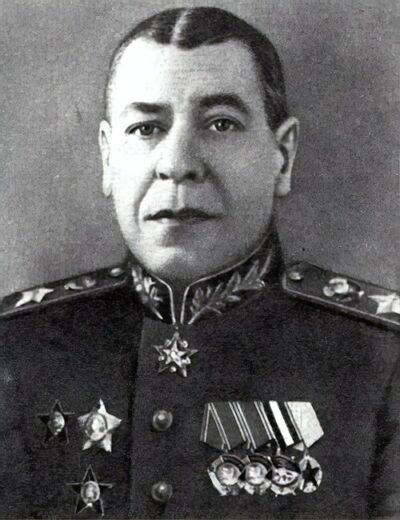
Boris Shaposhnikov
Boris Shaposhnikov was a Marshal of the Soviet Union. Born October 2, 1882, in Zlatoust. Died March 26, 1945, in Moscow. Positions held include deputy of the Supreme Soviet of the Soviet Union. Known for Mozg Armii. Educated at Alekseev military school. Awards include Order of Lenin (3 times), Order of the Red Banner (2 times) and Jubilee Medal "XX Years of the Workers' and Peasants' Red Army".
Facts
31 facts · 2 confirmed by two sources · 2 cited · 27 from one source
Where this comes from
Papalocal keeps its own record. It started from these sources; what each one said is kept here as it was copied, so a change on their side never changes this page by itself. Tap one to read its version.
What Wikidata says · copied November 16, 2026 · revision 2568936128
- Described as
- Marshal of the Soviet Union (1882-1945)
- Other names
- Boris Mikhailovitch Shaposhnikov, Boris Mikhaylovich Shaposhnikov
- Born
- October 2, 1882 · 3 references
- Died
- March 26, 1945 · 3 references
- Born in
- Zlatoust · 2 references
- Died in
- Moscow · 2 references
- Buried in
- Kremlin Wall Necropolis
- Cause of death
- tuberculosis
- Citizen of
- Russian Empire; Russian Socialist Federative Soviet Republic; Soviet Union
- Occupation
- politician; military personnel
- Positions held
- deputy of the Supreme Soviet of the Soviet Union
- Political party
- Communist Party of the Soviet Union
- Education
- Alekseev military school
- Member of
- Central Executive Committee of the Soviet Union
- Known for
- Mozg Armii
- Awards
- Order of Lenin (3 times) (1939, 1942, 1945); Order of the Red Banner (2 times) (1921, 1944); Jubilee Medal "XX Years of the Workers' and Peasants' Red Army" (1938); Order of Suvorov, 1st class (1944); Order of the Red Star (2 times) (1934, 1938); Medal "For the Defence of Moscow" (1944); Order of Saint Anna, 4th class (1914); Order of St. Anna 2nd class with swords (1916) · 1 reference; Order of St. Anne 3rd class with swords and bow (1915) · 1 reference; Order of Saint Vladimir 4th class with swords and bow (1914) · 1 reference; Order of Saint Stanislaus, 2nd class with swords (1915)
- Religion
- Eastern Orthodoxy · 1 reference
- Military branch
- Red Army (1918–)
- Military rank
- Marshal of the Soviet Union (1940–); colonel (1917–)
- Wikipedias with a page
- 48
Wikidata item Q48047 (wikidata.org/wiki/Q48047), public domain (CC0). Copied November 16, 2026.
What Wikipedia says · copied November 16, 2026 · revision 1379818558
Boris Mikhaylovich Shaposhnikov (Russian: Бори́с Миха́йлович Ша́пошников) (2 October [O.S. 20 September] 1882 – 26 March 1945) was a Soviet military officer, theoretician and Marshal of the Soviet Union. He served as the Chief of the General Staff of the Soviet Armed Forces from 1928 to 1931 and at the start of the Second World War. Shaposhnikov was one of the foremost military theorists during the Stalin-era. His most important work, Mozg Armii ("The Brain of the Army"), is considered a landmark in Soviet military theory and doctrine on the organization of the Red Army's General Staff.
Born to a family of Orenburg Cossack origins in Zlatoust in the Urals, Shaposhnikov was a graduate of the Nicholas General Staff Academy and served in the Imperial Russian Army, reaching the rank of colonel during the First World War. He supported the Russian Revolution and later joined the Red Army, but did not become a member of the Communist Party until 1939. He was Chief of the Staff of the Red Army from 1928 to 1931, followed by a stint as commandant of the Frunze Military Academy. In 1937, he was appointed to the newly created title of Chief of the General Staff. In 1940, he was named a Marshal of the Soviet Union.
Shaposhnikov resigned as Chief of the General Staff following Soviet failures during the Winter War in Finland. He was reappointed to the position following the Axis invasion of the Soviet Union in 1941, replacing Georgy Zhukov, but was again forced to resign a year later due to declining health. He then held the post of commandant of the Academy of the General Staff, and remained an influential and respected advisor to Stalin until his death in 1945.
- Born, in its opening lines
- October 2, 1882
- Died, in its opening lines
- March 26, 1945
From the Wikipedia article “Boris Shaposhnikov” (en.wikipedia.org/wiki/Boris_Shaposhnikov), by its contributors, under CC BY-SA 4.0 (creativecommons.org/licenses/by-sa/4.0/). Copied November 16, 2026; not changed.
Confirmed Two sources agree. Cited One source, and it names where it got it. One source One source, without a reference of its own. Sources disagree The sources disagree. We show the best-supported value and keep theirs below.
