
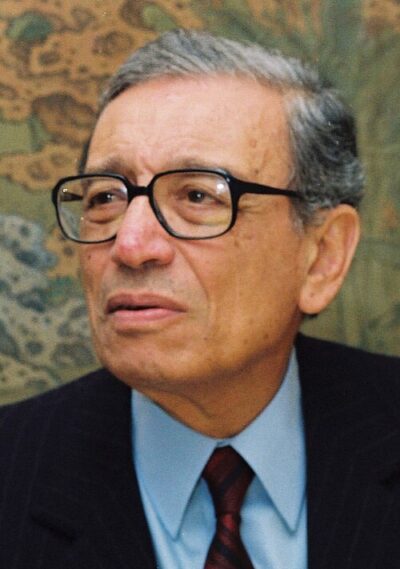
Boutros Boutros-Ghali
Boutros Boutros-Ghali was a Secretary-General of the United Nations from 1992 to 1996. Born November 14, 1922, in Cairo. Died February 16, 2016, in Giza. Positions held include United Nations Secretary-General (1992–1996), Egyptian Minister of Foreign Affairs (1978–1979) and Secretary-General of the Organisation internationale de la Francophonie (1997–2002). Known for An Agenda for Peace. Educated at Cairo University and Paris Institute of Political Studies. Awards include Companion of the Order of Canada, Honorary doctor of the Catholic University of Louvain and honorary doctor of Waseda University.
Facts
48 facts · 2 confirmed by two sources · 14 cited · 32 from one source
Where this comes from
Papalocal keeps its own record. It started from these sources; what each one said is kept here as it was copied, so a change on their side never changes this page by itself. Tap one to read its version.
What Wikidata says · copied November 16, 2026 · revision 2567936310
- Described as
- Secretary-General of the United Nations from 1992 to 1996
- Other names
- Ghali
- Born
- November 14, 1922 · 8 references
- Died
- February 16, 2016 · 10 references
- Born in
- Cairo · 4 references
- Died in
- Giza · 1 reference
- Citizen of
- Egypt · 2 references
- Occupation
- politician · 1 reference; diplomat · 3 references; writer; jurist · 2 references; university teacher · 2 references; general secretary · 1 reference
- Positions held
- United Nations Secretary-General (1992–1996); Egyptian Minister of Foreign Affairs (1978–1979); Secretary-General of the Organisation internationale de la Francophonie (1997–2002); President of the Institut de Droit International (1985–) · 1 reference
- Political party
- Arab Socialist Union
- Worked for
- United Nations; Cairo University (1949–1977)
- Education
- Cairo University (–1946); Paris Institute of Political Studies (–1949); College of the Holy Family
- Member of
- Russian Academy of Sciences; Académie des Sciences Morales et Politiques; Institut de Droit International; Académie des sciences d'outre-mer
- Known for
- An Agenda for Peace
- Awards
- Companion of the Order of Canada; Honorary doctor of the Catholic University of Louvain; honorary doctor of Waseda University; Grand Cross of the Order of Merit of the Grand Duchy of Luxembourg; Knight Grand Cross of the Order of Merit of the Italian Republic · 1 reference; Grand Cross of the Order of Prince Henry (1983) · 1 reference; Grand Cross of the Legion of Honour; Grand Cross of the Order of the Star of Romania; honorary doctor of the University of Vienna; Grand Cross of the Order of the Sun of Peru; Grand Cross 1st class of the Order of Merit of the Federal Republic of Germany; Honorary doctor of the University of Ottawa; honorary doctor of the Moscow State Institute of International Relations · 1 reference; Order of Merit; Order of the Republic
- Field
- international relations · 1 reference; political science · 1 reference
- Spouse
- Lilly Kahil; Leia Maria Nadler (1952–2016)
- Father
- Yusuf Butros Ghali
- Religion
- Coptic Orthodox Church; Coptic Catholic Church
- Wikipedias with a page
- 92
Wikidata item Q1257 (wikidata.org/wiki/Q1257), public domain (CC0). Copied November 16, 2026.
What Wikipedia says · copied November 16, 2026 · revision 1383267031
Boutros Boutros-Ghali (14 November 1922 – 16 February 2016) was an Egyptian politician and diplomat who served as the sixth secretary-general of the United Nations from 1992 to 1996. Prior to his appointment as secretary-general, Boutros-Ghali was the acting minister of foreign affairs of Egypt between 1977 and 1979. He oversaw the United Nations over a period coinciding with several world crises, including the breakup of Yugoslavia and the Rwandan genocide.
Born to a Coptic Christian family in Cairo, Boutros-Ghali was an academic by training and taught international law and international relations at Cairo University from 1949 to 1979. His political career began during the presidency of Anwar Sadat, who appointed him acting foreign minister in 1977. In that capacity, he helped negotiate the Camp David Accords and the Egypt–Israel peace treaty between Sadat and Israeli Prime Minister Menachem Begin. He was acting foreign minister until early 1991, when he served as deputy foreign minister for a few months.
Boutros-Ghali was elected secretary-general by the United Nations General Assembly in 1991 and began his term in 1992, succeeding Javier Pérez de Cuéllar. His tenure was marked by controversy and crises, which included the Somali Civil War, the Rwandan Civil War, the continuing Angolan Civil War and the Yugoslav Wars. He received criticism over UN inaction in Angola and during the genocide in Rwanda, and the perceived ineffectiveness of the UN peacekeeping operation in Bosnia led to a NATO intervention. In 1996, Boutros-Ghali ran unopposed for a second term as secretary-general, but the United States, long dissatisfied with his leadership, denied his bid by exercising its Security Council veto.
After leaving the UN, Boutros-Ghali served as the first Secretary-General of La Francophonie from 1997 to 2002. He then became chairman of the South Centre, an intergovernmental think tank for developing countries. He died in 2016, in Cairo at the age of 93.
- Born, in its opening lines
- November 14, 1922
- Died, in its opening lines
- February 16, 2016
From the Wikipedia article “Boutros Boutros-Ghali” (en.wikipedia.org/wiki/Boutros_Boutros-Ghali), by its contributors, under CC BY-SA 4.0 (creativecommons.org/licenses/by-sa/4.0/). Copied November 16, 2026; not changed.
Confirmed Two sources agree. Cited One source, and it names where it got it. One source One source, without a reference of its own. Sources disagree The sources disagree. We show the best-supported value and keep theirs below.
