
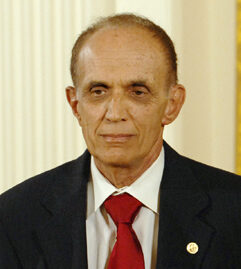
Bradley Efron
Bradley Efron is an American statistician and university teacher. Born May 24, 1938, in Saint Paul. Educated at California Institute of Technology and Stanford University. Awards include MacArthur Fellows Program, Wilks Memorial Award and National Medal of Science.
Facts
32 facts · 1 confirmed by two sources · 15 cited · 16 from one source
Where this comes from
Papalocal keeps its own record. It started from these sources; what each one said is kept here as it was copied, so a change on their side never changes this page by itself. Tap one to read its version.
What Wikidata says · copied November 18, 2026 · revision 2566782671
- Described as
- American statistician and university teacher (born 1938)
- Other names
- B. Efron, Efron, Bradley
- Born
- May 24, 1938 · 1 reference
- Born in
- Saint Paul · 1 reference
- Citizen of
- United States
- Occupation
- bioinformatician; mathematician · 1 reference; statistician · 2 references; university teacher · 1 reference; academic · 1 reference; editor · 1 reference
- Worked for
- Stanford University · 1 reference
- Education
- California Institute of Technology; Stanford University (–1964)
- Member of
- National Academy of Sciences; American Academy of Arts and Sciences; Institute of Mathematical Statistics (1972–) · 1 reference
- Awards
- MacArthur Fellows Program; Wilks Memorial Award; National Medal of Science (2005); Josiah Willard Gibbs Lectureship (2012); BBVA Foundation Frontiers of Knowledge Award (2016); Fellow of the American Statistical Association (1970) · 1 reference; Guy Medal in Gold (2014); Paul R. Halmos - Lester R. Ford Awards; Fellow of the Institute of Mathematical Statistics (1972) · 1 reference; Emanuel and Carol Parzen Prize for Statistical Innovation; International Prize in Statistics (2019) · 1 reference
- Field
- statistics · 2 references; bootstrapping · 1 reference; mathematics · 1 reference; mathematical statistics · 1 reference; publishing · 1 reference
- Website
- https://profiles.stanford.edu/bradley-efron
- Wikipedias with a page
- 16
Wikidata item Q897020 (wikidata.org/wiki/Q897020), public domain (CC0). Copied November 18, 2026.
What Wikipedia says · copied November 18, 2026 · revision 1372321606
Bradley Efron (; born May 24, 1938) is an American statistician. Efron has been president of the American Statistical Association (2004) and of the Institute of Mathematical Statistics (1987–1988). He is a past editor (for theory and methods) of the Journal of the American Statistical Association, and he is the founding editor of the Annals of Applied Statistics. Efron is also the recipient of many awards (see below).
Efron is especially known for proposing the bootstrap resampling technique, which has had a major impact in the field of statistics and virtually every area of statistical application. The bootstrap was one of the first computer-intensive statistical techniques, replacing traditional algebraic derivations with data-based computer simulations.
- Born, in its opening lines
- May 24, 1938
From the Wikipedia article “Bradley Efron” (en.wikipedia.org/wiki/Bradley_Efron), by its contributors, under CC BY-SA 4.0 (creativecommons.org/licenses/by-sa/4.0/). Copied November 18, 2026; not changed.
Confirmed Two sources agree. Cited One source, and it names where it got it. One source One source, without a reference of its own. Sources disagree The sources disagree. We show the best-supported value and keep theirs below.
