
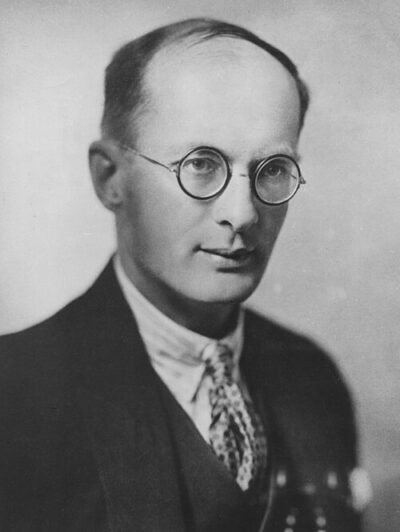
Bronisław Malinowski
Bronisław Malinowski was a Polish anthropologist and ethnographer based in England and the USA. Born April 7, 1884, in Kraków. Died May 16, 1942, in New Haven. Educated at Jagiellonian University and Leipzig University. Awards include Messenger Lectures and Honorary Fellow of the Royal Society Te Apārangi.
Facts
30 facts · 2 confirmed by two sources · 8 cited · 20 from one source
Where this comes from
Papalocal keeps its own record. It started from these sources; what each one said is kept here as it was copied, so a change on their side never changes this page by itself. Tap one to read its version.
What Wikidata says · copied November 16, 2026 · revision 2568738175
- Described as
- Polish anthropologist and ethnographer based in England and the USA (1884–1942)
- Other names
- Bronislaw K. Malinowski, Bronislaw Malinowski, Bronisław Kasper Malinowski, Bronislaw Kasper Malinowski
- Born
- April 7, 1884 · 8 references
- Died
- May 16, 1942 · 7 references
- Born in
- Kraków · 3 references
- Died in
- New Haven · 1 reference
- Buried in
- Evergreen Cemetery · 1 reference
- Cause of death
- myocardial infarction
- Citizen of
- Austria–Hungary; United Kingdom (1931–) · 1 reference; Second Polish Republic
- Occupation
- anthropologist · 3 references; university teacher; sociologist; ethnographer; photographer · 2 references; social anthropologist; ethnologist · 1 reference
- Worked for
- Cornell University; London School of Economics and Political Science; Yale University
- Education
- Jagiellonian University (1908); Leipzig University (1909); London School of Economics and Political Science (1910); Jan III Sobieski High School in Kraków
- Member of
- Royal Netherlands Academy of Arts and Sciences
- Awards
- Messenger Lectures (1932); Honorary Fellow of the Royal Society Te Apārangi (1936–) · 1 reference
- Field
- cultural anthropology
- Spouse
- Elsie Masson (1919–1935) · 1 reference; Valetta Swann (1940–1942)
- Father
- Lucjan Malinowski · 1 reference
- Wikipedias with a page
- 64
Wikidata item Q184992 (wikidata.org/wiki/Q184992), public domain (CC0). Copied November 16, 2026.
What Wikipedia says · copied November 16, 2026 · revision 1384666991
Bronisław Kasper Malinowski (Polish: [brɔˈɲiswaf maliˈnɔfskʲi]; 7 April 1884 – 16 May 1942) was a Polish anthropologist and ethnologist whose writings on ethnography, social theory, and field research have exerted a lasting influence on the discipline of anthropology.
Malinowski was born and raised in what was part of the Austrian partition of Poland, Kraków. He graduated from King John III Sobieski 2nd High School. In the years 1902–1906 he studied at the philosophy department of the Jagiellonian University and received his doctorate there in 1908. In 1910, at the London School of Economics (LSE), he worked on exchange and economics, analysing Aboriginal Australia through ethnographic documents. In 1914, he travelled to Australia. He conducted research in the Trobriand Islands and other regions in New Guinea and Melanesia where he stayed for several years, studying indigenous cultures.
Returning to England after World War I, he published his principal work, Argonauts of the Western Pacific (1922), which established him as one of Europe's most important anthropologists. He took posts as a lecturer and later as chair in anthropology at the LSE, attracting large numbers of students and exerting great influence on the development of British social anthropology. Over the years, he guest-lectured at several American universities; when World War II broke out, he remained in the United States, taking an appointment at Yale University. He died in 1942 while at Yale and was interred in a grave in New Haven, Connecticut. In 1967 his widow, Valetta Swann, published his personal diary kept during his fieldwork in Melanesia and New Guinea. It has since been a source of controversy, because of its ethnocentric and egocentric nature.
Malinowski's ethnography of the Trobriand Islands described the complex institution of the Kula ring and became foundational for subsequent theories of reciprocity and exchange. He was also widely regarded as an eminent fieldworker, and his texts regarding anthropological field methods were foundational to early anthropology, popularizing the concept of participatory observation. His approach to social theory was a form of psychological functionalism that emphasised how social and cultural institutions serve basic human needs—a perspective opposed to A. R. Radcliffe-Brown's structural functionalism, which emphasised ways in which social institutions function in relation to society as a whole.
- Born, in its opening lines
- April 7, 1884
- Died, in its opening lines
- May 16, 1942
From the Wikipedia article “Bronisław Malinowski” (en.wikipedia.org/wiki/Bronisław_Malinowski), by its contributors, under CC BY-SA 4.0 (creativecommons.org/licenses/by-sa/4.0/). Copied November 16, 2026; not changed.
Confirmed Two sources agree. Cited One source, and it names where it got it. One source One source, without a reference of its own. Sources disagree The sources disagree. We show the best-supported value and keep theirs below.
