
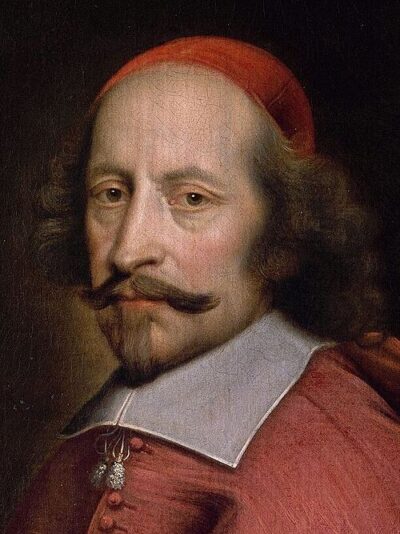
Cardinal Mazarin
Cardinal Mazarin was a French cardinal and statesman. Born July 14, 1602, in Pescina. Died March 9, 1661, in Vincennes. Positions held include cardinal (1641–1661), Prime Minister of France (1642–1661) and Roman Catholic Bishop of Metz (1653–1658). Educated at Pontifical Gregorian University and University of Alcalá.
Facts
30 facts · 2 confirmed by two sources · 10 cited · 18 from one source
Where this comes from
Papalocal keeps its own record. It started from these sources; what each one said is kept here as it was copied, so a change on their side never changes this page by itself. Tap one to read its version.
What Wikidata says · copied November 16, 2026 · revision 2565533336
- Described as
- French cardinal and statesman
- Other names
- Jules, Cardinal Mazarin, Jules Mazarin, Cardinal Mazarin Jules, Giulio Mazzarini, Julio Mazarino, Cardinal Jules Mazarin, Giulio Mazarino, Giulio Raimondo Mazzarino
- Born
- July 14, 1602 · 10 references
- Died
- March 9, 1661 · 11 references
- Born in
- Pescina · 2 references
- Died in
- Vincennes · 1 reference
- Buried in
- tomb of Cardinal Mazarin (1684–)
- Name at birth
- Giulio Raimondo Mazzarino
- Citizen of
- France; Kingdom of Naples
- Occupation
- diplomat · 1 reference; politician · 1 reference; Catholic priest; art collector · 1 reference; Catholic bishop; jurist · 1 reference
- Positions held
- cardinal (1641–1661) · 3 references; Prime Minister of France (1642–1661); Roman Catholic Bishop of Metz (1653–1658) · 1 reference; papal vice-legate (1634–1637) · 1 reference; abbot of Saint Etienne de Caen (1653–1661)
- Worked for
- Sapienza University of Rome
- Education
- Pontifical Gregorian University; University of Alcalá; University of Salamanca
- Father
- Pietro Mazzarini · 1 reference
- Mother
- Ortensia Buffalini · 1 reference
- Siblings
- Laura Margherita Mazzarini; Girolama Mazzarini; Michele Mazzarino; Francesco Maria Mancini
- Religion
- Catholic Church · 1 reference
- Wikipedias with a page
- 82
Wikidata item Q166056 (wikidata.org/wiki/Q166056), public domain (CC0). Copied November 16, 2026.
What Wikipedia says · copied November 16, 2026 · revision 1384282970
Jules Mazarin (born Giulio Raimondo Mazzarino or Mazarini; 14 July 1602 – 9 March 1661), from 1641 known as Cardinal Mazarin, was an Italian Catholic prelate, diplomat and statesman who served as the chief minister to the Kings of France Louis XIII and Louis XIV from 1642 to his death. He was made a cardinal in 1641.
After serving as a papal diplomat for Pope Urban VIII, Mazarin offered his diplomatic services to Cardinal Richelieu and moved to Paris in 1640. After the death of Richelieu in 1642, Mazarin took his place as first minister of Louis XIII, and then of Louis XIV, when he succeeded to the throne in 1643. Mazarin acted as the head of the government for Anne of Austria, the regent for the young Louis XIV, and was also responsible for the king's education until he came of age. The first years of Mazarin in office were marked by military victories in the Thirty Years' War, which he used to make France the main European power and establish the Peace of Westphalia (1646–1648). A major uprising against Anne of Austria and Mazarin, called the Fronde and led by the nobles of the Parlement of Paris, broke out in Paris in 1648, followed by a second Fronde, led by Louis, Grand Condé, who had turned from his chief ally to his chief enemy. Mazarin took Anne of Austria and Louis XIV out of Paris and then shifted his base to Germany for a time. Turenne, a general loyal to Louis XIV and Mazarin, defeated Condé, and Mazarin made a triumphal return to Paris in 1653.
The last years of Mazarin's life, between 1657 and his death in 1661, were marked by a series of major diplomatic victories. In 1657 he made a military alliance with England. In 1658 he unveiled the League of the Rhine. The same year, Marshal Turenne decisively defeated the army of Condé at the Battle of the Dunes in Flanders. On 7 November 1659, Spain signed the Treaty of the Pyrenees, which added three new provinces to France. In 1660 Mazarin arranged the marriage of Louis XIV to Maria Theresa of Spain, which ended the long and costly wars between the Habsburgs and France. Exhausted by his diplomatic efforts, Mazarin died in 1661.
Mazarin, as the de facto ruler of France for nearly two decades, played a crucial role in establishing the Westphalian principles that would guide European states' foreign policy and the prevailing world order. Some of the principles, such as the nation state's sovereignty over its territory and domestic affairs and the legal equality among states, have remained the basis of international law to this day. In addition to his diplomacy, Mazarin was an important patron of the arts. He introduced Italian opera on a grand scale to Paris and assembled a remarkable art collection, much of which today can be seen in the Louvre. He also founded the Bibliothèque Mazarine, the first true public library in France, which is now found in the Institut de France, across the Seine from the Louvre.
- Born, in its opening lines
- July 14, 1602
- Died, in its opening lines
- March 9, 1661
From the Wikipedia article “Cardinal Mazarin” (en.wikipedia.org/wiki/Cardinal_Mazarin), by its contributors, under CC BY-SA 4.0 (creativecommons.org/licenses/by-sa/4.0/). Copied November 16, 2026; not changed.
Confirmed Two sources agree. Cited One source, and it names where it got it. One source One source, without a reference of its own. Sources disagree The sources disagree. We show the best-supported value and keep theirs below.
