
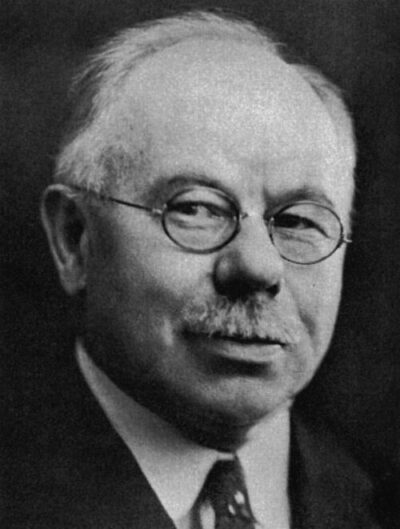
Carl H. Eigenmann
Carl H. Eigenmann was a German-American ichthyologist. Born March 9, 1863, in Flehingen. Died April 24, 1927, in San Diego. Positions held include full professor. Educated at Harvard University and Indiana University Bloomington (2 times).
Facts
26 facts · 2 confirmed by two sources · 11 cited · 13 from one source
Where this comes from
Papalocal keeps its own record. It started from these sources; what each one said is kept here as it was copied, so a change on their side never changes this page by itself. Tap one to read its version.
What Wikidata says · copied November 18, 2026 · revision 2569058677
- Described as
- German-American ichthyologist (1863–1927)
- Other names
- Eigenmann, C. H. Eigenmann, C.H. Eigenmann, Carl Eigenmann, Carl Henry Eigenmann
- Born
- March 9, 1863 · 2 references
- Died
- April 24, 1927 · 2 references
- Born in
- Flehingen
- Died in
- San Diego
- Buried in
- Greenwood Memorial Park · 1 reference
- Cause of death
- cerebrovascular disease
- Citizen of
- German Reich; United States
- Occupation
- zoologist · 2 references; university teacher · 1 reference; writer · 1 reference; zoological collector; ichthyologist; herpetologist; scientific collector · 1 reference
- Positions held
- full professor
- Worked for
- Indiana University Bloomington (1886–1927) · 1 reference; Carnegie Museum of Natural History (1909–1918) · 1 reference
- Education
- Harvard University; Indiana University Bloomington (2 times) (1886–1889) · 1 reference
- Member of
- National Academy of Sciences; American Philosophical Society (1917–)
- Field
- ichthyology · 1 reference; zoology · 1 reference
- Spouse
- Rosa Smith Eigenmann · 1 reference
- Children
- Adele Eigenmann
- Wikipedias with a page
- 18
Wikidata item Q66573 (wikidata.org/wiki/Q66573), public domain (CC0). Copied November 18, 2026.
What Wikipedia says · copied November 18, 2026 · revision 1374048192
Carl Henry Eigenmann (March 9, 1863 – April 24, 1927) was a German-American ichthyologist of the late nineteenth and early twentieth centuries who, along with his wife Rosa Smith Eigenmann and his zoology students, is credited with identifying and describing for the first time 195 genera containing nearly 600 species of fishes of North America and South America. Especially notable among his published papers are his studies of the freshwater fishes of South America, the evolution and systematics of South American fishes, and for his analysis of degenerative evolution based on his studies of blind cave fishes found in parts of North America and in Cuba. His most notable works are The American Characidae (1917–1929) and A revision of the South American Nematognathi or cat-fishes (1890), in addition to numerous published papers such as "Cave Vertebrates of North America, a study of degenerative evolution" (1909) and "The fresh-water fishes of Patagonia and an examination of the Archiplata-Archelenis theory" (1909).
Eigenmann was an alumnus of Indiana University, an instructor/professor in IU's department of zoology, and an administrator at IU's Bloomington, Indiana, campus for more than forty years. He was also the first dean of the IU graduate school from 1908 to 1927. In addition to his duties at IU, Eigenman was honorary curator of fishes at the Carnegie Museum in Pittsburgh, Pennsylvania, from 1909 to 1918. Eigenmann was elected to the National Academy of Sciences in 1923. He was also a fellow of the American Association for the Advancement of Science, a member and past president of the Indiana Academy of Science, an honorary member of the California Academy of Sciences and of the Sociedad de Ciencias Naturales of Bogotá, Colombia, as well as a member of other scientific organizations, including Sigma XI, a science honorary, and Phi Beta Kappa.
- Born, in its opening lines
- March 9, 1863
- Died, in its opening lines
- April 24, 1927
From the Wikipedia article “Carl H. Eigenmann” (en.wikipedia.org/wiki/Carl_H._Eigenmann), by its contributors, under CC BY-SA 4.0 (creativecommons.org/licenses/by-sa/4.0/). Copied November 18, 2026; not changed.
Confirmed Two sources agree. Cited One source, and it names where it got it. One source One source, without a reference of its own. Sources disagree The sources disagree. We show the best-supported value and keep theirs below.
