
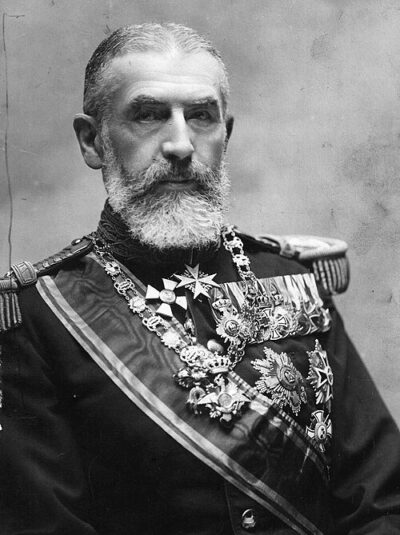
Carol I of Romania
Carol I of Romania was a king of Romania from 1881 to 1914. Born April 20, 1839, in Sigmaringen. Died October 10, 1914, in Peleș Castle. Positions held include King of Romania (1881–1914) and Prince of Romania (1866–1881). Educated at Prussian Military Academy. Awards include Knight of the Order of the Golden Fleece, Military Merit Cross III. Class and Order of the Black Eagle.
Facts
41 facts · 2 confirmed by two sources · 1 cited · 38 from one source
Where this comes from
Papalocal keeps its own record. It started from these sources; what each one said is kept here as it was copied, so a change on their side never changes this page by itself. Tap one to read its version.
What Wikidata says · copied November 16, 2026 · revision 2569028607
- Described as
- king of Romania from 1881 to 1914
- Other names
- Karl Eitel Friedrich Zephyrinus Ludwig, Carol, Princ Karol z Hohenzollernu Sigmaringen, Kráľ Karol I. Rumunský, Karol I.
- Born
- April 20, 1839 · 9 references
- Died
- October 10, 1914 · 9 references
- Born in
- Sigmaringen · 2 references
- Died in
- Peleș Castle
- Buried in
- Curtea de Argeș Monastery
- Citizen of
- Principality of Hohenzollern-Sigmaringen; United Principalities of Moldavia and Wallachia; Kingdom of Romania
- Occupation
- monarch; military personnel; art collector
- Positions held
- King of Romania (1881–1914); Prince of Romania (1866–1881)
- Education
- Prussian Military Academy
- Member of
- Romanian Academy
- Awards
- Knight of the Order of the Golden Fleece; Military Merit Cross III. Class; Order of the Black Eagle; Order of the Star of Romania; Order of St. Andrew; Order of St. George, 4th class; Order of St. George, 3rd class; Knight grand cross of the order of the crown of Italy; Order of Saints Cyril and Methodius Equal-to-apostles · 1 reference; Order of Bravery · 1 reference; Order of the Star of Karađorđe · 1 reference; Pour le Mérite · 1 reference; House Order of Hohenzollern · 1 reference; Order of Ludwig I · 1 reference; Order of the Saxe-Ernestine · 1 reference
- Spouse
- Elisabeth of Wied (1869–) · 1 reference
- Children
- Princess Maria of Romania
- Father
- Karl Anton, Prince of Hohenzollern
- Mother
- Josephine of Baden
- Siblings
- Prince Leopold, Prince of Hohenzollern; Stephanie of Hohenzollern-Sigmaringen; Prince Anton of Hohenzollern-Sigmaringen; Prince Friedrich of Hohenzollern; Princess Marie of Hohenzollern-Sigmaringen
- Religion
- Catholic Church · 1 reference
- Military rank
- Generalfeldmarschall
- Wikipedias with a page
- 58
Wikidata item Q57146 (wikidata.org/wiki/Q57146), public domain (CC0). Copied November 16, 2026.
What Wikipedia says · copied November 16, 2026 · revision 1384904279
Carol I or Charles I of Romania (Romanian: Carol I; Romanian: [ˈkarol ɨnˈtɨj] , born Karl Eitel Friedrich Zephyrinus Ludwig von Hohenzollern-Sigmaringen; 20 April 1839 – 10 October [O.S. 27 September] 1914), nicknamed the King of Independence (Romanian: Regele Independenței; Romanian: [ˈre.d͡ʒe.le in.de.penˈden.t͡sej] ); was the monarch of Romania from 1866 to his death in 1914, ruling as Prince (Domnitor) from 1866 to 1881, and as King from 1881 to 1914. He was elected Prince of the Romanian United Principalities on 20 April 1866 after the overthrow of Alexandru Ioan Cuza by a palace coup d'état. In May 1877, Romania was proclaimed an independent and sovereign nation. The defeat of the Ottoman Empire (1878) in the Russo-Turkish War secured Romanian independence, and he was proclaimed King on 26 March [O.S. 14 March] 1881. He was the first ruler of the Hohenzollern-Sigmaringen dynasty, which ruled the country until the proclamation of a socialist republic in 1947.
During his reign, Carol I personally led Romanian troops during the Russo-Turkish War and assumed command of the Russo-Romanian army during the siege of Plevna. The country achieved internationally recognized independence via the Treaty of Berlin, 1878 and acquired Southern Dobruja from Bulgaria in 1913. In 1883 the king entered a top-secret military alliance with the Austro-Hungarian Empire, despite popular demands against Hungary. When World War I broke out he was unable to activate the alliance. Romania remained neutral and in 1916 joined the Allies.
Domestic political life was organized around the rival Liberal and Conservative parties. During Carol's reign, Romania's industry and infrastructure were much improved, however this process also resulted in major scandals, including the Strousberg Affair which personally implicated Carol. Overall, the country still had an agrarian-focused economy and the situation of the peasantry failed to improve, leading to a major revolt in 1907, bloodily suppressed by the authorities.
He married Princess Elisabeth of Wied on 15 November 1869. They only had one daughter, Maria, who died at the age of four. Carol never produced a male heir, leaving his elder brother Leopold next in line to the throne. In October 1880 Leopold renounced his right of succession in favour of his son William, who in turn surrendered his claim six years later in favour of his younger brother, the future King Ferdinand I.
- Born, in its opening lines
- April 20, 1839
- Died, in its opening lines
- October 10, 1914
From the Wikipedia article “Carol I of Romania” (en.wikipedia.org/wiki/Carol_I_of_Romania), by its contributors, under CC BY-SA 4.0 (creativecommons.org/licenses/by-sa/4.0/). Copied November 16, 2026; not changed.
Confirmed Two sources agree. Cited One source, and it names where it got it. One source One source, without a reference of its own. Sources disagree The sources disagree. We show the best-supported value and keep theirs below.
