
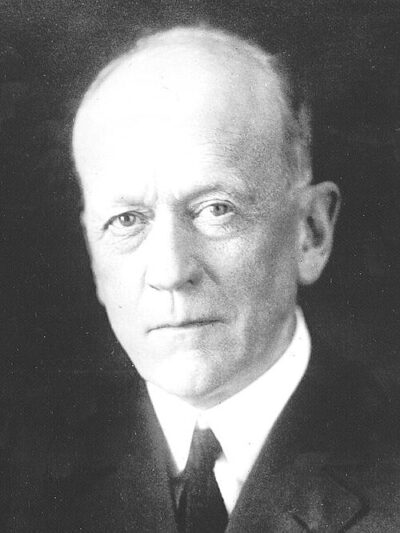
Charles Doolittle Walcott
Charles Doolittle Walcott was an American paleontologist and 4th Secretary of the Smithsonian. Born March 31, 1850, in New York Mills. Died February 9, 1927, in Washington, D.C.. Positions held include President of the Geological Society of America (1901–1902) and Secretary of the Smithsonian (1907–1927). Known for Description of a New Species of Trilobite, New Species of Trilobite from the Trenton Limestone at Trenton Falls, N. Y. and Notes on Ceraurus pleurexanthemus, Green. Awards include Bigsby Medal, Hayden Memorial Geological Award and Mary Clark Thompson Medal.
Facts
44 facts · 2 confirmed by two sources · 17 cited · 25 from one source
Where this comes from
Papalocal keeps its own record. It started from these sources; what each one said is kept here as it was copied, so a change on their side never changes this page by itself. Tap one to read its version.
What Wikidata says · copied November 15, 2026 · revision 2559409858
- Described as
- American paleontologist and 4th Secretary of the Smithsonian (1850-1927)
- Other names
- C.Walcott, Charles D. Walcott, Charles D Walcott, Charles Walcott, C. D. Walcott, C.D. Walcott, C D Walcott, C. Walcott
- Born
- March 31, 1850 · 6 references
- Died
- February 9, 1927 · 5 references
- Born in
- New York Mills · 1 reference
- Died in
- Washington, D.C.
- Buried in
- Rock Creek Cemetery
- Citizen of
- United States · 1 reference
- Occupation
- botanist; paleontologist; mycologist · 1 reference; naturalist; botanical collector · 1 reference; scientific collector · 1 reference; geologist · 2 references
- Positions held
- President of the Geological Society of America (1901–1902); Secretary of the Smithsonian (1907–1927) · 1 reference
- Worked for
- United States Geological Survey · 1 reference; Smithsonian Institution · 1 reference; New York State Museum · 1 reference
- Member of
- Paläontologische Gesellschaft; Academy of Sciences of the USSR; Saint Petersburg Academy of Sciences; Royal Swedish Academy of Sciences; National Academy of Sciences (1896–) · 1 reference; Royal Physiographic Society in Lund; American Academy of Arts and Sciences (1899–) · 1 reference; Russian Academy of Sciences (1917–1925); National Advisory Committee for Aeronautics; Accademia Nazionale dei Lincei (1901–) · 1 reference
- Known for
- Description of a New Species of Trilobite; New Species of Trilobite from the Trenton Limestone at Trenton Falls, N. Y.; Notes on Ceraurus pleurexanthemus, Green; Description of the Interior Surface of the Dorsal Shell of Ceraurus pleurexanthemus, Green
- Awards
- Bigsby Medal (1895); Hayden Memorial Geological Award (1905); Mary Clark Thompson Medal (1921) · 1 reference; Wollaston Medal (1918) · 1 reference; doctor honoris causa from the University of Paris (1924) · 1 reference
- Field
- botany; paleontology · 1 reference; geology · 1 reference
- Spouse
- Mary Vaux Walcott (1914–) · 1 reference; Lura Ann Rust (1872–1876) · 1 reference; Helena Stevens (1888–1911) · 1 reference
- Children
- Helen Walcott · 1 reference
- Wikipedias with a page
- 30
Wikidata item Q362124 (wikidata.org/wiki/Q362124), public domain (CC0). Copied November 15, 2026.
What Wikipedia says · copied November 15, 2026 · revision 1378321004
Charles Doolittle Walcott (March 31, 1850 – February 9, 1927) was an American paleontologist, administrator of the Smithsonian Institution from 1907 to 1927, and the third director of the United States Geological Survey. He is famous for his discovery in 1909 of well-preserved fossils, including some of the oldest soft-part imprints, in the Burgess Shale of British Columbia, Canada.
- Born, in its opening lines
- March 31, 1850
- Died, in its opening lines
- February 9, 1927
From the Wikipedia article “Charles Doolittle Walcott” (en.wikipedia.org/wiki/Charles_Doolittle_Walcott), by its contributors, under CC BY-SA 4.0 (creativecommons.org/licenses/by-sa/4.0/). Copied November 15, 2026; not changed.
Confirmed Two sources agree. Cited One source, and it names where it got it. One source One source, without a reference of its own. Sources disagree The sources disagree. We show the best-supported value and keep theirs below.
