
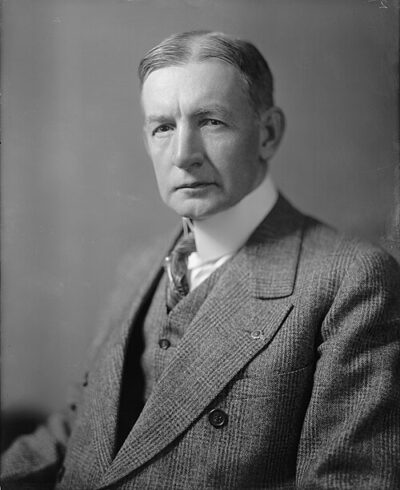
Charles G. Dawes
Charles G. Dawes was a vice president of the United States from 1925 to 1929. Born August 27, 1865, in Marietta. Died April 23, 1951, in Evanston. Positions held include United States Ambassador to the United Kingdom (1929–1931), Vice President of the United States (1925–1929) and Director of the Office of Management and Budget (1921–1922). Educated at Marietta College and University of Cincinnati College of Law. Awards include Nobel Peace Prize.
Facts
41 facts · 2 confirmed by two sources · 12 cited · 27 from one source
Where this comes from
Papalocal keeps its own record. It started from these sources; what each one said is kept here as it was copied, so a change on their side never changes this page by itself. Tap one to read its version.
What Wikidata says · copied November 13, 2026 · revision 2565577090
- Described as
- vice president of the United States from 1925 to 1929
- Other names
- Charles Dawes, Charles Gates Dawes, Chas. G. Dawes, C. G. Dawes
- Born
- August 27, 1865 · 14 references
- Died
- April 23, 1951 · 15 references
- Born in
- Marietta · 2 references
- Died in
- Evanston · 3 references
- Buried in
- Rosehill Cemetery · 1 reference
- Cause of death
- coronary thrombosis
- Citizen of
- United States
- Occupation
- politician · 2 references; diplomat; pianist; writer; economist; banker · 1 reference; songwriter; composer · 1 reference
- Positions held
- United States Ambassador to the United Kingdom (1929–1931); Vice President of the United States (1925–1929); Director of the Office of Management and Budget (1921–1922) · 1 reference
- Political party
- Republican Party
- Education
- Marietta College; University of Cincinnati College of Law; University of Cincinnati · 1 reference
- Member of
- American Legion; Forty and Eight · 1 reference; Delta Upsilon
- Instrument
- piano
- Awards
- Nobel Peace Prize (1925) · 2 references
- Field
- economics of banking · 1 reference; politics · 1 reference
- Spouse
- Caro Dawes
- Children
- Carolyn Dawes Ericson; Dana McCutcheon Dawes
- Father
- Rufus Dawes · 1 reference
- Mother
- Mary Beman Gates · 1 reference
- Siblings
- Beman Gates Dawes; Henry M. Dawes; Rufus C. Dawes · 1 reference
- Religion
- Congregational churches
- Military branch
- United States Army
- Military rank
- brigadier general
- Lived in
- Rufus Dawes House
- Wikipedias with a page
- 75
Wikidata item Q184565 (wikidata.org/wiki/Q184565), public domain (CC0). Copied November 13, 2026.
What Wikipedia says · copied November 13, 2026 · revision 1378178476
Charles Gates Dawes (August 27, 1865 – April 23, 1951) was the 30th vice president of the United States from 1925 to 1929 under President Calvin Coolidge. He was a co-recipient of the Nobel Peace Prize in 1925 for his work on the Dawes Plan for World War I reparations, and a member of the Republican Party.
Born in Marietta, Ohio, Dawes attended Cincinnati Law School before beginning a legal career in Lincoln, Nebraska. After serving as a gas plant executive, he managed William McKinley's 1896 presidential campaign in Illinois. After the election, McKinley appointed Dawes as the Comptroller of the Currency. He remained in that position until 1901 before forming the Central Trust Company of Illinois. Dawes served as a general during World War I and was the chairman of the general purchasing board for the American Expeditionary Forces. In 1921, President Warren G. Harding appointed Dawes as the first director of the Bureau of the Budget. Dawes served on the Allied Reparations Commission, where he helped formulate the Dawes Plan to aid the struggling German economy.
The 1924 Republican National Convention nominated President Calvin Coolidge without opposition. After former governor of Illinois Frank O. Lowden declined the vice-presidential nomination, the convention chose Dawes as Coolidge's running mate. The Republican ticket won the 1924 presidential election, and Dawes was sworn in as vice president in 1925. Dawes helped pass the McNary–Haugen Farm Relief Bill in Congress, but President Coolidge vetoed it. Dawes was a candidate for renomination at the 1928 Republican National Convention, but Coolidge's opposition to Dawes helped ensure that Charles Curtis was nominated instead. In 1929, President Herbert Hoover appointed Dawes to be the ambassador to the United Kingdom. Dawes also briefly led the Reconstruction Finance Corporation, which organized a government response to the Great Depression. He resigned from that position in 1932 to return to banking, and died in 1951 of coronary thrombosis.
- Born, in its opening lines
- August 27, 1865
- Died, in its opening lines
- April 23, 1951
From the Wikipedia article “Charles G. Dawes” (en.wikipedia.org/wiki/Charles_G._Dawes), by its contributors, under CC BY-SA 4.0 (creativecommons.org/licenses/by-sa/4.0/). Copied November 13, 2026; not changed.
Confirmed Two sources agree. Cited One source, and it names where it got it. One source One source, without a reference of its own. Sources disagree The sources disagree. We show the best-supported value and keep theirs below.
