
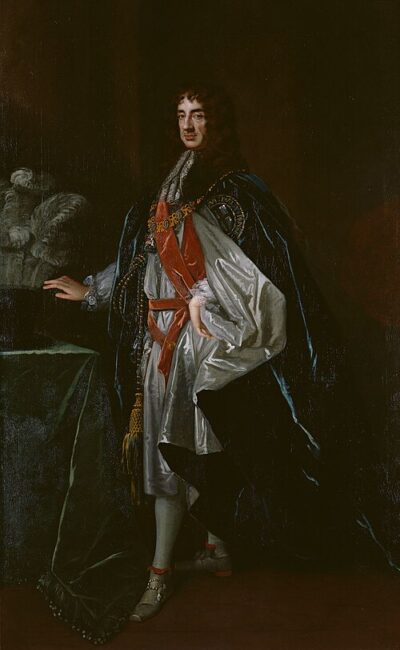
Charles II of England
Charles II of England was a King of England, Scotland, and Ireland. Born May 29, 1630, in St James's Palace. Died February 6, 1685, in Palace of Whitehall. Positions held include Monarch of England (1660–1685), Monarch of Scotland (1660–1685) and King of Ireland (1660–1685). Awards include Fellow of the Royal Society and Knight of the Garter.
Facts
46 facts · 2 confirmed by two sources · 22 cited · 21 from one source · 1 where the sources disagree
What’s different
- Cause of death: we show stroke (Sources disagree). Wikidata also lists uremia
Where this comes from
Papalocal keeps its own record. It started from these sources; what each one said is kept here as it was copied, so a change on their side never changes this page by itself. Tap one to read its version.
What Wikidata says · copied November 16, 2026 · revision 2567829372
- Described as
- King of England, Scotland, and Ireland (1630–1685)
- Other names
- The Merry Monarch, Merry Monarch, Charles II
- Born
- May 29, 1630 · 7 references
- Died
- February 6, 1685 · 7 references
- Born in
- St James's Palace · 1 reference
- Died in
- Palace of Whitehall · 1 reference
- Buried in
- Westminster Abbey · 1 reference
- Cause of death
- stroke; uremia
- Citizen of
- Kingdom of England
- Occupation
- politician; slave trader · 1 reference; sovereign; art collector; monarch
- Positions held
- Monarch of England (1660–1685); Monarch of Scotland (1660–1685); King of Ireland (1660–1685); Lord High Admiral (2 times) (1673–1685); Governor of the Charterhouse (1660–)
- Member of
- Royal Society of London (1665–); Order of the Garter (1638–)
- Awards
- Fellow of the Royal Society; Knight of the Garter (1638–) · 1 reference
- Spouse
- Catherine of Braganza (1662–) · 3 references
- Children
- Charles Lennox, 1st Duke of Richmond · 1 reference; George FitzRoy, 1st Duke of Northumberland; James Scott, 1st Duke of Monmouth · 2 references; Charles FitzRoy, 2nd Duke of Cleveland · 1 reference; Henry FitzRoy, 1st Duke of Grafton · 1 reference; Charlotte Lee, Countess of Lichfield · 1 reference; Charles Beauclerk, 1st Duke of St Albans · 1 reference; Charles FitzCharles, 1st Earl of Plymouth; Mary Tudor, Countess of Derwentwater; Barbara FitzRoy; Charlotte Jemima FitzRoy · 1 reference; Catherine FitzCharles · 1 reference
- Father
- Charles I of England · 2 references
- Mother
- Henrietta Maria of France · 2 references
- Siblings
- Henrietta of England · 2 references; Mary Henrietta, Princess Royal · 2 references; Princess Elizabeth of England; Princess Anne of England; James II of England · 2 references; Henry Stuart, Duke of Gloucester · 1 reference
- Religion
- Anglicanism; Catholicism
- Nickname
- Old Rowley · 1 reference; the Merry Monarch · 1 reference
- Wikipedias with a page
- 98
Wikidata item Q122553 (wikidata.org/wiki/Q122553), public domain (CC0). Copied November 16, 2026.
What Wikipedia says · copied November 16, 2026 · revision 1384044172
Charles II (29 May 1630 – 6 February 1685) was King of Scotland from 1649 until 1651 and King of England, Scotland, and Ireland from the 1660 Restoration of the monarchy until his death in 1685.
Charles II was the oldest surviving child of Charles I of England, Scotland and Ireland and Henrietta Maria of France. After Charles I's execution at Whitehall on 30 January 1649, at the climax of the English Civil War, the Parliament of Scotland proclaimed Charles II king on 5 February 1649. However, England entered the period known as the English Interregnum or the English Commonwealth with a republican government eventually led by Oliver Cromwell. Cromwell defeated Charles II at the Battle of Worcester on 3 September 1651, and Charles fled to mainland Europe. Cromwell became Lord Protector of England, Scotland and Ireland. Charles spent the next nine years in exile in France, the Dutch Republic and the Spanish Netherlands. A political crisis after Cromwell's death in 1658 resulted in the restoration of the monarchy in 1660, and Charles was invited to return to Britain. On 29 May 1660, his 30th birthday, he was received in London to public acclaim.
Charles's English Parliament enacted the Clarendon Code, to shore up the position of the re-established Church of England. Charles acquiesced to these new laws even though he favoured a policy of religious tolerance. The major foreign policy issue of his early reign was the Second Anglo-Dutch War. In 1670, he entered into the Treaty of Dover, an alliance with his cousin, King Louis XIV of France. Louis agreed to aid him in the Third Anglo-Dutch War and pay him a pension, and Charles secretly promised to convert to Catholicism at an unspecified future date. Charles attempted to introduce religious freedom for Catholics and Protestant dissenters with his 1672 Royal Declaration of Indulgence, but the English Parliament forced him to withdraw it. In 1679, Titus Oates's fabrication of a supposed Popish Plot sparked the Exclusion Crisis when it was revealed that Charles's brother and heir presumptive, James, Duke of York, had become a Catholic. The crisis saw the birth of the pro-exclusion Whig and anti-exclusion Tory parties. Charles sided with the Tories and, after the discovery of the Rye House Plot to murder Charles and James in 1683, some Whig leaders were executed or forced into exile. Charles dissolved the English Parliament in 1681 and ruled alone until his death in 1685.
A patron of the arts and sciences, Charles became known for his affability and friendliness, and for allowing his subjects easy access to his person. But he also showed an almost impenetrable reserve, especially concerning his political agendas. His court gained a reputation for moral laxity. Charles's marriage to Catherine of Braganza produced no surviving children, but the king acknowledged at least 12 illegitimate children by various mistresses. He was succeeded by his brother James.
- Born, in its opening lines
- May 29, 1630
- Died, in its opening lines
- February 6, 1685
From the Wikipedia article “Charles II of England” (en.wikipedia.org/wiki/Charles_II_of_England), by its contributors, under CC BY-SA 4.0 (creativecommons.org/licenses/by-sa/4.0/). Copied November 16, 2026; not changed.
Confirmed Two sources agree. Cited One source, and it names where it got it. One source One source, without a reference of its own. Sources disagree The sources disagree. We show the best-supported value and keep theirs below.
