
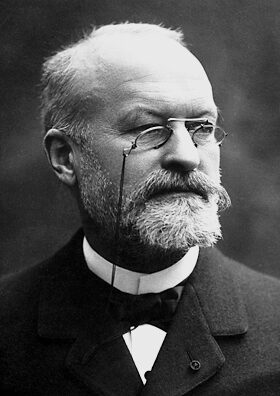
Charles Louis Alphonse Laveran
Charles Louis Alphonse Laveran was a French physician. Born June 18, 1845, in Paris. Died May 18, 1922, in Paris. Educated at Lycée Louis-le-Grand and Faculté de médecine de Strasbourg. Awards include Nobel Prize in Physiology or Medicine, Cothenius Medal and Foreign Member of the Royal Society.
Facts
28 facts · 2 confirmed by two sources · 10 cited · 16 from one source
Where this comes from
Papalocal keeps its own record. It started from these sources; what each one said is kept here as it was copied, so a change on their side never changes this page by itself. Tap one to read its version.
What Wikidata says · copied November 16, 2026 · revision 2563201383
- Described as
- French physician
- Other names
- Laveran, Alphonse Laveran
- Born
- June 18, 1845 · 13 references
- Died
- May 18, 1922 · 13 references
- Born in
- Paris · 2 references
- Died in
- Paris · 2 references
- Buried in
- Montparnasse Cemetery
- Citizen of
- France · 1 reference
- Occupation
- microbiologist; parasitologist · 1 reference; botanist · 1 reference; researcher; bacteriologist · 1 reference; physician · 1 reference
- Worked for
- Pasteur Institute · 1 reference; French Defence Health service
- Education
- Lycée Louis-le-Grand · 1 reference; Faculté de médecine de Strasbourg
- Member of
- Royal Society of London (1916–); French Academy of Sciences (1901–) · 1 reference; Société zoologique de France; Académie Nationale de Médecine · 1 reference
- Awards
- Nobel Prize in Physiology or Medicine (1907) · 2 references; Cothenius Medal (1895); Foreign Member of the Royal Society (1916) · 1 reference; Commander of the Legion of Honour (1912) · 1 reference; Edward Jenner Medal (1902)
- Field
- malaria; medicine
- Spouse
- Sophie-Marie Pidancet
- Wikipedias with a page
- 74
Wikidata item Q189006 (wikidata.org/wiki/Q189006), public domain (CC0). Copied November 16, 2026.
What Wikipedia says · copied November 16, 2026 · revision 1383106703
Charles Louis Alphonse Laveran (18 June 1845 – 18 May 1922) was a French physician who won the Nobel Prize in Physiology or Medicine in 1907 for his discoveries of parasitic protozoans as causative agents of infectious diseases such as malaria and trypanosomiasis. Following his father, Louis Théodore Laveran, he took up military medicine as his profession. He obtained his medical degree from University of Strasbourg in 1867.
At the outbreak of the Franco-Prussian War in 1870, he joined the French Army. At the age of 29 he became Chair of Military Diseases and Epidemics at the École de Val-de-Grâce. At the end of his tenure in 1878 he worked in Algeria, where he made his major achievements. He discovered that the protozoan parasite Plasmodium was responsible for malaria, and that Trypanosoma caused trypanosomiasis or African sleeping sickness. In 1894 he returned to France to serve in various military health services. In 1896 he joined Pasteur Institute as Chief of the Honorary Service, from where he received the Nobel Prize. He donated half of his Nobel prize money to establish the Laboratory of Tropical Medicine at the Pasteur Institute. In 1908, he founded the Société de Pathologie Exotique.
Laveran was elected to French Academy of Sciences in 1893, and was conferred Commander of the National Order of the Legion of Honour in 1912.
- Born, in its opening lines
- June 18, 1845
- Died, in its opening lines
- May 18, 1922
From the Wikipedia article “Charles Louis Alphonse Laveran” (en.wikipedia.org/wiki/Charles_Louis_Alphonse_Laveran), by its contributors, under CC BY-SA 4.0 (creativecommons.org/licenses/by-sa/4.0/). Copied November 16, 2026; not changed.
Confirmed Two sources agree. Cited One source, and it names where it got it. One source One source, without a reference of its own. Sources disagree The sources disagree. We show the best-supported value and keep theirs below.
