
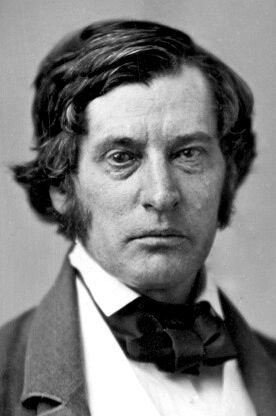
Charles Sumner
Charles Sumner was an American abolitionist and statesman. Born January 6, 1811, in Boston. Died March 11, 1874, in Washington, D.C.. Positions held include United States senator (1851–1874). Known for The Barbarism of Slavery. Educated at Harvard Law School and Harvard University.
Facts
19 facts · 2 confirmed by two sources · 5 cited · 12 from one source
Where this comes from
Papalocal keeps its own record. It started from these sources; what each one said is kept here as it was copied, so a change on their side never changes this page by itself. Tap one to read its version.
What Wikidata says · copied November 15, 2026 · revision 2567373812
- Described as
- American abolitionist and statesman (1811–1874)
- Born
- January 6, 1811 · 6 references
- Died
- March 11, 1874 · 6 references
- Born in
- Boston · 1 reference
- Died in
- Washington, D.C.
- Buried in
- Mount Auburn Cemetery
- Cause of death
- myocardial infarction
- Citizen of
- United States
- Occupation
- politician · 1 reference; writer · 1 reference; lawyer
- Positions held
- United States senator (1851–1874) · 1 reference
- Political party
- Republican Party
- Education
- Harvard Law School; Harvard University · 1 reference
- Member of
- American Academy of Arts and Sciences; American Antiquarian Society; American Philosophical Society (1867–)
- Known for
- The Barbarism of Slavery
- Mother
- Relief Sumner · 1 reference
- Wikipedias with a page
- 29
Wikidata item Q1066198 (wikidata.org/wiki/Q1066198), public domain (CC0). Copied November 15, 2026.
What Wikipedia says · copied November 15, 2026 · revision 1383407017
Charles Sumner (January 6, 1811 – March 11, 1874) was an American lawyer and statesman who represented Massachusetts in the United States Senate from 1851 until his death in 1874. Before and during the American Civil War, he was a leading American advocate for the abolition of slavery, and after the war he was a key figure in the Reconstruction era, during which he and other Radical Republicans successfully fought to end slavery and ensure basic rights for Black Americans. He continued advocating for racial equality until his death, lobbying in his final days for a civil rights bill that served as a model for the Civil Rights Act of 1964. Historians credit Sumner with coining the phrase "equality before the law," which he first used as part of an early attempt to integrate Boston's public school system.
Sumner chaired the Senate Foreign Relations Committee from 1861 to 1871, until he lost the position following a dispute with President Ulysses S. Grant over the attempted annexation of Santo Domingo. After breaking with Grant, he joined the Liberal Republican Party, spending his final two years in the Senate alienated from his party.
Sumner began his political activism as a member of various anti-slavery groups, leading to his election to the U.S. Senate in 1851 as a member of the Free Soil Party; he soon became a founding member of the Republican Party. In the Senate, he devoted his efforts to opposing the "Slave Power," which in 1856 culminated in a vicious beating, almost to death, by Representative Preston Brooks on the Senate floor. Sumner's severe injuries and extended absence from the Senate made him a symbol of the anti-slavery cause. Though he did not return to the Senate until 1859, Massachusetts reelected him in 1857, leaving his empty desk as a reminder of the incident, which polarized the nation as the Civil War approached.
During the war, Sumner led the Radical Republican faction, which believed President Abraham Lincoln was too moderate toward the South. As chair of the Foreign Relations Committee, Sumner worked to ensure that the United Kingdom and France did not intervene on behalf of the Confederate States. After the Union won the war and Lincoln was assassinated, Sumner and Thaddeus Stevens led congressional efforts to grant equal civil and voting rights to freedmen and to block ex-Confederates from power so they would not reverse the gains derived from the Union's victory in the war. President Andrew Johnson's persistent opposition to these efforts played a role in his impeachment in 1868.
During the Grant administration, Sumner fell out of favor with his party. He supported the annexation of Alaska but opposed Grant's proposal to annex Santo Domingo. After leading senators to defeat the Santo Domingo Treaty in 1870, Sumner denounced Grant in terms that made reconciliation impossible, and Senate Republicans stripped Sumner of his power. Sumner opposed Grant's 1872 reelection and supported Liberal Republican Horace Greeley. Sumner died in office less than two years later.
- Born, in its opening lines
- January 6, 1811
- Died, in its opening lines
- March 11, 1874
From the Wikipedia article “Charles Sumner” (en.wikipedia.org/wiki/Charles_Sumner), by its contributors, under CC BY-SA 4.0 (creativecommons.org/licenses/by-sa/4.0/). Copied November 15, 2026; not changed.
Confirmed Two sources agree. Cited One source, and it names where it got it. One source One source, without a reference of its own. Sources disagree The sources disagree. We show the best-supported value and keep theirs below.
