
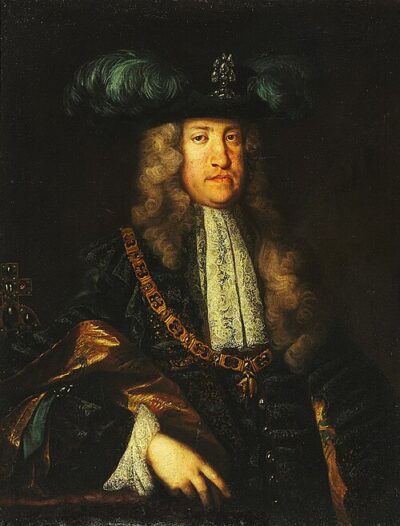
Charles VI, Holy Roman Emperor
Charles VI, Holy Roman Emperor was the 18th century Habsburg Holy Roman Emperor. Born October 1, 1685, in Vienna. Died October 20, 1740, in Vienna. Positions held include Holy Roman Emperor (1711–1740), Prince-Elector and Apostolic King of Hungary (1711–1740). Awards include Knight of the Order of the Golden Fleece.
Facts
34 facts · 2 confirmed by two sources · 6 cited · 26 from one source
Where this comes from
Papalocal keeps its own record. It started from these sources; what each one said is kept here as it was copied, so a change on their side never changes this page by itself. Tap one to read its version.
What Wikidata says · copied November 16, 2026 · revision 2563978026
- Described as
- 18th century Habsburg Holy Roman Emperor
- Other names
- Karl VI, Archduke of Austria and King of Hungary Charles III, Emperor of Germany Karl VI, Charles VI, King of Spain Charles III, keizer van Duitsland Karl VI, empereur germanique Charles VI, Holy Roman Emperor Charles VI, Holy Roman Emperor Karl VI, Carolus VI, Imperator Romanus Sacer
- Born
- October 1, 1685 · 17 references
- Died
- October 20, 1740 · 14 references
- Born in
- Vienna · 2 references
- Died in
- Vienna · 2 references
- Buried in
- Imperial Crypt
- Cause of death
- gastrointestinal system disease
- Citizen of
- Hungary; Spain
- Occupation
- monarch · 1 reference; art collector
- Positions held
- Holy Roman Emperor (1711–1740); Prince-Elector; Apostolic King of Hungary (1711–1740) · 1 reference; King of Bohemia (1711–1740); monarch of the Crown of Aragon (1706–1714); King of Sardinia and Corsica (1713–1720); Archduke of Austria
- Instrument
- harpsichord
- Awards
- Knight of the Order of the Golden Fleece
- Spouse
- Elisabeth Christine of Brunswick-Wolfenbüttel (1708–) · 1 reference
- Children
- Maria Theresa of Austria; Archduchess Maria Anna of Austria; Archduchess Maria Amalia of Austria · 1 reference; Archduke Leopold Johann of Austria · 2 references
- Father
- Leopold I, Holy Roman Emperor
- Mother
- Eleonor Magdalene of Neuburg
- Siblings
- Maria Antonia of Austria; Archduchess Maria Magdalena of Austria; Archduchess Maria Elisabeth of Austria; Maria Anna of Austria; Archduchess Maria Theresa of Austria; Joseph I, Holy Roman Emperor; Archduke Leopold Joseph of Austria
- Religion
- Catholic Church
- Wikipedias with a page
- 79
Wikidata item Q150665 (wikidata.org/wiki/Q150665), public domain (CC0). Copied November 16, 2026.
What Wikipedia says · copied November 16, 2026 · revision 1385929826
Charles VI (German: Karl; Latin: Carolus; 1 October 1685 – 20 October 1740) was Holy Roman Emperor and ruler of the Austrian Habsburg monarchy from 1711 until his death, succeeding his elder brother, Joseph I. He unsuccessfully claimed the throne of Spain following the death of his relative Charles II of Spain. In 1708, he married Elisabeth Christine of Brunswick-Wolfenbüttel, by whom he had his four children: Leopold Johann (who died in infancy), Maria Theresa, Maria Anna (Governess of the Austrian Netherlands), and Maria Amalia (who also died in infancy).
Four years before the birth of Maria Theresa, faced with his lack of male heirs, Charles provided for a male-line succession failure with the Pragmatic Sanction of 1713. The Emperor favoured his own daughters over those of his elder brother and predecessor, Joseph I, in the succession, ignoring the Mutual Pact of Succession he had signed during the reign of his father, Leopold I. Charles sought the other European powers' approval. They demanded significant terms, among which were that Austria close the Ostend Company. In total, the states of Great Britain, France, Saxony-Poland, the Dutch Republic, Spain, Venice, the Papal States, Prussia, Russia, Denmark, Savoy-Sardinia, and Bavaria, plus the Diet of the Holy Roman Empire, recognised the sanction. France, Spain, Saxony-Poland, Bavaria, and Prussia later reneged. Charles died in 1740, sparking the War of the Austrian Succession, which plagued his successor, Maria Theresa, for eight years. His death without male heirs also resulted in the complete extinction of the male line in the Habsburg dynasty.
- Born, in its opening lines
- October 1, 1685
- Died, in its opening lines
- October 20, 1740
From the Wikipedia article “Charles VI, Holy Roman Emperor” (en.wikipedia.org/wiki/Charles_VI,_Holy_Roman_Emperor), by its contributors, under CC BY-SA 4.0 (creativecommons.org/licenses/by-sa/4.0/). Copied November 16, 2026; not changed.
Confirmed Two sources agree. Cited One source, and it names where it got it. One source One source, without a reference of its own. Sources disagree The sources disagree. We show the best-supported value and keep theirs below.
